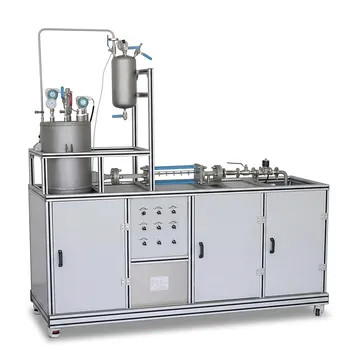
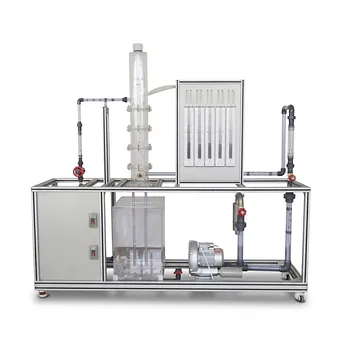
Boundary-layer theory is essential because it explains how high-Reynolds-number flows can be treated as mostly inviscid while still satisfying the no-slip condition at solid walls. In fluid dynamics training plants, it connects theoretical flow predictions with measurable velocity profiles, wall shear stress, pressure drops, drag, lift, heat transfer, and separation. Without it, setting viscosity to zero produces a mathematically simpler flow that cannot represent the dominant physical effects occurring near surfaces.
At high Reynolds numbers, viscosity is concentrated in thin boundary layers rather than disappearing. Boundary-layer theory provides the framework for analyzing this near-wall region and for understanding how it controls the performance of practical equipment.
Why High-Reynolds-Number Flows Need Special Treatment
Inertia Dominates the Bulk Flow
The Reynolds number compares inertial forces with viscous forces. When it is large, viscous effects are relatively small through much of the fluid, so the outer flow can often be approximated as inviscid.
This approximation reduces the complexity of analyzing the bulk flow around plates, airfoils, pipes, immersed bodies, and process equipment.
Viscosity Still Matters at Solid Walls
Viscosity cannot simply be removed from the entire flow. The fluid must satisfy the no-slip condition, meaning its velocity equals the wall velocity at a solid boundary.
An inviscid solution generally cannot satisfy this condition because it does not contain the required near-wall velocity gradient. Boundary-layer theory resolves this conflict by treating the flow as two connected regions.
The Governing Equations Expose the Problem
In the high-Reynolds-number limit, dropping viscous terms changes the mathematical character of the governing equations and reduces the number of boundary conditions they can accommodate.
The resulting outer-flow solution may predict pressure and velocity away from the wall, but it cannot determine the wall shear stress or the velocity rise from zero to the free-stream value. The boundary layer supplies the missing physics.
How Boundary Layers Simplify Flow Analysis
The Outer Region Is Approximated as Inviscid
Outside the boundary layer, velocity gradients normal to the wall are often small, and viscous shear has a limited direct effect on the local flow.
This allows students to compare experimental pressure distributions with ideal-flow predictions while identifying where the inviscid approximation begins to fail.
The Inner Region Contains the Strong Gradients
Within the boundary layer, velocity increases rapidly from zero at the wall to nearly the external-flow velocity.
Those strong gradients generate wall shear stress, skin-friction drag, and important transport effects. The layer is thin, but its influence on equipment performance can be large.
Its Thickness Decreases Relative to Equipment Size
For a laminar boundary layer under standard conditions, order-of-magnitude analysis gives the scaling
[ \frac{\delta}{L} \sim Re^{-1/2}, ]
where (\delta) is boundary-layer thickness and (L) is a characteristic length.
This explains why high-Reynolds-number flows can have an almost inviscid bulk region alongside a very thin frictional region. Turbulent boundary layers follow different detailed scaling laws, but the central division between outer and near-wall flow remains useful.
Why Training Plants Make the Theory Practical
They Connect Equations to Measurements
Pilot-scale apparatus allows students to measure velocity profiles, surface pressures, flow rates, and pressure losses under controlled conditions.
These measurements show that an ideal-flow model can predict broad pressure behavior while missing friction, wall retardation, and separation unless boundary-layer effects are included.
They Demonstrate Wall Shear and Pressure Loss
In pipes and channels, the boundary layer grows from the entrance and develops into the velocity profile responsible for wall friction and pressure drop.
This makes boundary-layer theory directly relevant to friction factors, pump requirements, hydraulic losses, and the usable capacity of process equipment.
They Explain External Drag and Lift
For flow over plates, airfoils, and immersed bodies, the outer flow helps establish the pressure distribution, while the boundary layer determines skin friction and whether the flow remains attached.
Students can therefore distinguish skin-friction drag from pressure drag and observe how changes in the boundary layer affect lift and overall aerodynamic or hydrodynamic performance.
They Support Heat and Mass Transfer Analysis
Near-wall velocity gradients influence the thickness of thermal and concentration boundary layers.
Because heat and mass must cross these near-wall regions, their behavior affects convective heat-transfer coefficients, mass-transfer rates, and the performance of heat exchangers, reactors, and stirred vessels.
What Boundary-Layer Behavior Reveals
Boundary-Layer Growth
As fluid moves along a surface, the boundary layer generally becomes thicker because viscous effects diffuse momentum away from the wall.
In training equipment, observing this growth helps explain why entrance regions, surface length, and flow development affect measured pressure and transport data.
Laminar-to-Turbulent Transition
A boundary layer may transition from laminar to turbulent flow as disturbances grow or operating conditions change.
Turbulent boundary layers generally produce greater wall friction but can withstand adverse pressure gradients more effectively than laminar layers. This trade-off affects both resistance and separation behavior.
Flow Separation
Separation occurs when the boundary layer can no longer overcome an adverse pressure gradient and detaches from the surface.
Separated flow changes the pressure distribution, increases pressure drag, promotes recirculation, and may create unsteady forces. Training plants can demonstrate these effects using steps, humps, bends, trailing edges, or other geometries.
Stirred-Tank and Process Equipment Effects
In stirred tanks, thin near-wall and blade-adjacent regions influence wall heat transfer, local dissipation, shear exposure, and gas-liquid mass transfer.
The bulk flow may be dominated by inertia, but these localized viscous regions remain important for scale-up and for preventing stagnation zones, hot spots, or excessive shear.
Understanding the Trade-offs
The Inviscid Approximation Has Limits
Treating the outer flow as inviscid is a powerful simplification, but it does not directly provide wall shear stress, frictional pressure loss, or the details of separation.
It must be coupled with boundary-layer analysis or experimental data when surface forces and transport performance matter.
High Reynolds Number Does Not Mean Uniform Behavior
A high Reynolds number does not guarantee that every region of the apparatus behaves in the same way.
Entrance zones, sharp geometric features, wakes, separated regions, and near-wall flows can remain strongly affected by viscosity. Local Reynolds numbers and pressure gradients must be considered.
The Simple Thickness Scaling Is Not Universal
The relationship (\delta/L \sim Re^{-1/2}) is a useful laminar scaling for a particular class of boundary layers.
Surface roughness, turbulence, pressure gradients, curvature, wall suction, heating, and geometry can change boundary-layer development. The scaling should therefore be used as a physical guide rather than a universal design equation.
Experimental Agreement Requires Care
Measured pilot-plant data may include inlet disturbances, instrumentation effects, roughness, three-dimensional flow, and facility-scale limitations.
Differences between theory and measurement are valuable only when these effects are identified rather than attributed automatically to theoretical failure.
Applying Boundary-Layer Theory in Training
Start With the Outer-Flow Prediction
Use ideal-flow theory to establish the expected pressure or velocity field away from the wall.
This creates a reference against which measured deviations can be interpreted.
Measure the Near-Wall Consequences
Measure velocity profiles, pressure loss, surface pressure, or wall shear-related quantities where possible.
The objective is to identify how the thin boundary layer modifies the quantities predicted by the outer-flow model.
Examine Transition and Separation
Vary flow rate, surface geometry, pressure gradient, or operating conditions to observe changes in boundary-layer state.
These experiments reveal why a small change in operating conditions can produce a large change in drag, mixing, pressure loss, or heat-transfer performance.
Making the Right Choice for Your Goal
Boundary-layer theory should be treated as the link between simplified high-Reynolds-number models and the real behavior of process equipment.
- If your primary focus is pressure drop and pumping power: Use boundary-layer concepts to analyze velocity-profile development, wall friction, and the resulting resistance through pipes and channels.
- If your primary focus is drag or lift: Compare inviscid pressure predictions with boundary-layer transition, skin friction, and separation to explain the measured surface forces.
- If your primary focus is heat or mass transfer: Study the near-wall momentum, thermal, and concentration layers because they control transport across solid-fluid interfaces.
- If your primary focus is equipment scale-up: Use boundary-layer behavior to evaluate how geometry, turbulence, wall effects, and localized dissipation change between laboratory and pilot-scale systems.
- If your primary focus is fluid dynamics training: Combine theoretical outer-flow solutions with measured profiles and pressures so students can see exactly where ideal assumptions remain valid and where viscosity controls performance.
Understanding the thin region where viscosity remains dominant is what makes high-Reynolds-number flow analysis both mathematically consistent and practically useful.
Summary Table:
| Focus area | What boundary-layer theory explains | Training-plant application |
|---|---|---|
| Outer flow | Why high-Reynolds-number bulk flow can often be treated as inviscid | Compare ideal-flow predictions with measured pressure and velocity data |
| Near-wall flow | No-slip conditions, velocity gradients, and wall shear stress | Measure velocity profiles, friction, and pressure losses |
| Boundary-layer growth | How viscous effects develop along surfaces and through entrance regions | Evaluate pipe, channel, and process-equipment performance |
| Transition and turbulence | The trade-off between friction, mixing, and resistance to separation | Study changing flow rates and operating conditions |
| Separation | How adverse pressure gradients create recirculation and pressure drag | Investigate steps, bends, humps, trailing edges, and immersed bodies |
| Heat and mass transfer | How near-wall momentum, thermal, and concentration layers control transport | Analyze heat exchangers, reactors, stirred tanks, and bioprocess equipment |
| Scale-up | How geometry, turbulence, roughness, and wall effects influence performance | Connect laboratory measurements with pilot-scale and industrial design |
Make high-Reynolds-number flow theory practical with LABPARK Educational and Vocational Unit Operations Pilot Plants. Our chemical engineering, bioprocess and biotech, and environmental and water treatment systems help universities, research institutes, and enterprises measure velocity profiles, pressure losses, wall effects, separation, heat transfer, and mass transfer under controlled operating conditions. Contact LABPARK to discuss the right training or pilot-plant configuration for your teaching, research, process development, and scale-up goals.
Related Products
- Fluid Transport and Piping Dynamics Practical Training Unit Operations Pilot Plant
- Two-Dimensional Fluidization Hydrodynamics Educational Pilot Plant for Unit Operations Training
- Multi Pump Fluid Transport Process Piping Unit Operations Training Pilot Plant
- Orifice and Venturi Flowmeter Calibration Educational Pilot Plant for Fluid Mechanics Laboratory
- Chemical Pipeline Assembly and Fluid Transport Practical Training Unit Operations Pilot Plant
People Also Ask
- What are the primary methods for regulating flow rate in pilot plants? VFD vs. Throttle
- Gear vs Centrifugal Pumps in Pilot Plants: How do operating characteristics and power requirements differ?
- How is shaft work (We) used to determine pump specifications? Optimize pilot plant fluid transport design.
- Why distinguish Newtonian & non-Newtonian fluids in pilot plants? Prevent design errors.
- How does active time pulsing mixing enhance fluid homogenization? Configuration Guide for Educational Pilot Plants