Impurities don’t scale linearly—they often explode into failed batches during pilot-plant campaigns. The accurate characterization of starting material impurities is essential because even minor contaminants can consume critical reagents, skew stoichiometry, and collapse yields when a reaction is moved from the bench to the engineering pilot plant. Combining high-performance liquid chromatography (HPLC) with proton nuclear magnetic resonance (¹H NMR) gives process engineers a robust method to calculate the true potency of a feedstock, resolving discrepancies that would otherwise lead to undercharging, incomplete reactions, and costly rework.
Scaling a fine-chemical process without first resolving potency discrepancies turns a reactor into a chemistry experiment. The real danger isn't the impurity itself—it’s the silent consumption of your active reagent, which destroys the mass balance you depend on. HPLC and NMR together provide the orthogonal data needed to see the full picture and charge the reactor with confidence.
The Hidden Danger of Ignoring Impurities at Scale
Pilot-plant scale-up magnifies every mole of impurity into a potential process failure. The bench-scale tolerance for a few percent of an unknown contaminant disappears when hundreds of liters are involved.
Why Impurities Devastate Reaction Stoichiometry
A reactive impurity—such as a residual starting material or a volatile component—will consume the very reagent you are counting on to drive the main transformation. This hidden consumption reduces the effective concentration of your active reactant, causing the main reaction to stall or proceed with insufficient driving force.
The result is an undercharged reactor where the stoichiometric ratio is no longer what the chemistry requires. In the pilot plant, this manifests as incomplete conversion, low yield, and a mixture of unwanted side products that are extremely expensive to separate.
The Amplified Cost of Trial-and-Error Adjustments
On paper, one might correct an undercharged batch by adding more reagent mid-campaign. In practice, this leads to a cascade of problems: extended cycle times, thermal runaway risks from imprecise additions, and irreproducible quality.
A pilot-plant run that repeatedly relies on “fixes” erodes the engineering data needed for tech transfer, delays commercialization, and multiplies solvent-waste disposal costs. Getting the potency right upfront eliminates the most common root cause of these iterative failures.
The Analytical Foundation: Measuring True Potency, Not Just Purity
A certificate of analysis may report an area-percent purity of 98%, but that number alone is misleading if the sample contains a significant amount of unreactive solvent or volatile species. True potency is the weight fraction of active reagent you will actually charge into the reactor.
What a Simple Purity Value Misses
Area-percent HPLC purity assesses the ratio of the main peak to all other peaks detected under the chosen conditions. It does not account for:
- Volatile solvents that evaporate during sample preparation or simply don’t show a UV response.
- Residual starting materials that elute near the void volume or co-elute with the product.
- Inorganic salts that go undetected but contribute to the sample weight.
Thus, a feedstock can appear 98% pure by HPLC yet contain only 85% active reagent when the mass balance includes a large solvent fraction. Charging based on the inaccurate 98% number leads directly to the undercharging scenario described above.
How Impurities Skew Reagent-to-Substrate Ratios
The active reagent doesn’t just need to be present; it must be present in the correct molar ratio versus the substrate. If you assume a feedstock contains 100% active material but it actually contains 15% inert solvent, you will add 15% less reactive species than intended.
In a multi-step synthesis or a tight stoichiometric window (e.g., 1.00–1.05 equivalents), this mistake is catastrophic. The reaction rate drops, the equilibrium shifts, and the entire campaign may produce off-spec material that cannot be reworked.
How HPLC and NMR Work Together to Resolve Discrepancies
No single analytical detector reveals the complete composition of a process feedstock. The most pragmatic solution—and the one that directly translates to a reliable mass balance for the reactor—is to pair HPLC with ¹H NMR.
HPLC’s Role: Quantifying the Active Reactant and Organic Impurities
HPLC equipped with a UV detector excels at separating and quantifying non-volatile organic components. It provides a direct measure of the ratio of the desired active reagent to structurally related organic impurities.
By integrating all peaks and applying appropriate response factors, you can establish the chromatographic purity of the active species relative to other carbon-based contaminants. This number becomes the “organic purity” fraction, but it is blind to solvents and inorganics.
NMR’s Role: Revealing the Solvent-to-Reagent Ratio
¹H NMR tackles the blind spot. By dissolving the feedstock in a deuterated solvent and integrating the characteristic proton signals of the active reagent versus those of the process solvent (or any volatile component), you obtain a molar ratio of solvent to reagent.
Because NMR responds to all hydrogen-containing species, it quantifies volatile organic solvents that HPLC missed and also detects residual water or other protic impurities. This ratio is what you need to calculate how much of the sample weight is actually active compound.
The Combined Potency Calculation: A True Mass Balance
The reconciliation is simple but powerful:
- From HPLC, determine the organic purity of the reagent (reagent_area / total organic_areas, corrected for response).
- From NMR, determine the molar fraction of reagent relative to the sum of reagent + solvent.
- Convert the NMR molar ratio to a weight fraction, factoring in molecular weights.
- The true potency = (organic purity from HPLC) × (reagent weight fraction from NMR).
This value represents the grams of active reagent per gram of feedstock. It closes the mass balance and gives the process engineer a real number to input into the reactor charge sheet, eliminating the guesswork that leads to undercharging.
Understanding the Trade-offs of This Approach
While HPLC-NMR integration is the gold standard for resolving potency discrepancies, it is not a frictionless universal solution. Acknowledging the limitations ensures the technique is applied thoughtfully.
The Limitations of HPLC Alone
HPLC purity assessments are detector-dependent. UV-inactive impurities (e.g., aliphatic solvents, some counterions) produce no signal, so they are effectively invisible. Purity expressed as “area%” confuses composition with response, and without careful calibration, impurities with dramatically different extinction coefficients can be over- or underestimated.
The Limitations of NMR Alone
¹H NMR excels at providing ratios but struggles with low-level impurities, overlapping peaks, and quantification of non-protonated species. Sensitive detection of a 0.5% impurity often requires a burdensome number of scans, and integration errors from broad or complex multiplets can propagate into the potency number.
When the Combined Method Might Not Be Enough
The HPLC-NMR strategy addresses organic solvents and most organic impurities, but it doesn’t directly quantify inorganic salts or non-protonated volatile solvents like carbon tetrachloride. For feedstocks with significant salt content, additional techniques such as ion chromatography or loss-on-drying tests are needed to fill the final gaps in the mass balance.
Making the Right Choice for Your Pilot-Plant Campaign
Your decision to invest in combined HPLC-NMR potency determination should be driven by the specific risks your process faces. The approach is not theoretical; it directly translates to achieving first-pass success in the pilot reactor.
- If your primary focus is maximizing reactor yield and avoiding undercharging: Prioritize the combined potency calculation for every lot of feedstock that is supplied as a solution or that contains volatile residues. The mass balance you obtain will give you confidence that the right number of moles is entering the reactor.
- If your primary focus is ensuring process safety and avoiding runaway reactions: Use the NMR solvent ratio to identify and quantify volatiles that can build pressure or create unintended exotherms when they react with strong bases or acids. Knowing the exact composition removes the unknowns that trigger emergency shutdowns.
- If your primary focus is accelerating tech transfer and reducing R&D iteration: Characterize the true potency of the feedstock once, document the procedure, and make it a gate-check before every campaign. This single step will eliminate the most common source of data scatter between lab, kilo-lab, and pilot plant, turning your scale-up runs into a predictable engineering exercise rather than a troubleshooting exercise.
A single, accurate potency number derived from orthogonal analytical data transforms a risky chemical scale-up into a controlled engineering operation.
Summary Table:
| Analytical Method | Key Capabilities & Strengths | Limitations & Blind Spots |
|---|---|---|
| HPLC | Quantifies organic purity; separates structurally related organic impurities. | Blind to volatile solvents, inorganic salts, and UV-inactive species. |
| ¹H NMR | Measures molar ratio of solvent to reagent; detects volatile residues and water. | Struggles with low-level impurities (<0.5%), overlapping peaks, and non-protonated species. |
| Combined HPLC-NMR | Provides true mass balance and active reagent potency for accurate reactor charging. | Does not account for inorganic salts or non-protonated solvents (requires auxiliary testing). |
Scale Up with Confidence using LABPARK Pilot Plants
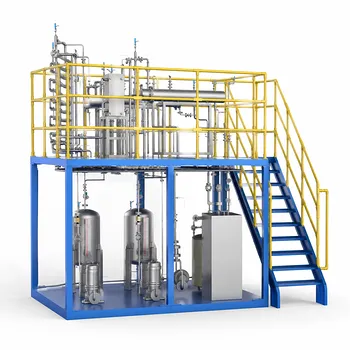
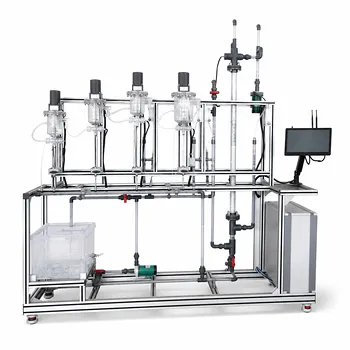
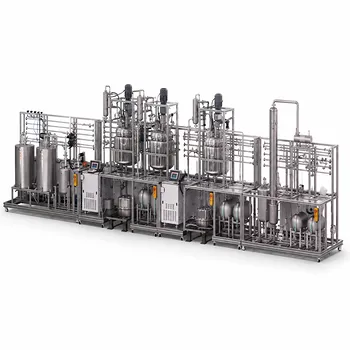
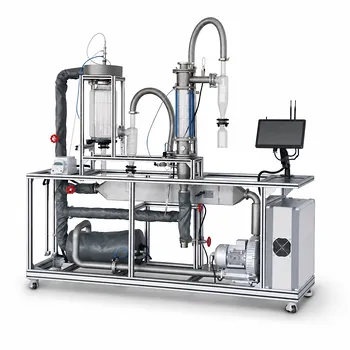
Transitioning chemical processes from the bench to a pilot run demands absolute precision in mass balance and process control. LABPARK provides advanced Educational and Vocational Unit Operations Pilot Plants in chemical engineering, bioprocess & biotech, and environmental & water treatment.
Engineered specifically for universities, research institutes, and enterprises, our pilot plants enable you to validate stoichiometry, analyze impurities, and ensure safe, predictable scale-up operations.
Ready to eliminate scale-up risks and optimize your chemical processes? Contact our technical team today to find the perfect pilot plant solution for your facility!
Related Products
- Multi Pump Fluid Transport Process Piping Unit Operations Training Pilot Plant
- Multi-Reactor Educational Pilot Plant for Reaction Engineering Unit Operations
- Comprehensive Multi-Modal Heat Transfer Unit Operations Pilot Plant for Engineering Training
- Ethyl Acetate Synthesis Unit Operations Pilot Plant for Practical Training
- Natural Product Extraction Unit Operations Training Pilot Plant
People Also Ask
- Why distinguish Newtonian & non-Newtonian fluids in pilot plants? Prevent design errors.
- Why is the chemical plant startup schedule crucial? De-risk scale-up with pilot plants.
- When to transition from PID to adaptive control in pilot plants? Key process indicators.
- How do deviations in estimating latent heat impact pilot plant thermal systems? Avoid hardware mis-sizing.
- Why Use PTFE & Hastelloy in Chemical Pilot Plants? Prevent Corrosion & Ensure Safety