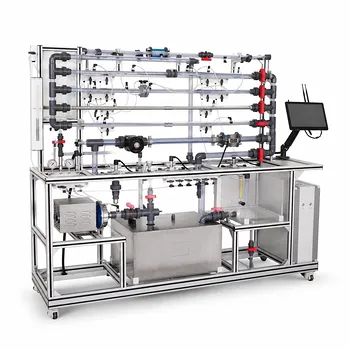
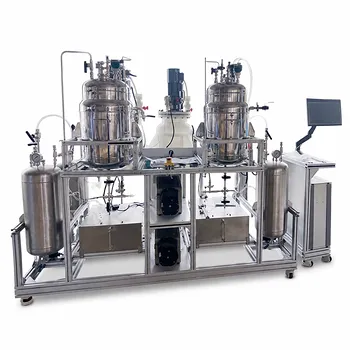
A pervaporation pilot plant turns a complex chemical problem into a clear, physical demonstration. It eliminates the need for hazardous third-party entrainers, operates safely at small laboratory scale, and shows students how a membrane can recover 90–97 % of a solvent purely based on chemical affinity. This makes the underlying thermodynamics tangible, while directly aligning with modern green chemistry and sustainable process design.
Traditional entrainer distillation obscures azeotropic separation behind chemical complexity, high energy demands, and pilot-scale impracticality. Pervaporation, by contrast, strips the problem down to its physical fundamentals—solubility, diffusion, and desorption—in a modular, low-temperature system that students can safely run, tweak, and truly understand.
The Educational Limitations of Entrainer Distillation
Entrainer distillation has long been the textbook answer for breaking azeotropes. As a teaching tool, however, it creates more barriers than it removes.
The Chemical “Black Box” Problem
Adding an entrainer like benzene or cyclohexane fundamentally changes the thermodynamic landscape. The separation no longer depends on the original mixture’s properties alone, but on a new ternary system with its own phase behavior, residue curves, and recovery challenges. For a student, this turns a separation lesson into a maze of chemical interactions, hiding the core physics of what actually breaks the azeotrope.
Hazardous Materials and Safety Overhead
Common entrainers are toxic, flammable, or both. Running even a glass pilot column with benzene demands rigorous safety protocols, fume hoods, and hazardous waste handling that dominate the learning time. The educational focus shifts from “how do we separate this azeotrope?” to “how do we safely manage the entrainer?”.
Scale Mismatch in Pilot Training
Entrainer distillation requires a high minimum operating capacity to sustain stable profiles and recover the entrainer loop economically. Lab‑scale columns often fall below that threshold, making runs unstable, data inconsistent, and the whole experience frustrating for students who cannot see a robust, repeatable separation.
Why Pervaporation Wins as a Teaching Platform
A pervaporation unit strips away those layers of complexity. It replaces the chemical agent with a selective membrane, turning azeotropic recovery into a purely physical transport demonstration.
Separation Without Chemical Crutches
The pervaporation pilot plant needs no entrainer at all. A thin, dense membrane—often polyvinyl alcohol (PVA)—acts as a molecular filter. Water, for example, preferentially dissolves into the hydrophilic layer, diffuses through it, and evaporates on the permeate side. Students see directly how chemical affinity, not boiling point differences, achieves >99 % purity. The process is clean, single-step, and the solvent is recovered ready for reuse without entrainer contamination.
Bypassing the Vapor‑Liquid Equilibrium Barrier
Azeotropes exist because vapor‑liquid equilibrium (VLE) forces the vapor and liquid to have identical compositions at the azeotropic point. Pervaporation sidesteps VLE entirely. Separation is governed by the solution‑diffusion mechanism: sorption at the feed‑membrane interface, selective diffusion across the film, and desorption into the vapour phase. This three‑step sequence is easy to visualize, model, and measure, making the thermodynamic escape route clear rather than an abstract mathematical constraint.
Hands‑On Demonstration of the Solution‑Diffusion Model
In a teaching lab, students can:
- Vary the feed temperature and observe how it alters permeation flux according to Arrhenius‑type relationships.
- Measure permeate composition and calculate separation factors.
- Visually confirm that only the targeted component vaporizes, while the retentate remains liquid and concentrated in the desired product.
This builds a direct, intuitive link between molecular‑scale phenomena and macroscopic performance that a complex entrainer column cannot offer.
Lower Energy, Lower Risk
Because only the permeating fraction changes phase, the energy demand drops by 30–40 % compared to azeotropic distillation. Operating at ambient or moderate temperatures means the system is inherently safer—students can work with heat‑sensitive or flammable solvents without the high‑temperature risks of a distillation column. The carbon footprint is visibly smaller, which reinforces the “green engineering” message.
Modular, Pilot‑Friendly Scale
Pervaporation units are compact and work efficiently at flow rates of a few liters per hour—perfect for a pilot hall or a teaching lab bench. There is no minimum volume below which performance collapses. Students can run an entire cycle, from feed loading to purified retentate collection, in a single session. The modular design also lets them swap membrane modules to compare hydrophilic versus organophilic performance, turning the rig into a configurable separation platform.
Understanding the Trade‑offs
No educational tool is flawless. Pervaporation has its own constraints that students must learn to recognize.
Membrane Fouling and Selectivity Limits
Real feed streams often contain salts, particulates, or trace solvents that can foul the membrane or plasticize it, reducing selectivity over time. In an industrial context, this demands pretreating the feed, which adds unit operations. Showing students a flux‑decay curve teaches them about maintenance requirements and material limitations—valuable lessons that a simple distillation column does not expose.
Not Universally Applicable
Pervaporation excels at dehydrating alcohols or removing trace organics from water. For bulk separations where both components are volatile and neither has a strong affinity for a single membrane chemistry, a hybrid system (pervaporation + distillation) is often needed. The educational takeaway is that pervaporation is a targeted unit operation, not a one‑size‑fits‑all distillation replacement.
Vacuum and Condensation Complexity
The permeate side operates under vacuum to maintain the driving force. This requires a reliable vacuum pump and a cold trap or condenser system. Students must learn to manage these subsystems, which adds an operational layer that is absent in an atmospheric distillation. When framed correctly, this becomes a hands‑on introduction to vacuum system design and vapour recovery rather than a distraction.
Making the Right Choice for Your Curriculum
Which pilot plant you prioritize depends on what you want the students to take away.
- If your primary focus is teaching thermodynamic fundamentals and the solution‑diffusion model: A pervaporation pilot plant gives a clean, repeatable system where students measure chemical potential directly, without entrainer‑induced phase complexity.
- If your primary focus is green chemistry and sustainable process design: Pervaporation wins by eliminating hazardous entrainers, cutting energy use, and demonstrating a circular, on‑site solvent recovery loop.
- If your primary focus is hands‑on process validation at realistic lab scale: The modular, small‑footprint pervaporation unit avoids the minimum capacity trap of entrainer columns, letting students run complete, meaningful experiments within a single lab period.
- If your primary focus is exposing students to industry‑relevant hybrid processes: Use pervaporation alongside a simple distillation column to show how membranes and distillation complement each other for challenging separations.
A well‑designed pervaporation pilot plant doesn’t just teach azeotropic recovery—it teaches a different, more modern way to think about separation, making it an unmatched educational tool for the next generation of chemical engineers.
Summary Table:
| Feature | Pervaporation Pilot Plant | Entrainer Distillation |
|---|---|---|
| Separation Agent | Membrane (selective affinity) | Hazardous chemical entrainer (e.g., benzene) |
| Thermodynamic Basis | Solution-diffusion mechanism | Ternary vapor-liquid equilibrium (VLE) |
| Safety & Hazards | Safe, low-temperature, non-toxic | High risk (flammable/toxic entrainers) |
| Operational Scale | Compact, modular, bench-scale | Large footprint, high minimum capacity |
| Educational Fit | Clear physical model, 1-session run | Complex VLE calculation, slow startup |
Bring Modern Separation Technology to Your Lab
Looking to upgrade your chemical engineering curriculum or research facilities? LABPARK provides state-of-the-art Educational and Vocational Unit Operations Pilot Plants in chemical engineering, bioprocess & biotech, and environmental & water treatment.
We help universities, research institutes, and enterprises bridge the gap between theory and industrial practice with safe, efficient, and modular teaching systems.
Contact LABPARK today to request a quote or customize a pilot plant solution for your institution!
Related Products
- Natural Product Extraction Unit Operations Training Pilot Plant
- Rising and Falling Film Evaporation Educational Unit Operations Pilot Plant
- Supercritical High-Gravity Flash Evaporation Educational Unit Operations Pilot Plant
- Absorption and Desorption Educational Unit Operations Pilot Plant
- Multimodal Absorption and Desorption Pilot Plant for Unit Operations Training
People Also Ask
- How to Demo Solubility Sensitivity in SFE Pilot Plants? Practical Thermodynamics
- How do pilot plants differentiate physical vs chemical extraction? Enhance Chemical Engineering Training
- How are HTU and NTU applied to determine extraction column height? Guide to Pilot Plant Scaling
- How can Hotelling's T² & Q statistics detect pilot plant abnormalities? Optimize Safety
- Why use split-plot designs in pilot plants instead of CRD? Optimize process parameters effectively.