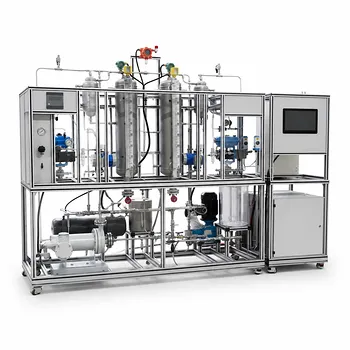
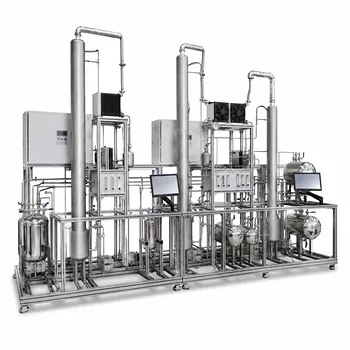
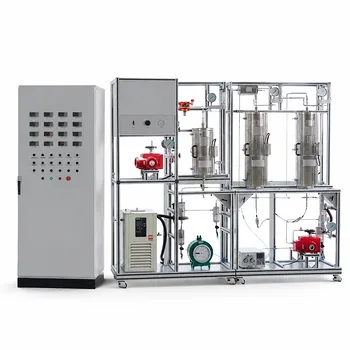
The fundamental reason you need a multi-column distillation configuration instead of a single giant tower comes down to the physics of how vapor-liquid equilibrium works in complex mixtures. A chemical reaction producing alkenes generates a broad spectrum of hydrocarbons, ranging from light gases (C4) to heavy waxes (C20+). A single column cannot produce more than two pure product streams—one distillate and one bottoms. To isolate the specific, high-value alkene fraction (typically C12–C18) from the reactor soup, you physically must break the separation problem into a sequence of binary splits, each handled by its own column.
A multi-column sequence is the only practical way to separate a multi-component alkene mixture. This necessity stems from a fundamental rule: separating an n-component mixture into pure fractions requires n-1 columns. The real engineering problem, however, isn't just assembling columns—it's selecting the optimal sequence to minimize energy consumption and precisely controlling pressure, temperature, and reflux ratio in each stage to prevent thermal degradation and achieve the target purity.
Why a Single Column Fails in Alkene Production
The reactor effluent in alkene synthesis is not a neat binary mixture. It is a wide-boiling, multi-component blend that immediately breaks any single-column strategy.
The Fundamental Rule of Separation
A standard distillation column has exactly two product outlets: the top and the bottom. Each column can therefore only perform one sharp separation between two key components. To split a mixture of, say, five components (A, B, C, D, E) into pure streams, you need four columns in series. Each column in a pilot plant creates a "cut" that becomes the feed for the next stage, progressively narrowing the composition.
The Direct vs. Indirect Sequence Decision
Sequencing these columns is where engineering judgment first applies. The "direct sequence" vaporizes and removes the most volatile component (light ends) first in each step. This approach is often thermodynamically favorable for alkene production because it avoids repeatedly condensing and revaporizing the light, high-heat-capacity gases. The "indirect sequence" pulls the heaviest components from the bottoms first. The optimal choice balances energy cost against product thermal sensitivity—a critical concern when products can polymerize.
The Hidden Driver: Thermal Stability
Beyond the n-1 rule, the pilot plant configuration must address a practical danger. If you attempt to separate a heavy C20+ component in a single tower that also processes lights, the high reboiler temperature required for the heavies can degrade or polymerize the valuable alkenes. A multi-column setup allows you to isolate and remove heat-sensitive or unstable components early, protecting the rest of the plant. This heuristic—isolate unstable materials first—often overrides pure energy optimization in a pilot-scale safety protocol.
The Crucial Control Parameters
Building the sequence is only half the challenge. Each column in the chain must be controlled to operate within a narrow thermodynamic window to replicate industrial conditions precisely.
Pressure and Temperature Profiles
Alkene separation relies on manipulating relative volatility, which is directly governed by pressure and temperature. A pilot plant must hold pressure in the 3 to 20 bar range across different columns. Higher pressure raises boiling points and may allow the use of cheaper cooling water in the condenser, but it can also reduce relative volatility, making the separation harder. Temperature control up to 410 K is necessary, but the strategy often involves keeping reboiler temperatures as low as practical to avoid fouling from coking or polymerization, using appropriate vacuum or pressure settings.
Reflux Ratio and Column Hydraulics
The reflux ratio is the pilot plant operator's primary dial for adjusting purity. Increasing reflux returns more condensed liquid to the column, improving separation up to a point, but it also raises reboiler duty and reduces the product take-off rate. The goal is to find the minimum practical reflux ratio for economic operation. Simultaneously, you must monitor plate hydraulics—parameters like pressure drop per tray and weir loading—to avoid flooding, weeping, or entrainment, which catastrophically reduce efficiency.
The Degrees of Freedom Analysis
For any single column in the sequence, a rigorous control strategy begins with a degrees-of-freedom analysis. For a standard adiabatic column, the number of control variables you can manipulate equals the number of side streams plus two—typically the reflux flow rate and the reboiler boilup rate. In a pilot plant with multiple side-stream temperature sensors, you gain the ability to infer and control the composition profile along the column height by adjusting these primary variables. This allows researchers to maintain the thermal equilibrium needed to hit a precise cut point between, for example, a C10 and a C12 alkene.
Understanding the Trade-offs in a Pilot Plant Environment
A pilot plant is not a scaled-down refinery. It is a learning and data-gathering tool, and its design involves explicit compromises that a production plant would not face.
Packed vs. Plate Columns for Visibility
The choice of column internals impacts what you can measure. Packed columns are compact and excellent for low-pressure-drop, vacuum-sensitive alkenes, and they teach the concept of Height Equivalent to a Theoretical Plate (HETP). Plate columns, such as those with bubble-cap trays, are bulkier but allow for visual observation of hydraulic phenomena like froth height and entrainment. For a truly educational or research-focused pilot plant, a combination or a plate column with multiple sight glasses provides richer diagnostic data on mass transfer limitations.
The Conflict Between Purity and Productivity
There is always a direct trade-off driving toward an industrial optimum. Operating at a very high reflux ratio to achieve ultra-high purity for a single batch (surface need) comes at the direct expense of throughput and energy consumption (deep need for scalable process data). A pilot plant must allow researchers to quantify this cost-benefit curve by easily adjusting the ratio and logging the resulting composition and energy usage, teaching that "perfect" separation is economically irrational.
Sequencing Heuristics vs. Reality
The theoretical heuristics for column sequencing—remove the largest volume component first, perform difficult separations last, aim for a 50/50 molar split—are excellent starting points. However, in alkene production, the reactivity of the chemicals often overrides these rules. Pulling off a light, reactive diene early to prevent gum formation in downstream columns is a safety-critical decision that may technically violate a heuristic written for stable, ideal mixtures. A pilot plant must be flexible enough to test these non-ideal sequences.
How to Apply This to Your Project
The optimal multi-column configuration depends entirely on your primary goal for the pilot plant project.
- If your primary focus is maximizing energy efficiency and developing scale-up data: Prioritize the direct sequence for the initial light-end removal. Configure sophisticated control loops on the first column's reflux and reboiler to map the exact relationship between energy input and separation sharpness for the light cut.
- If your primary focus is testing catalyst longevity or preventing fouling: Implement the heuristic to isolate reactive or heat-sensitive components first. Install the first column as a "guard bed" stripper operated at the lowest feasible pressure and temperature, removing polymerization precursors before they reach the high-temperature zone.
- If your primary focus is achieving a specific product purity for a certification sample: Select the column that performs the final, most difficult separation (the one with the lowest relative volatility between your product and the adjacent-heavy component). Operate this final column with a high number of theoretical plates and the ability to fine-tune a high reflux ratio, accepting the reduced throughput.
The power of a well-designed multi-column pilot plant lies in its ability to make these trade-offs visible and quantifiable, transforming theoretical heuristics into actionable process knowledge.
Summary Table:
| Parameter | Target / Range | Key Process Impact |
|---|---|---|
| Temperature | Up to 410 K | Minimizes reboiler heat to prevent fouling & polymerization |
| Pressure | 3 to 20 bar | Adjusts relative volatility and boiling points across columns |
| Reflux Ratio | Variable | Balances product purity against throughput and energy cost |
| Column Internals | Packed vs. Plate | Impacts pressure drop, HETP, and visual hydraulic observation |
Optimize Your Chemical Engineering Research with LABPARK
Are you looking to bridge the gap between laboratory research and industrial-scale alkene production? LABPARK provides state-of-the-art Educational and Vocational Unit Operations Pilot Plants in chemical engineering, bioprocess & biotech, and environmental & water treatment designed specifically for universities, research institutes, and enterprises.
Our highly flexible pilot plants enable your team to easily configure multi-column sequences, precisely control critical parameters like temperature and pressure, and collect high-fidelity scale-up data for process optimization.
Ready to elevate your research and training capabilities? Contact LABPARK today to discuss your custom pilot plant requirements!
Related Products
- Multi-Modal Distillation Unit Operations Training Pilot Plant
- Multi-Functional Special Distillation Educational Pilot Plant
- Continuous Sieve-Plate Distillation Pilot Plant for Unit Operations Laboratory Education
- Continuous Batch Extractive Distillation Educational Pilot Plant
- Dual-Mode Rectification Pilot Plant for Practical Training Unit Operations
People Also Ask
- How can energy balance equations for condensers & reboilers be validated experimentally? Guide
- How can real-time carbon number prediction improve distillation pilot plants? Optimize control.
- Why is vacuum operation capability an essential feature for a distillation unit operations pilot plant? Unlock Efficiency
- How does catalyst water concentration affect distillation pilot plant design? Key separation train choices.
- What are the primary reflux ratio control strategies? Master Distillation Unit Operations