Zero-order kinetics in the reactants is the secret. The Monsanto acetic acid process follows a unique rate law—first order in the rhodium catalyst and methyl iodide promoter, but zero order in methanol and carbon monoxide. Because the reaction rate does not depend on how much feedstock has been consumed, a Continuous Stirred-Tank Reactor (CSTR) can operate at high conversion without the rate decline that normally plagues mixed reactors. This lets educational pilot plants pack a complete, high-conversion demonstration into a remarkably small benchtop footprint.
The Monsanto carbonylation’s insensitivity to reactant concentration removes the traditional volume penalty of back-mixed reactors. In a single CSTR, students can achieve near-total feedstock utilization and constant production rate, making it an exceptionally space- and resource-efficient platform for teaching kinetics, reactor design, and process control.
The Kinetic Foundation: Why Conversion Doesn’t Slow the Reaction
Zero‑Order Dependence Eliminates the Usual CSTR “Penalty”
In conventional reactors, a rising conversion lowers reactant concentrations, which slows the reaction rate. For the Monsanto process, the rate stays constant regardless of how much methanol or CO remains. The CSTR experiences no rate handicap as it approaches complete conversion—performance does not sag.
Constant Rate Means Compact Reactor Volume
Because the production rate per unit volume remains steady, a single stirred tank can be sized to deliver high conversion in a very small active volume. This is a rare gift for a pilot‑plant instructor: you can demonstrate full‑scale kinetics without bulky equipment or large inventories of hazardous materials.
Educational Efficiency of the CSTR for Monsanto Carbonylation
A Self‑Contained Teaching Tool on the Bench
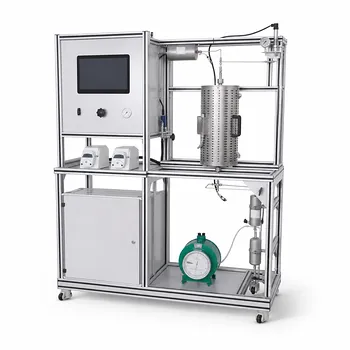
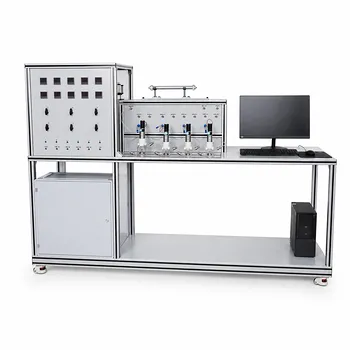
The constant‑rate behavior directly addresses the classic challenge of fitting meaningful reactor engineering experiments into crowded teaching labs. A CSTR running the Monsanto chemistry can reach >95% conversion in a reactor volume small enough for a standard fume hood, while still producing steady‑state data streams students can analyze.
Sampling and Real‑Time Analysis Without Disruption
Most educational CSTR setups include integrated sampling ports and sensors at each stage. With zero‑order kinetics, the steady‑state outlet concentration directly reflects the feed‑to‑product transformation without time‑dependent rate corrections. Students can instantly verify that methanol concentration does not influence the measured rate—reinforcing the theory with hard numbers.
Extending the Teaching Value: Cascades, Modeling, and Safety
From One CSTR to a Cascade—Approximating Plug Flow
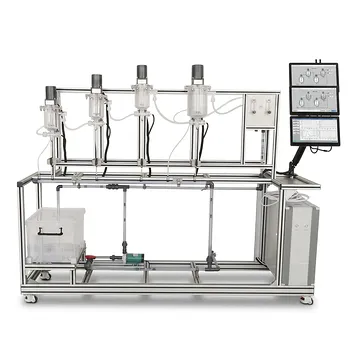
Supplementary references emphasize how multiple CSTRs in series can narrow the residence‑time distribution toward that of a plug‑flow reactor. Educators can physically connect Monsanto‑capable CSTR stages and let students measure intermediate conversions. This lets them demonstrate that, for a zero‑order reaction, a single tank already gives excellent volume efficiency—and the cascade adds minimal volume gain, a counterintuitive but powerful lesson.
Steady‑State Multiplicity and Thermal Stability
Non‑isothermal CSTRs exhibit fascinating stability behavior. By manipulating feed flow (changing the Damköhler number) or cooling‑jacket parameters, students can plot heat‑removal and heat‑generation curves against dimensionless temperature. They see the van Heerden stability criterion unfold: three steady states, with the upper and lower stable and the middle unstable. The Monsanto process’s exothermic carbonylation provides a real‑world backdrop for safe, visual process safety instruction.
Bridging Simulation and Reality with Hard Data
Mathematical models of CSTRs involve solving coupled mass and energy balances. With a physical benchtop unit, students can compare predicted temperature and concentration profiles against measured data, then adjust parameters like the overall heat transfer coefficient to align simulation with experiment. This closes the gap between theoretical design equations and actual plant behavior.
Understanding the Trade‑offs
The Efficiency Is a Special Case—Not a Universal Rule
The CSTR’s outstanding performance for Monsanto chemistry stems entirely from its zero‑order dependence on reactants. For a typical positive‑order reaction, a single mixed flow reactor would require much more volume than a plug‑flow reactor to achieve the same conversion. Instructors should explicitly contrast this behavior so students don’t misinterpret CSTR efficiency as general.
Real Industrial Systems Often Use Different Contacting Patterns
Commercial Monsanto plants frequently employ bubble column reactors or other gas‑liquid configurations where the liquid phase may approximate a CSTR but the gas phase behaves closer to plug flow. The educational CSTR is a deliberate simplification that extracts the kinetic learning without the mechanical complexity of large‑scale spargers or high‑pressure CO handling.
Catalyst Cost and Safety Still Dominate
Even a compact CSTR must handle rhodium catalyst and toxic methyl iodide under CO pressure. The small volume helps contain these hazards, but rigorous safety protocols remain essential. The setup’s footprint advantage does not eliminate the need for proper gas monitoring and emergency procedures.
Making the Right Choice for Your Teaching Goal
After you’ve absorbed the kinetic rationale, align the reactor configuration with your specific learning objectives.
- If your primary focus is kinetic verification: Use a single CSTR to let students directly observe that conversion has no impact on rate; they can run multiple steady states and graph rate versus methanol concentration to see the zero‑order plateau.
- If your primary focus is reactor engineering and volume optimization: Connect 2–4 CSTR stages in series and have students measure the incremental volume savings—or lack thereof—for this zero‑order system, then compare with a positive‑order esterification reaction to highlight the contrast.
- If your primary focus is process dynamics and safety: Operate a non‑isothermal CSTR and trigger multiple steady states by ramping flow or cooling; use the van Heerden analysis to discuss ignition and extinction points, reinforcing thermal runaway prevention concepts.
- If your primary focus is modeling and simulation validation: Harvest transient and steady‑state data from the physical plant and fit kinetic parameters. Then demonstrate how those parameters predict performance in a cascade or a virtual PFR, bridging lab to scale‑up.
A CSTR’s true teaching power for the Monsanto process lies in its ability to turn a special kinetic quirk into a vivid, space‑efficient lesson that spans kinetics, reactor design, and process control—all from a single benchtop unit.
Summary Table:
| Teaching Focus | Reactor Configuration | Key Learning Outcome |
|---|---|---|
| Kinetic Verification | Single CSTR | Verify zero-order reaction rate independence |
| Reactor Design | 2-4 CSTR Cascade | Measure volume efficiency vs. positive-order systems |
| Process Safety | Non-Isothermal CSTR | Study van Heerden stability & thermal runaway |
| Simulation Validation | Physical Benchtop CSTR | Fit kinetic parameters to bridge lab work with scale-up |
Elevate Your Chemical Engineering Lab with LABPARK
Looking to demonstrate complex kinetics like the Monsanto carbonylation process on a benchtop scale? LABPARK provides state-of-the-art Educational and Vocational Unit Operations Pilot Plants in chemical engineering, bioprocess & biotech, and environmental & water treatment.
We help universities, research institutes, and enterprises bridge the gap between theory and industrial reality with safe, compact, and highly efficient training systems.
Contact LABPARK today to customize the perfect pilot plant configuration for your curriculum!
Related Products
- Multi-Stage Stirred Tanks in Series Residence Time Distribution and Mixing Performance Determination Educational Pilot Plant
- Multi-Reactor Educational Pilot Plant for Reaction Engineering Unit Operations
- Multi Functional Catalytic Reaction and Reactor Evaluation Educational Unit Operations Pilot Plant
- 100L Continuous Loop Hydrogenation Educational Unit Operations Pilot Plant
- Residence Time Distribution and Reactor Flow Characteristics Determination Educational Pilot Plant
People Also Ask
- How does MRF model impeller rotation in CFD? Key Boundary Conditions Explained
- How can a CSTR pilot plant demonstrate reactor staging? Visualize volume savings.
- How does steady-state multiplicity affect the operation and safety of exothermic reactions within a CSTR pilot plant? - Guide
- What parameters to monitor transitioning from Batch to CSTR? Master Pilot Plant Setup
- Why is temperature regulation via a cooling jacket a critical feature in CSTR pilot plants used for laboratory training?