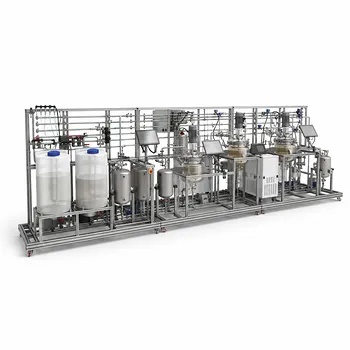
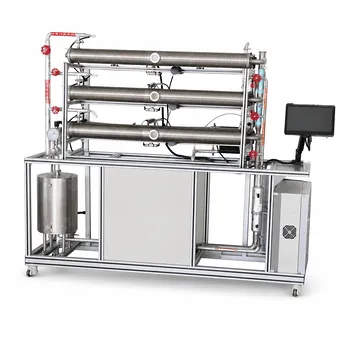
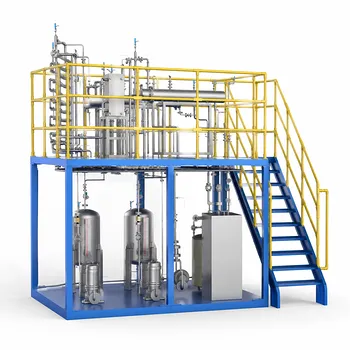
Because chemical processes don't live in the straight-line world of linear programming. The math that governs heat exchangers, reactors, and distillation columns is fundamentally non-linear, creating optimization landscapes that are rugged, twisted, and full of deceptive local minima. A unit operations pilot plant forces you to confront this reality head-on—not as a textbook abstraction, but as a physical system where a small change in temperature or flow rate can send you sailing past a false optimum and into an infeasible operating state.
Non-convex optimization isn't an academic hurdle; it’s the engineer's core tool for describing reality. Pilot plants demonstrate that the real world cannot be captured by simple linear assumptions because the physics itself (reaction kinetics, phase equilibrium, fluid dynamics) and the physical constraints (flooding, pressure drop, safety) all conspire to create problems with many possible "best" answers—and only one true global optimum.
The Inherent Non-Linearity of Chemical Processes
Why Linear Models Break Down Instantly
Chemical engineering is built on phenomena like the Arrhenius equation for reaction rates and the Antoine equation for vapor pressure—relationships that are exponential, logarithmic, or power-law in nature. These are not linearizable across wide operating ranges. When you model a reactor's yield as a function of temperature, you don't get a flat plane; you get a curved surface with a peak that sits between competing degradation and rate-limiting effects.
Adding mass and energy balances creates a system of non-linear equality and inequality constraints. The feasible region of solutions—the set of all pressure, temperature, and composition combinations that can physically exist—becomes non-convex. A non-convex feasible region has an irregular border with dents and pockets, which means a straight line between two valid operating points can pass through an impossible zone. Linear programming, by definition, assumes a convex feasible region, so it is fundamentally blind to these forbidden interiors.
The Trap of Multiple Local Minima
In a linear program, the optimal solution always lies at a vertex of the feasible region; you can trust a simple search algorithm to find it. In a non-convex chemical process model, your objective function (e.g., net profit, purity, energy efficiency) can have many local minima—points where the gradient is zero and any small move makes things worse, even though a much better solution exists elsewhere on the landscape.
A pilot plant makes this visceral. A student optimizing a distillation column might find that increasing reflux improves purity up to a point, after which column flooding causes a precipitous drop in performance. The optimization surface has a local peak in purity that isn't the global maximum energy-efficient solution. Without the hands-on pilot plant experience, a student might wrongly assume that any "optimum" found by a simple hill-climbing algorithm is the final answer.
The Educational Role of Unit Operations Pilot Plants
From Theory to Physical Reality
A pilot plant is a safe, scaled-down version of an industrial process where students must manage real-time trade-offs. The primary reference’s core insight—that non-linear models lead to non-convex optimization—is amplified here because students aren't just solving equations; they're interacting with physical equipment that embodies those equations.
When you turn a valve to raise pressure, you see the immediate, non-linear response in a flow meter and temperature gauge. The pilot plant transforms optimization from a pure math exercise into an experiential learning loop. You propose a better operating point, implement the change, and watch whether yield improves or the column starts to weep. This cycle trains you to recognize that the "best" settings in theory may be impossible to achieve due to physical constraints like pump capacity or heat exchanger area.
Confronting Design and Operational Optimization
The supplementary references clarify a vital distinction: design optimization sets the equipment's physical limits (the maximum diameter of a column, the surface area of a condenser), while operational optimization finds the best way to run within those limits. Pilot plants naturally blend both. A student might first perform a design exercise to size a packed bed, then run it across different flow rates to find the optimal operating point that avoids flooding and channeling.
This combined view reinforces the non-convex nature of the problem. The constraints aren't just equations—they include hard stops like "the column will flood beyond 80% of this flow rate" or "the reboiler’s heat duty has a physical maximum." These operational boundaries create sharp cut-offs in the feasible region, further distorting it away from a simple convex shape.
Beyond the Equations: Safety, Operability, and Resilience
Why the "Mathematically Optimal" Design May Be a Failure
In industry, a process designed purely for economic optimum using a simplified model is often a nightmare to operate. The supplementary references highlight that such a design can be unsafe, inflexible, and overly sensitive to disturbances. A pilot plant teaches this through lived experience. You might calculate that a certain reflux ratio maximizes profit, but if that operating point sits right at the edge of weeping, any minor fluctuation in feed composition will crash the separation. The optimization problem is no longer just about maximizing purity; it's a multi-objective, constrained problem that must include stability and safety margins.
These practical constraints inherently create non-convexity. A constraint like "maximum allowable pressure drop to avoid plate damage" is a hard, non-linear boundary. Safety requirements often forbid certain combinations of temperature and pressure that would technically meet purity specs. The feasible region becomes a patchwork of allowed and forbidden zones, full of isolated pockets that a linear program could never describe.
Learning Multi-Objective Trade-offs
A pilot plant naturally becomes a laboratory for understanding trade-offs. You can directly observe the tension between yield and purity, or between throughput and energy cost. For example, pushing a heat exchanger to its maximum heat transfer coefficient might obtain the fastest reaction, but it also risks thermal degradation of sensitive products. Navigating these trade-offs is a non-convex optimization exercise, where the "best" answer depends on the weight you assign to each objective and there may be several Pareto-optimal points scattered across the decision space. Simple linear weighted-sum methods can easily miss the best compromise solutions.
Why Linear Programming Falls Short
The Illusion of a Universal Solution
Linear programming’s power lies in its ability to guarantee a global optimum quickly. But that guarantee comes at the cost of realism. Chemical processes are simply not linear. Reaction rate laws contain concentration exponents. Phase equilibrium is calculated using fugacity coefficients that depend on composition and pressure in convoluted ways. Heat transfer coefficients vary non-linearly with flow regime. Trying to force these into linear approximations creates a model that is so far from reality that the "optimum" it finds is meaningless.
The pilot plant exposes this gap. A student who has only solved linear optimization problems will be baffled when a seemingly optimal set-point, derived from a linear model, produces a completely different outcome in the real column. The non-linear reality of the plant—where efficiency plummets due to channeling at high vapor rates—cannot be captured by a simple line.
The Tools You Must Actually Master
Because the problems are non-convex, you can't rely on the simplex method. Instead, you must use gradient-based methods (like sequential quadratic programming) or derivative-free heuristic algorithms (like genetic algorithms, simulated annealing). The primary reference is correct: pilot plant training prepares students to use these advanced tools. You learn to judge when a solver has converged to a local minimum, to apply multi-start strategies, and to use physical insight to bound the search space. The plant becomes a physical simulator for testing optimization algorithms, where you can compare a model’s predicted optimum against what actually happens when you set those knobs.
How to Extract Maximum Value from Your Pilot Plant Experience
Confronting non-convex optimization in a pilot plant is not about learning a single algorithm—it's about developing an engineer's intuition for real-world complexity. The following goals will guide your approach.
- If your primary focus is grasping chemical process fundamentals: Treat every unexpected result as a clue about the underlying non-linear physics. Trace a purity dip back to the flooding correlation, and you'll never again assume a linear input-output relationship.
- If your primary focus is designing a safe and operable process: Deliberately search for the "edge" of your pilot plant’s feasible region—find the reflux ratio that just starts to cause pressure surges. Document these hard boundaries and incorporate them as non-linear constraints in your optimization model.
- If your primary focus is mastering modern optimization algorithms: Use the pilot plant data to test different solvers. Start with a gradient descent to find a local minimum, then apply a genetic algorithm to see if it can discover a better global solution that you initially missed.
- If your primary focus is bridging the gap to industrial practice: Frame every optimization as a multi-objective problem. Instead of just maximizing purity, try to minimize total energy input while maintaining a purity tolerance, and observe the non-convex trade-off curve that emerges.
The pilot plant is your crucible for learning that optimization is never just about equations. It’s a messy, physical dance with non-convexity, and the engineer who understands that complexity—rather than ignoring it—is the one who can truly optimize the chemical processes that power our world.
Summary Table:
| Feature | Linear Programming (LP) | Non-Convex Optimization (NCO) |
|---|---|---|
| Feasible Region | Convex (simple, flat boundaries) | Non-convex (irregular, contains forbidden zones) |
| Physics Modeling | Simplistic linear approximations | Captures non-linear phenomena (e.g., Arrhenius, Antoine) |
| Optimal Solutions | Single global optimum at a vertex | Multiple local minima, false peaks, and traps |
| Real-World Fit | Poor; ignores physical boundaries | High; accounts for flooding, pressure drop, and safety limits |
Bring Real-World Chemical Engineering into Your Lab
Bridging the gap between mathematical theory and physical reality requires hands-on experience with complex, non-linear systems. LABPARK provides state-of-the-art Educational and Vocational Unit Operations Pilot Plants in chemical engineering, bioprocess & biotech, and environmental & water treatment.
Whether you are a university preparing the next generation of engineers, a research institute studying process safety, or an enterprise optimizing industrial scale-ups, our pilot plants offer the physical platform needed to master real-world operational challenges.
Ready to elevate your engineering curriculum or research capabilities? Contact LABPARK today to find the perfect pilot plant solution for your institution.
Related Products
- General Purpose Cosmetics Production Unit Operations Training Pilot Plant
- Multi Pump Fluid Transport Process Piping Unit Operations Training Pilot Plant
- Multi-Functional Drying Educational Unit Operations Pilot Plant
- Fixed-Bed Chemical Reaction and Gas Dust Tar Removal Unit Operations Pilot Plant
- 100L Continuous Loop Hydrogenation Educational Unit Operations Pilot Plant
People Also Ask
- How do deviations in estimating latent heat impact pilot plant thermal systems? Avoid hardware mis-sizing.
- Why is the chemical plant startup schedule crucial? De-risk scale-up with pilot plants.
- When to transition from PID to adaptive control in pilot plants? Key process indicators.
- Why Compare Predicted and Experimental Excess Enthalpy? Key to Accurate Pilot Plant Scale-up
- How to study gasification in pilot plants? Compare exit gas composition & efficiency