Knowledge Chemical Engineering Education Why do pilot-scale extraction columns require external mechanical energy? Boost separation & scale-up efficiency.
Author avatar

Tech Team · LABPARK

Updated 1 month ago

Why do pilot-scale extraction columns require external mechanical energy? Boost separation & scale-up efficiency.


Gravity-driven columns can’t deliver the intensity of mixing required when every drop of solvent and solute must be used with maximum efficiency.
Pilot-scale liquid–liquid extraction columns frequently demand external mechanical energy—such as pulsing or reciprocating motion—because gravity alone cannot produce the fine droplet dispersion and turbulence needed for rapid, complete mass transfer. When the liquid system has high interfacial tension, low density difference, or high viscosity, passive gravity flow results in large stagnant droplets and unacceptably slow extraction rates. Mechanical agitation shatters these large droplets into a high-surface-area swarm and continuously renews the contact interface, making the column far more effective in a compact footprint.

Pilot extraction often targets high-value products with demanding fluid properties; gravity-driven columns simply lack the mechanical force to overcome natural phase-separation tendencies. External energy is the engineering lever that transforms a struggling gravity column into a high-performance separation tool.

The Limitations of Gravity-Driven Flow in Liquid–Liquid Extraction

When Interfacial Tension and Viscosity Dominate

Interfacial tension acts like a skin, holding the dispersed phase together in large droplets. Gravity alone cannot overcome this cohesive force, so the droplets remain coarse and their internal circulation is minimal. The result is a drastically reduced interfacial area—the primary highway for mass transfer. High liquid viscosity further dampens any natural turbulence, turning the column into a near-stagnant pipe where transfer relies on slow molecular diffusion rather than vigorous mixing.

The Density Difference Dilemma

The driving force for counter‑current flow is the density difference between the two liquids. When this difference is small, droplets rise or fall sluggishly. A spray column or a packed bed under these conditions offers a long but poorly utilized contact path. The liquid–liquid contact time may be sufficient on paper, but the lack of active droplet break‑up and re‑coalescence means the effective mass-transfer coefficient stays stubbornly low. Practically, this forces the column to become impractically tall for a pilot-scale setup.

How Mechanical Energy Solves the Problem

Fine Droplet Dispersion and Enhanced Interfacial Area

Applying external pulses or a reciprocating plate stack injects directed kinetic energy into the liquid column. This energy overcomes the interfacial forces that keep droplets large, shattering them into a cloud of tiny droplets. The available surface area for mass transfer can increase by an order of magnitude, directly boosting the overall rate of extraction. The primary reference emphasizes that this “significantly increases the interfacial contact area,” which is the single most decisive improvement.

Turbulence-Driven Mass Transfer

Beyond droplet size, the same energy input generates turbulence inside and around the droplets. Intense turbulent eddies continuously sweep the interface, reducing the diffusion boundary layer and accelerating solute transport. The flow is no longer a gentle counter‑current stream; it becomes a dynamic, chaotic mix that maximizes the mass-transfer coefficient. For pilot‑scale work, where testing a wide range of solvents and flow ratios is the norm, this rapid equilibration is essential for reliable data.

Design Variants: Pulsed vs. Reciprocating Columns

Pulsed Columns: Clean Power with No Internal Moving Parts

In a pulsed column, the entire liquid inventory is gently pulsed by an external device—often a diaphragm or piston isolated from the process fluid. There are no internal moving components, so sealing is straightforward and maintenance is low. This design is particularly attractive when handling corrosive, toxic, or sterile fluids, because the mechanical energy source stays completely outside the column shell.

Reciprocating (Karr) Columns: Maximized Open Area for Tough Streams

A reciprocating column moves an entire stack of perforated plates up and down. The reference notes that Karr columns use larger plate openings than stationary sieve‑tray columns. This generous free area maximizes throughput and resists fouling, making them robust against suspended solids or slurries. The violent vertical motion of the plates provides the droplet break‑up and mixing, making them a workhorse in pharmaceutical and bio‑processing pilot plants.

Understanding the Trade‑offs

Mechanical agitation is not a free upgrade. Here’s what you must weigh:

  • Added complexity and cost: Pulsing units or reciprocating drives add capital expense and potential failure points. They demand precise control systems and regular maintenance.
  • Energy consumption: Pumping and mechanical drive motors consume energy, which may be a concern in a 24/7 pilot campaign.
  • Potential for emulsification: Over‑agitation can create stable emulsions that are difficult to separate downstream, especially with surfactants present. Careful tuning is essential.
  • Scale‑down predictability: The intense mixing in small pilot columns must be carefully characterized to predict the more gently agitated full‑scale units; otherwise, scalability suffers.

Yet, for many challenging extractions, these trade‑offs are far outweighed by the step‑change improvement in performance and experimental flexibility.

Making the Right Choice for Your Pilot Operation

  • If your primary focus is handling high‑interfacial‑tension or viscous liquids: Mechanical agitation (pulsing or reciprocating) is non‑negotiable. A pure gravity column will fail to deliver meaningful mass transfer in a practical residence time.
  • If your primary focus is maximizing experimental throughput with limited floor space: Opt for a mechanically agitated column—its compact height and rapid equilibration let you test more conditions per day.
  • If your primary focus is working with clean systems and you need ultimate sterility or containment: A pulsed column with no internal moving parts gives you a sealed, easy‑to‑clean process path.
  • If your primary focus is simplicity and you are dealing with an easy system (large density difference, low viscosity): A gravity‑driven spray or packed column may suffice, but be prepared for slower data generation and limited efficiency.

External mechanical energy is the bridge that turns a sluggish, size‑limited gravity column into a flexible, high‑intensity pilot tool—unlocking rapid development cycles and reliable scale‑up paths for even the most demanding separations.

Summary Table:

Column Type Agitation Mechanism Key Advantages Best Applications
Gravity-Driven Natural buoyancy (density difference) Simple design, low cost, easy maintenance Easy separations with low viscosity
Pulsed Column External pulsing (no internal moving parts) Hermetic sealing, low maintenance, sterile Toxic, corrosive, or sterile fluids
Reciprocating (Karr) Moving reciprocating plate stack High throughput, resists fouling, intense mixing Viscous fluids, slurries, bioprocesses

Optimize Your Extraction and Process Scale-Up with LABPARK

At LABPARK, we empower universities, research institutes, and enterprises with state-of-the-art Educational and Vocational Unit Operations Pilot Plants. Our systems are engineered specifically for hands-on training and advanced research in:

  • Chemical Engineering (including pulsed and reciprocating extraction columns)
  • Bioprocess & Biotech
  • Environmental & Water Treatment

Ready to elevate your laboratory capabilities and achieve reliable, scalable results? Contact our technical team today to discuss your custom project requirements!

Related Products

People Also Ask

Related Products

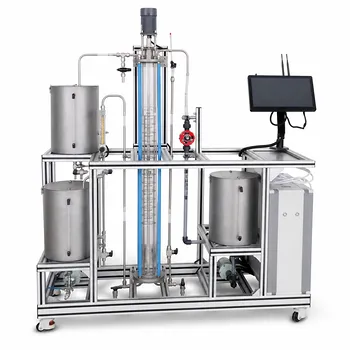
Educational Rotary Disc Liquid-Liquid Extraction Pilot Plant

Educational Rotary Disc Liquid-Liquid Extraction Pilot Plant

A transparent rotary disc column for educational liquid-liquid extraction experiments. This pilot plant enables students to study mass transfer, droplet dynamics, and flooding behavior, bridging theory and practice in chemical engineering unit operations education. Features variable-speed agitation and PLC control.

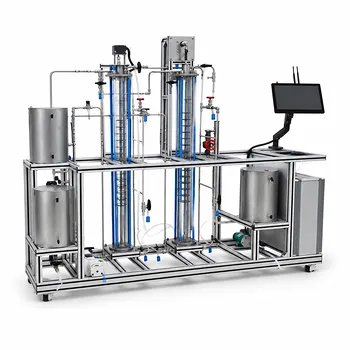
Comprehensive Liquid-Liquid Extraction Pilot Plant for Engineering Education

Comprehensive Liquid-Liquid Extraction Pilot Plant for Engineering Education

Comprehensive liquid-liquid extraction pilot plant for engineering education, integrating rotary and vibratory columns for hands-on observation of phase behavior, flooding limits, and mass transfer efficiency, enabling precise HTU and mass transfer coefficient calculations.

Continuous Sieve-Plate Distillation Pilot Plant for Unit Operations Laboratory Education

Continuous Sieve-Plate Distillation Pilot Plant for Unit Operations Laboratory Education

Integrated pilot-scale teaching system for continuous sieve-plate distillation studies. Visual demonstration of tray hydraulics, flexible feed positions, and automatic reflux control for hands-on unit operations education in engineering labs. Designed for higher education engineering laboratories.

Continuous Batch Extractive Distillation Educational Pilot Plant

Continuous Batch Extractive Distillation Educational Pilot Plant

Versatile pilot plant for continuous, batch, and extractive distillation training. High-borosilicate glass column for visualizing hydraulics, 15.6-inch touchscreen with data logging, precise reflux ratio control 1-99, and durable corrosion-resistant frame. Ideal for chemical engineering education and process research.

Bench Scale Dual Column Gas Separation and Capture Educational Pilot Plant

Bench Scale Dual Column Gas Separation and Capture Educational Pilot Plant

This dual-column educational pilot plant provides hands-on teaching of gas adsorption, separation, and capture processes. It features stainless steel columns, regeneration up to 400°C, and a 15.6-inch touchscreen PLC for TSA and PSA studies in chemical engineering curricula, process simulation.

Multi-Functional Special Distillation Educational Pilot Plant

Multi-Functional Special Distillation Educational Pilot Plant

Versatile multi-functional special distillation pilot plant for chemical engineering education. Supports continuous, vacuum, azeotropic, reactive, extractive distillation. Transparent glass columns enable real-time visual observation of hydrodynamics and separation processes.

Plate Column Hydrodynamics Tray Demonstration Educational Pilot Plant

Plate Column Hydrodynamics Tray Demonstration Educational Pilot Plant

Advanced transparent educational pilot plant for chemical engineering labs demonstrates plate column hydrodynamics with industrial sieve bubble cap serrated valve trays for visual observation of gas-liquid contact pressure drop measurement and operational limit analysis including flooding weeping entrainment

Multi-Modal Distillation Unit Operations Training Pilot Plant

Multi-Modal Distillation Unit Operations Training Pilot Plant

Multi-modal distillation pilot plant for practical unit operations training in chemical engineering education. Features real, analog, and semi-physical simulation modes, industrial construction, customizable for university labs. Hands-on fractionation columns, SCADA control, safety systems. Includes sight glasses, sampling ports, closed-loop recycling.

Absorption and Desorption Educational Unit Operations Pilot Plant

Absorption and Desorption Educational Unit Operations Pilot Plant

Dual packed column absorption and desorption pilot plant for chemical engineering education, offering real-time mass transfer coefficient measurement, durable mobile frame, industrial touch-screen interface, and customizable design for varied laboratory curricula, enabling hands-on study of gas absorption and stripping.

Dual-Mode Rectification Pilot Plant for Practical Training Unit Operations

Dual-Mode Rectification Pilot Plant for Practical Training Unit Operations

Industrial-scale dual-mode rectification pilot plant for chemical engineering practical training. Features real-material and simulated-material operation modes, sieve-plate column with sight glasses for visual observation of hydrodynamics, and customizable SCADA control for safe, hands-on learning of unit operations and mass transfer.

Natural Product Extraction Unit Operations Training Pilot Plant

Natural Product Extraction Unit Operations Training Pilot Plant

Integrated natural product extraction pilot plant for chemical engineering training bridges theory and industrial practice with modular extraction and evaporation/concentration units, hybrid touchscreen and manual control, realistic process simulation, and self-contained softened water and vacuum utilities.

Multimodal Absorption and Desorption Pilot Plant for Unit Operations Training

Multimodal Absorption and Desorption Pilot Plant for Unit Operations Training

Multimodal absorption and desorption pilot plant for higher education labs. Bridges theory and industrial practice with transparent packed columns, three operational modes (real-material, simulated, semi-physical), and SCADA control. Students explore mass transfer, column hydraulics, and process control. Customizable.

Packed Bed Absorption Educational Unit Operations Pilot Plant

Packed Bed Absorption Educational Unit Operations Pilot Plant

Study gas-liquid absorption, pressure drop, flooding, and mass transfer coefficients with this pilot plant. Transparent packed column, industrial touchscreen, real-time sensor data, automated analysis. Investigate two-phase flow, loading points, column efficiency. Comprehensive data logging and assessment software included.

Pressure Swing Adsorption Educational Unit Operations Pilot Plant

Pressure Swing Adsorption Educational Unit Operations Pilot Plant

Integrated bench-scale pressure swing adsorption pilot plant for hands-on teaching of gas-solid separation, mass transfer, and process optimization using nitrogen-oxygen model, featuring dual-column design, industrial touchscreen control, digital assessment suite, and customizable hardware and software configurations for educational laboratories.

Green Anhydrous Ethanol Purification Extractive Distillation Unit Operations Training Pilot Plant

Green Anhydrous Ethanol Purification Extractive Distillation Unit Operations Training Pilot Plant

Modular pilot plant produces high-purity anhydrous ethanol from crude ethanol via extractive distillation in a zero-emission closed-loop process providing hands-on training in unit operations with PLC-based control SCADA software and digitalized process management focusing on green engineering principles

Gallium and Indium Selective Extraction Educational Pilot Plant

Gallium and Indium Selective Extraction Educational Pilot Plant

Integrated pilot-scale laboratory system for engineering education bridging theoretical concepts with industrial practice enabling hands-on study of liquid liquid extraction reaction kinetics and mass transfer for selective gallium and indium separation featuring real-time IoT connectivity with integrated safety

Ion Exchange Water Purification Educational Pilot Plant for Engineering Unit Operations

Ion Exchange Water Purification Educational Pilot Plant for Engineering Unit Operations

This bench-scale ion exchange pilot plant trains engineering students in water purification. Dual transparent columns simulate industrial softening and demineralization. Students observe fluid dynamics, perform resin regeneration, and analyze breakthrough curves. The corrosion-resistant frame ensures durability in unit operations experiments.

Green Anhydrous Ethanol Refining Practical Training Pilot Plant

Green Anhydrous Ethanol Refining Practical Training Pilot Plant

Advanced integrated pilot plant for university labs demonstrating extractive distillation to produce high-purity absolute ethanol from crude feedstock, featuring multi-column continuous operation, closed-loop solvent recycling, and customizable controls for hands-on engineering education, ideal for chemical engineering training and research.

Bench Scale Carbon Dioxide Capture Educational Unit Operations Pilot Plant

Bench Scale Carbon Dioxide Capture Educational Unit Operations Pilot Plant

This bench-scale educational pilot plant simulates industrial CO₂ separation using a multi-tower adsorption system for hands-on engineering training. Students achieve ≥90% CO₂ purity while studying pressure swing adsorption, desorption kinetics, and process control in gas purification experiments.

Supercritical High-Gravity Flash Evaporation Educational Unit Operations Pilot Plant

Supercritical High-Gravity Flash Evaporation Educational Unit Operations Pilot Plant

Bench-scale integrated teaching system for advanced separation and mass transfer, combining supercritical high-gravity flash evaporation with heating, chemical reaction, and material collection, featuring modular design, Stainless Steel 316L construction, transparent visualization, touchscreen control, and safety systems for chemical engineering education.


Leave Your Message