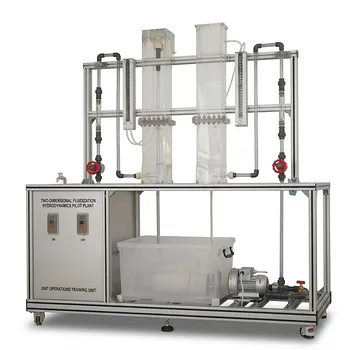
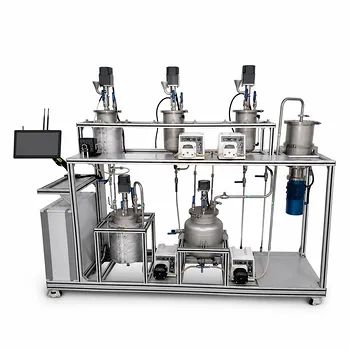
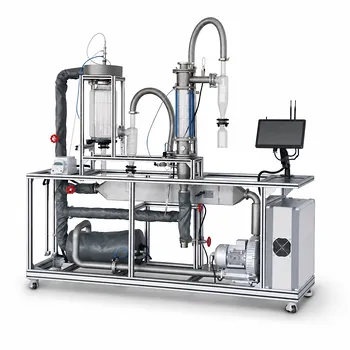
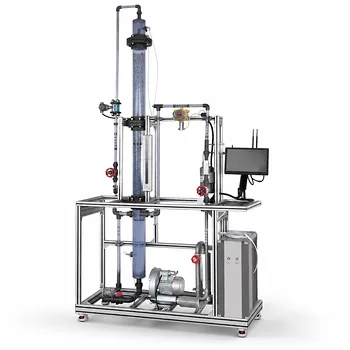
Cold gas efficiency (CGE) is higher in moving bed and fluidized bed gasifiers because their lower operating temperatures preserve methane and other hydrocarbons in the product syngas. These hydrocarbons carry a higher heating value than carbon monoxide and hydrogen, so their retention directly boosts the chemical energy transferred from coal to gas. Entrained flow systems, by contrast, operate at such extreme temperatures (1600–2200 K in many pilot designs) that methane is completely cracked into CO and H₂, sacrificing CGE for a tar-free, high-purity syngas.
The core insight for pilot‑plant training is that cold gas efficiency is not solely about carbon conversion – it reflects the product gas composition determined by reactor temperature. Moving bed and fluidized bed configurations deliver efficiency figures of 81–88 % because they leave valuable hydrocarbons intact, while entrained flow reactors intentionally trade this efficiency for a clean, nearly hydrocarbon‑free syngas and ultra‑high carbon conversion.
Why Cold Gas Efficiency Defines the Learning Goal
In a chemical engineering pilot plant, cold gas efficiency quantifies how much of the coal’s original chemical energy ends up in the syngas. It is the first metric students encounter when comparing gasification technologies, but it only tells half the story.
The real pedagogical value lies in linking this number to the underlying reaction temperature and the resulting product slate. That connection directly reveals the fundamental trade‑offs between moving bed, fluidized bed, and entrained flow designs.
The Temperature–Product Distribution Link
How Lower Temperatures Preserve Hydrocarbon Energy
Moving bed and fluidized bed gasifiers both operate with exit gas temperatures far below those of an entrained flow unit. A moving bed pilot typically discharges syngas at 700–900 K, while a fluidized bed exits at 1150–1300 K. At these moderate conditions, the pyrolysis and gasification steps are not aggressive enough to fully decompose methane, ethane, or tar-like fractions.
Methane has a significantly higher heating value per unit mass than both CO and H₂. Therefore, any CH₄ that slips through to the product stream raises the cold gas efficiency. The primary reference confirms this effect: moving bed configurations reach 81–88 % CGE, and fluidized beds close behind at 81–85 %, specifically because they retain methane and higher hydrocarbons.
Why Entrained Flow Systems Sacrifice Efficiency for Syngas Purity
Entrained flow reactors operate at the highest temperature envelope, often 1600–2200 K in pilot‑scale units. At these temperatures, all hydrocarbons are completely reformed into CO and H₂. The exit gas is essentially a binary mixture of synthesis gas, free of tars, oils, and methane.
This clean stream simplifies downstream processing and is ideal for chemical synthesis, but the chemical energy content per unit volume drops. Entrained flow designs consequently show a lower cold gas efficiency of 74–81 % – the penalty exacted for full cracking of the hydrocarbons. In an educational setting, this contrast teaches students that “higher temperature” is not always synonymous with “higher efficiency.”
Moving Bed vs. Fluidized Bed: Two Routes to High Efficiency
The Moving Bed: Counter‑Current Temperature Profiling
Moving bed (fixed bed) gasifiers use a counter‑current flow pattern: coal descends slowly while the gasifying agent rises. This creates a pronounced temperature gradient, from a hot combustion zone near the bottom (up to 1200 °C) to a cool drying and pyrolysis zone at the top.
The raw syngas leaves at a relatively low temperature (700–900 K), rich in methane and tars produced during the initial devolatilization. This thermal pincer effect is the primary reason moving bed units can achieve 84–88 % CGE in pilot plants – they extract the maximum chemical energy from the volatiles before intense oxidation can destroy them.
The Fluidized Bed: Isothermal, Back‑Mixed Hydrocarbon Retention
Fluidized bed reactors suspend crushed coal (<5 mm) in an upward gas flow, creating an almost perfectly mixed, isothermal environment around 1250–1400 K. The uniform temperature prevents localized hot spots that would crack all hydrocarbons.
While some methane still survives, the higher average temperature and intensive back‑mixing lead to a slightly lower hydrocarbon yield than a moving bed. Nevertheless, the cold gas efficiency remains high (81–85 %) because the majority of the volatiles are preserved in the product gas. For students, this demonstrates how fluidization dynamics influence not just heat transfer but also the final gas quality.
Understanding the Trade‑offs
Cold gas efficiency is a critical number, but a pilot plant must also teach the practical consequences of each reactor choice. The high CGE of moving and fluidized beds comes with significant operational burdens.
- Moving bed penalties: The low‑temperature syngas contains substantial tars, oils, and unreacted fines. Downstream gas cleanup becomes a major unit operation, requiring quenching, electrostatic precipitators, or solvent scrubbing just to render the gas usable for combustion or synthesis.
- Fluidized bed limitations: A portion of the char exits the reactor with the ash, necessitating a separate combustion system to recover energy. Moreover, the tolerance is narrow for coal particle size and reactivity, demanding precise feed preparation.
- Entrained flow drawbacks: Although the syngas is ultra‑clean, the high temperature demands massive oxygen consumption, refractory‑grade reactor linings, and fine coal grinding (<0.1 mm). The cold gas efficiency is lower, but carbon conversion approaches 99 %, and the syngas is immediately ready for downstream catalysis without tar removal.
The pedagogical value of a multi‑reactor pilot plant lies in allowing students to measure these trade‑offs directly – to see that cold gas efficiency and syngas quality exist on opposite sides of the temperature lever.
Making the Right Choice for Your Pilot Plant Goal
When specifying a gasifier for an educational or research pilot facility, the decision should align with the core learning outcomes you want to demonstrate.
- If your primary focus is teaching reaction thermodynamics and the impact of temperature on product distribution: Choose a moving bed or fluidized bed unit. The preserved methane gives students a tangible link between temperature, CGE, and the hydrocarbon content they measure in the gas chromatograph.
- If your primary focus is fluidization dynamics and solid-state handling: A fluidized bed dryer or gasifier lets students determine minimum fluidization velocity, observe bubbling and slugging regimes, and study drying kinetics, directly bridging the Ergun equation with real‑world operation.
- If your primary focus is high‑temperature slagging operation and downstream synthesis gas conditioning: An entrained flow gasifier, despite its lower CGE, provides an unmatched platform to teach oxygen‑blown start‑ups, slag tapping, and the rapid quenching needed to avoid dioxin formation in waste‑to‑energy applications.
Cold gas efficiency is not a universal measure of superiority – it is a lens through which the fundamental process trade‑off between energy retention and gas cleanliness becomes immediately visible to the next generation of engineers.
Summary Table:
| Reactor Type | Operating Temp (K) | Cold Gas Efficiency (CGE) | Syngas Characteristics & Hydrocarbons |
|---|---|---|---|
| Moving Bed | 700–900 K | 84–88% | Rich in methane and tars; requires extensive downstream cleaning. |
| Fluidized Bed | 1150–1300 K | 81–85% | Moderate methane retention; back-mixed isothermal environment. |
| Entrained Flow | 1600–2200 K | 74–81% | Ultra-clean, tar-free, high-purity syngas (methane fully cracked). |
Elevate Your Engineering Curriculum with LABPARK Pilot Plants
Are you looking to bridge the gap between thermodynamic theory and hands-on chemical process engineering?
LABPARK provides state-of-the-art Educational and Vocational Unit Operations Pilot Plants tailored for universities, research institutes, and enterprises. Whether you are demonstrating fluidization dynamics, chemical gasification thermodynamics, or advanced separation techniques, our systems are built to industrial standards to ensure safe, repeatable, and deeply educational student lab experiences.
Our Core Offerings Include:
- Chemical Engineering unit operations (gasification, distillation, heat exchange)
- Bioprocess & Biotech pilot training systems
- Environmental & Water Treatment laboratory rigs
Bring real-world process trade-offs to life in your lab. Contact LABPARK today to discuss your custom training equipment needs!
Related Products
- Fluidized Bed Gas Solid Catalytic Reaction Educational Pilot Plant
- Multi-Reactor Educational Pilot Plant for Reaction Engineering Unit Operations
- Two-Dimensional Fluidization Hydrodynamics Educational Pilot Plant for Unit Operations Training
- Fixed Bed Gas Solid Catalytic Reaction Educational Pilot Plant
- High-Gravity Emulsification and Mass Transfer Educational Pilot Plant
People Also Ask
- Why is the bed height-to-diameter ratio (L/dt) critical? Fluidized bed pilot plant selection guide.
- How is the minimum fluidization velocity (U_mf) determined and utilized? A Unit Operations Guide
- How does the Mears criterion evaluate transport resistance? Key Guide to Intrinsic Kinetics
- How do reactor pilot plants safely study gas-solid reactions? Master kinetics with thermal & flow control.
- How do pilot plants demonstrate fluidized-bed reactor advantages over fixed-bed? Find Out Now