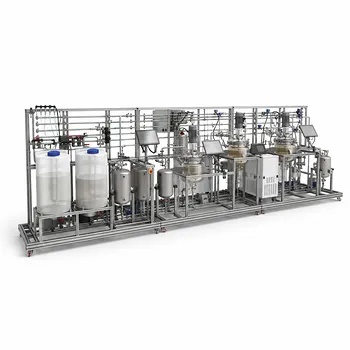
An operating manual is the single most critical tool for transforming a complex pilot plant from a potential hazard into a powerful learning instrument. In vocational training for bioprocess or chemical unit operations, comprehensive, step-by-step manuals are not a luxury—they are the foundational document that ensures inexperienced students can safely perform start-up, operation, and emergency shutdown procedures on equipment that often involves high temperatures, pressures, reactive chemicals, and intricate process control. They directly answer the surface need for clear, repeatable instructions.
Pilot plants exist to mimic the real industrial environment; without a formal operating manual, you eliminate the very protocol-driven, safety-centric discipline that students must absorb before entering the workforce. A step-by-step manual is therefore the curriculum’s backbone—it establishes consistent safety protocols, minimizes equipment damage, and builds the technical confidence required for genuine competence.
The Unique Challenge of Pilot Plants in Education
Navigating Scale and Complexity in a Learning Environment
Pilot plants sit at a critical intermediate scale where chemical and physical phenomena—heat transfer, mass transfer, and fluid dynamics—no longer behave like bench-scale glassware. In a vocational setting, students face the added layer of real-time process control, often through PLC or SCADA interfaces, while managing multiple interconnected unit operations.
These integrated systems may combine distillation columns, catalytic reactors, filtration units, and heat exchangers. Each piece of equipment introduces its own start-up sequence, normal operating envelope, and shut-down logic. Without a step-by-step guide, a simple mix-up like opening a valve out of sequence or misreading a pressure transducer can cause a pump to run dry, a reactor to overheat, or a glass column to shatter.
Why Inexperience Demands Structure, Not Guesswork
Vocational students and lab technicians are not yet experts. Their learning process must be scaffolded by formal protocols that remove ambiguity. A comprehensive manual does exactly this: it codifies the correct, repeatable method for every procedure, ensuring that a trainee’s attention goes to observing the process, recording data, and understanding the underlying principles, not to figuring out what step comes next.
The primary reference emphasizes that these manuals serve as a foundation for developing standard operating procedures (SOPs) and safety protocols. This is key: the manual isn’t just a one-day checklist; it’s the blueprint from which instructors derive training modules, safety drills, and assessment rubrics.
The Deep Functional Role of the Operating Manual
Establishing a Bulletproof Safety Culture
Safety in a pilot plant is not about luck—it’s about ingrained habit. A detailed manual mandates pre-start safety checks, lockout/tagout coordination, and emergency shutdown sequences. This formalizes the link between reading a viscosity sensor in mPa·s or a pressure reading in bar and the immediate action required.
Because pilot plants often handle exothermic reactions, flammable solvents, or biologically active agents, the manual translates theoretical hazard awareness into a concrete sequence of actions. It tells a student: “If the temperature exceeds X, close valve Y and activate cooling Z.” This elimination of judgment calls under stress is what prevents equipment destruction and personal injury.
Protecting Capital Investment and Ensuring Data Integrity
Pilot-plant equipment—such as industrial-grade pumps, precision flow meters, and pressure vessels built to ASME standards—represents a significant investment. A single error during start-up can damage a pump seal, contaminate a catalyst bed, or crack a heat exchanger. Manuals provide the ramp-up rates, flush procedures, and pressure-test steps that safeguard this hardware.
Furthermore, valid educational experiments depend on consistent, reproducible operation. A step-by-step manual ensures that every student cohort operates the plant under the same conditions, making the resulting mass and energy balance calculations meaningful. Without this, the data is useless for teaching the economic trade-offs between, say, selective hydrogenation and cryogenic distillation.
Bridging to Modern Industrial Practice
Modern industry runs on documented procedures. By using a manual that mirrors the structure of an industrial operating booklet—complete with P&ID references, alarm settings based on ISA standards, and troubleshooting logic—the vocational lab becomes a direct simulation of the workplace.
The supplementary references highlight that pilot plants increasingly incorporate environmental treatment units for exhaust gas scrubbing, wastewater neutralization, and solid residue handling. A manual for such an integrated system forces the student to manage the “three wastes” as an integral part of the process, not an afterthought. This teaches regulatory compliance and green chemistry as operational habits, not abstract concepts.
Providing a Consistent Benchmark for Emerging Technologies
When a lab introduces micro-reactors or process intensification modules alongside conventional unit operations, the manual becomes the common language for comparison. It provides the baseline operational parameters for the conventional setup, allowing students to benchmark the micro-reactor’s performance in heat transport and reaction kinetics. Without a documented baseline, the comparative analysis collapses into guesswork.
Understanding the Trade-offs
The Manual Must Not Become a Crutch
The single biggest risk of a highly detailed, step-by-step manual is that students will follow it blindly, failing to develop the troubleshooting intuition essential for real operations. You must design the training curriculum so that as competence grows, the manual transitions from a script to a reference. Structured fault-insertion exercises—where the instructor deliberately triggers a deviation and asks the student to consult the troubleshooting section—can bridge this gap.
Keeping the Manual from Becoming a Static Document
Pilot plants evolve. New sensors are added, software gets updated, and process recipes change. A manual that is not rigorously version-controlled and updated becomes worse than useless—it becomes actively dangerous by prescribing outdated procedures. Acknowledge this by building a formal revision process into the program, where instructors and lab technicians review the manual after every course cycle.
Balancing Industry Rigor with Educational Pacing
A verbatim copy of a 300-page industrial operating manual can overwhelm a vocational student and bury the learning objectives in procedural noise. The manual must be a pedagogical adaptation: it should include clear learning goals for each step, simple explanations of the “why” behind critical actions, and graduated complexity. It should cover emergency and standard operations with equal clarity, but prioritize comprehension where it matters most for the student’s developmental stage.
How to Maximize the Value of Your Operating Manual
After introducing the manual as the core training document, you can amplify its impact by aligning its use with specific educational goals.
- If your primary focus is foundational safety and operational discipline: Use the manual as the basis for all laboratory sessions. Require students to recite critical start-up and shutdown steps from memory before touching the equipment, and conduct unannounced drills using the emergency procedures.
- If your primary focus is teaching process economics and scale-up principles: Structure the manual to highlight the key operational variables (flow rates, temperatures, reaction times) that drive yield and cost. Have students use the manual to run the plant at different set points, then calculate the resulting economic trade-offs.
- If your primary focus is exposing students to advanced automation and data analytics: Integrate the manual with your SCADA or DCS system. Create a digital checklist where students must log data points specified by the manual in real time, then export those logs to perform a post-run analysis against the manual’s expected parameter windows.
- If your primary focus is environmental and sustainability training: Expand the manual’s scope to include detailed procedures for sampling and treating all waste streams. Make the successful completion of the manual’s environmental checklist a pass/fail condition for the laboratory session.
A comprehensive, step-by-step operating manual does more than prevent mistakes—it creates the controlled, predictable environment in which genuine chemical engineering intuition can safely be born, prepared to meet the demands of the modern industrial world.
Summary Table:
| Key Role | Impact on Training | Real-World Value |
|---|---|---|
| Safety & Protocol | Establishes emergency and start-up sequences | Prevents physical hazards and accidents |
| Asset Protection | Avoids dry runs, thermal shock, and blockages | Safeguards high-value educational equipment |
| Data Integrity | Standardizes operational parameters | Ensures reproducible student experiments |
| Workforce Readiness | Simulates industrial SOPs and P&ID references | Prepares students for modern plant environments |
Equip Your Lab for Safe, Industry-Ready Training
Ready to elevate your vocational curriculum? LABPARK provides state-of-the-art Educational and Vocational Unit Operations Pilot Plants in chemical engineering, bioprocess & biotech, and environmental & water treatment. We help universities, research institutes, and enterprises implement safe, highly productive training environments complete with comprehensive documentation.
Contact LABPARK Today to discuss your lab requirements and request a customized quote!
Related Products
- Bio-fermentation Ethanol Production Practical Training Unit Operations Pilot Plant
- Multimodal Absorption and Desorption Pilot Plant for Unit Operations Training
- Natural Product Extraction Unit Operations Training Pilot Plant
- Multi Pump Fluid Transport Process Piping Unit Operations Training Pilot Plant
- Multi-Functional Drying Educational Unit Operations Pilot Plant
People Also Ask
- Why Use PTFE & Hastelloy in Chemical Pilot Plants? Prevent Corrosion & Ensure Safety
- Why Compare Predicted and Experimental Excess Enthalpy? Key to Accurate Pilot Plant Scale-up
- Why is the chemical plant startup schedule crucial? De-risk scale-up with pilot plants.
- When to transition from PID to adaptive control in pilot plants? Key process indicators.
- Why must batch and fed-batch fermentation pilot plants be designed to accommodate changing rheological conditions?