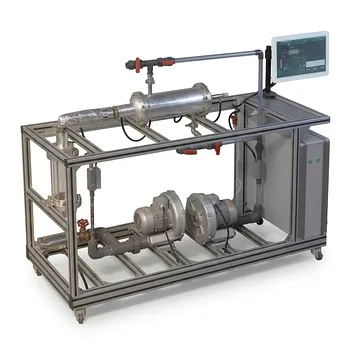
The answer for your students comes down to correlation selection based on two-phase flow structure. In horizontal tube condensation, the local flow regime dictates which empirical model is physically valid. For low vapor velocities, stratified flow prevails, requiring a modified Nusselt equation with a correction factor for the liquid pool at the tube bottom. For high vapor velocities, annular flow dominates, and the Boyko‑Kruzhilin correlation must be used. The standard design protocol—and the key learning outcome—is to compute the average heat transfer coefficient using both models and select the higher value, using the pilot plant to validate where each regime applies.
Determining the heat transfer coefficient in horizontal tube condensation is not a single equation problem; it is a regime‑identification challenge. The physical flow structure (stratified vs. annular) fundamentally changes the heat transfer mechanism, and safe pilot‑plant design requires calculating both possibilities and adopting the larger coefficient.
The Dual‑Regime Reality in Horizontal Tubes
In a chemical engineering pilot plant, condensation inside a horizontal tube is a classic demonstration of how hydrodynamics govern heat transfer. The vapor‑liquid interface can take several forms, but two flow models capture the extremes that directly impact the coefficient.
Stratified Flow: When Gravity Controls the Interface
At low vapor velocities, gravity dominates over vapor shear. Liquid condensate accumulates along the bottom of the tube, creating a stratified layer.
This pool acts as a thermal barrier, reducing the effective condensation area on the upper tube wall. The heat transfer coefficient is derived from a modified Nusselt equation that accounts for this liquid buildup, typically incorporating a correction factor around 0.8. The model uses the liquid‑phase properties (conductivity, density, viscosity) and the condensate mass flow rate per unit length, (\Gamma_h), to capture the thinning film above the pool.
Students can observe this regime by operating the pilot condenser at low steam inlet pressures and low vapor velocities. The resulting coefficient will be noticeably lower than the theoretical Nusselt prediction for a full tube perimeter.
Annular Flow: When Vapor Shear Sculpts the Film
At high vapor velocities, interfacial shear forces become dominant. The vapor drags the condensate into a symmetric, annular film that wets the entire tube circumference.
This uniform thin film presents a much lower conductive resistance, and the heat transfer coefficient increases substantially compared to stratified flow. The Boyko‑Kruzhilin correlation is the standard empirical tool for this regime. It relates the two‑phase heat transfer coefficient to the single‑phase liquid coefficient and the vapor quality, capturing the acceleration effect of the condensing vapor.
Pilot plant exercises that push steam flow rates high will visibly shift the condenser toward annular behavior, giving students a direct experimental comparison.
The Calculation Protocol That Bridges Theory and Practice
For a real pilot‑plant condenser, the flow regime may be uncertain or transitional over the tube length. The conservative design approach taught in industry is to calculate the average heat transfer coefficient under both the stratified and annular assumptions.
The higher of the two values is then selected for equipment sizing or performance prediction. This method ensures that the design does not under‑predict the required area, while also respecting the physical limits of each model. In a student activity, this demonstrates how engineering judgment navigates between idealized correlations.
The Condensate Film Regime: Laminar vs. Turbulent
Beyond the two‑phase flow pattern inside the tube, the condensate film itself can transition from laminar to turbulent flow, dramatically altering the local heat transfer coefficient. Pilot plants allow manipulation of steam pressure and cooling water rate to drive this transition.
Laminar Film Condensation (Re(_f) < 1800)
When the condensate film Reynolds number is below approximately 1800, the film is laminar and flows smoothly. Nusselt’s classical theory holds: as the film flows downward and thickens, thermal resistance increases, and the heat transfer coefficient decreases with increasing condensate load.
Students can plot the coefficient versus film Reynolds number and see the inverse relationship predicted by Nusselt’s equation.
Turbulent Film Condensation (Re(_f) > 1800)
Once the Reynolds number exceeds the critical value, the film becomes turbulent. Mixing within the film enhances convection and increases the heat transfer coefficient as the condensate load rises further.
The Badger correlation replaces Nusselt’s equation in this regime. A pilot plant exercise that varies cooling water temperature to deliberately raise the condensation rate can force this transition, allowing students to identify the inflection point and validate the competing empirical models.
Understanding the Trade‑offs and Limitations
Treating these correlations as infallible can mislead students. It is essential to discuss their boundaries and practical compromises.
- Transitional regimes are problematic: At intermediate vapor velocities, the flow is a churning, wavy mixture that neither the stratified nor the annular model represents accurately. Using the “higher of the two” is a practical fix, not a physical truth.
- Stratified flow correction is empirical: The 0.8 factor (or 0.76 constant in some correlations) is an average over typical fluids; for high‑Prandtl‑number fluids, the inundation effect may be over‑ or under‑predicted.
- Annular flow assumes symmetry: The Boyko‑Kruzhilin correlation assumes a smooth, symmetric film. In real tubes, gravitational drainage can still cause a slightly thicker bottom film, introducing errors at moderate vapor velocities.
- Film transition is geometry‑specific: The laminar‑to‑turbulent transition Reynolds number of 1800 applies to vertical surfaces; for a horizontal tube, the dripping and film instability make the transition behavior more complex, and the Badger correlation is a simplification.
- Tube bundles add a complexity: In shell‑side condensation over horizontal tube banks, condensate from upper rows drains onto lower rows, increasing the effective film thickness. The correction (N_r^{-1/6}) (rather than the theoretical (N_r^{-1/4})) is used to account for non‑continuous draining, as the Kern method teaches.
Making the Most of Your Pilot Plant Training
The question of heat transfer coefficient determination is best answered by letting students drive the pilot unit to the limits of each flow regime.
- If your primary focus is demonstrating regime identification: Run the condenser at two extreme vapor velocities. Have students measure the overall coefficient and compare it with the predictions from the stratified and annular models, confirming which correlation matches each operating point.
- If your primary focus is the film dynamics lesson: Vary the steam pressure while holding cooling water flow constant to sweep the film Reynolds number from below 1000 to above 2000. Students should calculate both Nusselt and Badger coefficients and plot them against their experimental data to locate the transition.
- If your primary focus is industrial relevance of design safety: Require students to calculate the required heat transfer area using both the stratified (low) and annular (high) coefficients and discuss the economic and safety implications of selecting the larger value.
By physically manipulating flow regimes and measuring the outcome, students learn that the heat transfer coefficient is not a fixed number—it is a dynamic response of the two‑phase flow to the operating conditions. This is the core lesson the pilot plant is uniquely positioned to teach.
Summary Table:
| Flow Regime / Film State | Dominant Force | Empirical Model / Correlation | Heat Transfer Coefficient (HTC) Impact |
|---|---|---|---|
| Stratified Flow | Gravity | Modified Nusselt (with ~0.8 factor) | Lower HTC; liquid pool at the bottom acts as a thermal barrier. |
| Annular Flow | Vapor Shear | Boyko-Kruzhilin | Higher HTC; thin, symmetric film wets the entire perimeter. |
| Laminar Film (Re < 1800) | Gravity / Viscosity | Nusselt's Classical Theory | HTC decreases as the condensate film thickens. |
| Turbulent Film (Re > 1800) | Turbulent Mixing | Badger Correlation | HTC increases with higher condensate loading. |
Elevate Your Chemical Engineering Lab with LABPARK
Bridge the gap between theoretical thermodynamics and hands-on engineering. LABPARK provides state-of-the-art Educational and Vocational Unit Operations Pilot Plants in chemical engineering, bioprocess & biotech, and environmental & water treatment. Designed specifically for universities, research institutes, and enterprises, our pilot plants empower students to safely visualize and calculate real-world heat transfer coefficients.
Ready to upgrade your laboratory training equipment? Contact LABPARK today to discuss your custom pilot plant requirements!
Related Products
- Three-Tube Heat Transfer Educational Pilot Plant for Unit Operations Training
- Shell and Tube Heat Exchanger Heat Transfer Coefficient Determination Educational Pilot Plant
- Tubular Reactor Flow Characteristics Determination Educational Unit Operations Pilot Plant
- Comprehensive Multi-Modal Heat Transfer Unit Operations Pilot Plant for Engineering Training
- Residence Time Distribution and Reactor Flow Characteristics Determination Educational Pilot Plant
People Also Ask
- When is ε-NTU preferred over LMTD in pilot plants? Predict heat exchanger performance without iteration.
- Why is the study of thermal boundary layers and Prandtl numbers critical in heat transfer unit operations pilot plants?
- Why is emissivity critical in heat transfer pilot plants? Bridge the Gap Between Theory & Industrial Design
- How does thermal conductivity affect pilot plant performance? Optimize heat transfer & accuracy
- How to Verify Air-Side Heat Transfer Coefficient with a Pilot Plant? Practical Lab Guide