There’s more to a pile of powder than meets the eye. At pilot-plant scale, you must move beyond “a heap of particles” and see a structured assembly of solids and carefully classified air spaces. In solids unit operations, air voids in a powder sample are classified into three distinct categories—open intraparticulate, closed intraparticulate, and interparticulate voids—and these directly define the critical volume measures: true volume, granular volume, and bulk volume.
The volumes you work with—whether true, granular, or bulk—are not interchangeable. Each one reflects a different population of air voids, and confusing them leads directly to flawed scale-up, inconsistent mixing, or inaccurate packing predictions.
Decoding the Air in Your Powder
A powder sample is a three-phase system: solid material, internal voids, and external spaces. In a pilot plant, where flowability, compaction, and reactivity matter deeply, you must name and quantify each void space.
The Three Voids That Define All Volumes
Open intraparticulate voids are pores, cracks, or cavities within a single particle that connect to the outside surface.
Think of them as tiny caves with an open door to the particle’s exterior.
They are accessible to fluids and play a huge role in absorption, dissolution, and wetting operations.
Closed intraparticulate voids are fully sealed pores inside a particle.
These are like bubbles frozen inside glass; they don’t communicate with the particle’s outer surface.
They affect true density measurements and can lead to misleading porosity calculations if ignored.
Interparticulate voids are the spaces between separate particles in the bulk.
This is the air you see vanish when you tap a graduated cylinder—the voidage that governs packing, segregation, and hopper discharge.
Why This Classification Matters in a Pilot Plant
Teaching these concepts is not about memorizing terms. It’s about linking laboratory characterization to real unit operations.
A mixer’s performance depends on whether you fill the interparticulate voids with powder or with a liquid binder.
A tablet press’s fill depth is a function of bulk volume, while dissolution kinetics care only about the true volume of the active solid.
From Voids to Volumes: The Three Measures You Must Know
Once you classify the voids, you can assign a specific volume to a sample. Each volume includes a different subset of void spaces, and the distinction has direct operational consequences.
True Volume – The Solid Itself
True volume (V_T) is the volume occupied exclusively by the solid skeleton of the particles.
It excludes all voids—both intraparticulate and interparticulate.
You obtain this from helium pycnometry or by grinding to eliminate closed porosity, and it gives you the density that matters for chemical reaction rates inside the particle.
Granular Volume – The Particle with Its Pores
Granular volume (V_G) is the sum of the true volume and all intraparticulate voids (both open and closed).
In other words, it is the volume of a single particle, including its internal porosity.
This is the volume you need when you want to design a pelletizing drum or calculate the effectiveness factor of a porous catalyst.
Bulk Volume – The Process Volume
Bulk volume (V_B) is the sum of granular volume plus all interparticulate voids.
It’s the volume a powder actually occupies in a hopper, a dryer, or a transport container.
Most process calculations—silo sizing, fluidization velocity, bed pressure drop—start from this bulk measurement.
Understanding the Trade-offs
No single volume measurement is universally “correct.” Each serves a purpose, and ignoring a void category can create costly mismatches.
The Hidden Risk of Closed Voids
When you measure density using liquid intrusion, closed intraparticulate voids may remain unpenetrated, causing you to under-report true volume.
At pilot scale, this leads to overestimating the active mass inside a reactor and can throw off kinetic models by 10–15%.
Tap Density Deception
A tapped density test minimizes interparticulate voids but does not eliminate them.
Students often mistake the tapped volume for granular volume. That error propagates into incorrect porosity data for fluidized beds, where you’re actually dealing with incipient voidage, not tap consolidation.
The Granular-Volume Gap
Granular volume sits between true and bulk and is the hardest to measure directly without a mercury porosimeter or a careful gas expansion method.
In a teaching pilot plant, this gap becomes a valuable lesson: sometimes the most process-relevant quantity is the one you must infer, not measure directly.
Applying This to Pilot-Plant Education and Operation
Clarity around void classification transforms how you teach—and execute—solid unit operations. The decision of which volume to use depends entirely on what you are trying to control or predict.
- If your primary focus is reaction engineering or dissolution: Start with true volume. It tells you the real amount of solid reactant or active ingredient available, stripped of all porosity effects.
- If your primary focus is particle design, granulation, or pelletizing: Lean on granular volume. It captures the particle’s internal structure and governs intra-particle diffusion limitations and mechanical strength.
- If your primary focus is storage, flow, or transport: Work from bulk volume. This is the volume that fills your silos, sets your conveying rates, and determines hopper slope requirements.
Once each volume is tied to a specific void population, pilot-plant troubleshooting becomes systematic rather than intuitive. You stop saying “the powder doesn’t flow” and start asking whether the interparticulate voidage has collapsed, whether the particle porosity has changed, or whether your true density measurement is still valid. That shift—from guesswork to void-based diagnosis—is the core of professional solids handling.
Summary Table:
| Volume Measure | Definition | Included Voids | Key Process Application |
|---|---|---|---|
| True Volume ($V_T$) | Volume of the solid skeleton only | None (excludes all voids) | Chemical kinetics, dissolution rates |
| Granular Volume ($V_G$) | Volume of the particle including its pores | Open & closed intraparticulate voids | Catalyst design, pelletizing, granulation |
| Bulk Volume ($V_B$) | Total space occupied by the bulk powder | Intraparticulate & interparticulate voids | Silo sizing, conveying, hopper design |
Bridge the Gap Between Powder Theory and Pilot-Scale Reality
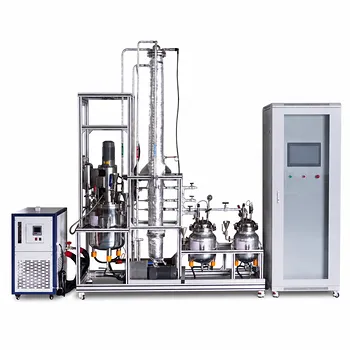
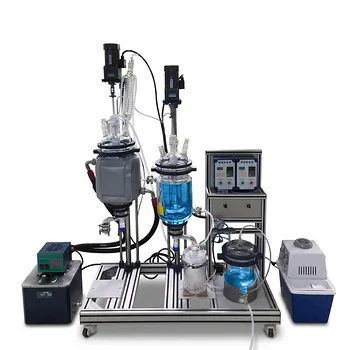
Teaching complex solids handling and unit operations requires hands-on equipment that accurately replicates industrial processes. LABPARK provides state-of-the-art Educational and Vocational Unit Operations Pilot Plants in chemical engineering, bioprocess & biotech, and environmental & water treatment.
Designed for universities, research institutes, and enterprises, our pilot plants help students and researchers transition from laboratory powder characterization to real-world process design.
Ready to upgrade your lab or training facility? Contact LABPARK today to discuss your pilot plant requirements.
Related Products
- Polymerization Granulation and Pellet Processing Educational Unit Operations Pilot Plant
- Residence Time Distribution and Reactor Flow Characteristics Determination Educational Pilot Plant
- Natural Product Extraction Unit Operations Training Pilot Plant
- Tubular Reactor Flow Characteristics Determination Educational Unit Operations Pilot Plant
- Multi-Functional Special Distillation Educational Pilot Plant
People Also Ask
- How do educational unit operations pilot plants bridge theory and design? Bridge the Engineering Gap
- How do educational unit operations pilot plants address safety and waste management when scaling up?
- Why Compare Predicted and Experimental Excess Enthalpy? Key to Accurate Pilot Plant Scale-up
- When to transition from PID to adaptive control in pilot plants? Key process indicators.
- Why Use PTFE & Hastelloy in Chemical Pilot Plants? Prevent Corrosion & Ensure Safety