For a pilot plant circulating process fluids, the meter you choose doesn't just measure flow—it steals energy. A standard orifice plate imposes a massive, permanent pressure loss because the fluid's kinetic energy is dissipated into turbulent eddies downstream. A Venturi tube, by contrast, uses a carefully angled recovery cone to convert that kinetic energy back into static pressure, slashing the net energy loss to a small fraction of the orifice's value.
While both orifice plates and Venturi tubes create a differential pressure to measure flow, their downstream fates diverge completely. The orifice trades low upfront cost for high permanent pressure loss (often over half the measured differential), making it an energy-wasting device. The Venturi achieves up to 90% pressure recovery, but demands precision machining and a much higher purchase price. The core decision for a pilot plant hinges on whether you prioritize energy efficiency and demonstration of ideal fluid behavior, or budget and simplicity.
The Physics of Permanent Pressure Loss and Recovery
To answer the surface question clearly, we must look at what happens to the fluid after the constriction.
The Orifice Plate: Turbulent Dissipation, Not Recovery
A standard orifice plate forces the entire flow through a small, sharp-edged hole. The fluid jet contracts into a minimum area called the vena contracta, accelerating to a high velocity and low pressure.
Downstream of this constriction, the jet abruptly expands into the full pipe diameter. This sudden deceleration generates intense vortex formation and turbulent mixing. This process destroys the fluid's kinetic energy, converting it irreversibly into heat. The result is a permanent pressure loss that is typically 50–80% of the measured differential pressure.
For a pilot plant, that wasted energy directly translates into larger pump motors and higher operating costs.
The Venturi Tube: Engineered for Kinetic Energy Recovery
A Venturi meter guides the fluid through a smooth converging cone, a short throat, and—critically—an extended diverging cone. The gradual expansion in that diffuser section is the key to its performance.
As the fluid slows down smoothly in the diverging cone, the high velocity head is reconverted into static pressure. By avoiding abrupt changes and minimizing flow separation, the Venturi can recover 80–90% of the differential pressure. The permanent pressure loss is therefore only 10–20% of the measured differential.
This near-ideal pressure recovery makes the Venturi an excellent demonstrator of the Bernoulli principle in action, directly showing conservation of energy in a real fluid system.
Why This Contrast Matters in a Unit Operations Pilot Plant
In an educational or vocational pilot plant, the choice isn't just a component selection exercise—it's a teaching point.
A high permanent pressure loss across an orifice limits the number of sequential unit operations you can power from a single pump. It forces you to size pumps for wasted energy, not just useful work. In a research or demonstration loop where students measure pump curves and energy balances, the orifice’s hidden tax clouds the data.
The Venturi's low-loss design, however, preserves system pressure. This allows students to run multiple experiments in series without re-pumping, making the entire plant more energy-efficient and physically demonstrative of fluid mechanics textbook ideals.
Understanding the Trade-offs
No meter is perfect. Your choice must balance physics against practical constraints.
The Price of Efficiency: Manufacturing and Cost
Orifice plates are simple: a flat metal disc with a hole. They can be water-jet cut, easily replaced, and cost very little. Their installation is straightforward between standard flanges, making them the go-to for quick, low-cost flow metering.
Venturi tubes are complex: their converging and diverging cones demand precise machining to strict dimensional tolerances. The physical length is considerably greater, requiring significant straight pipe runs both upstream and downstream. This makes them expensive to manufacture and challenging to retrofit into a cramped pilot plant skid.
In a training environment, the high cost of a precision Venturi is a trade-off: you gain an elegant demonstration of pressure recovery, but you lose the budget flexibility to install a dozen flow measurement stations.
Accuracy, Wear, and Calibration Factors
The permanent pressure loss isn't just an energy story—it interacts with measurement reliability over time.
- Orifice meters have a relatively low discharge coefficient (typically 0.59–0.68) that is sensitive to the sharpness of the inlet edge. Erosion or deposits can round the edge, altering the coefficient and requiring routine recalibration—a valuable lesson for students, but a maintenance headache.
- Venturi meters operate with a high discharge coefficient (0.97–0.99), staying close to ideal behavior. However, surface roughening or scale buildup inside the throat can still shift this coefficient by 1–2% over years, demanding periodic verification.
From an educational standpoint, these differing calibration demands are a gift. Students can experimentally determine discharge coefficients across varying Reynolds numbers, directly comparing the near-ideal performance of a Venturi with the lossy, real-world behavior of an orifice.
A Note on Compressible Flows and Choking
In gas-flow demonstrations, the difference becomes even more striking. An orifice plate can only accelerate a gas to sonic velocity at the vena contracta, capping its mass flow rate. A Venturi, with its diverging section, allows the gas to continue accelerating supersonically, a phenomenon that can vividly illustrate choked flow and shock-wave theory—something an orifice-based pilot plant simply cannot show.
Making the Right Choice for Your Pilot Plant
Your decision should not be based on a generic "better or worse" judgment, but on what you need the equipment to teach and tolerate.
- If your primary focus is demonstrating energy conservation and ideal fluid mechanics: Choose a Venturi tube. Its high pressure recovery keeps your loop flexible, visually reinforces the Bernoulli equation, and lets students measure near-ideal system behavior with minimal parasitic losses.
- If your primary focus is minimizing budget and maximizing experiment flexibility: Choose orifice plates. Their low cost and easy interchangeability let you study the effects of different beta ratios and sharp-edge degradation on flow measurement, directly confronting students with the realities of industrial metering.
- If your primary focus is building a comprehensive comparative teachin g module: Install both. A side-by-side meter run—orifice, nozzle, and Venturi—with downstream pressure taps lets students quantify permanent pressure loss, calculate discharge coefficients, and understand the hidden energy cost of a simple design choice in a single lab session.
The ultimate lesson becomes clear: every flow measurement device is a compromise between upfront cost and its silent, ongoing drain on system energy.
Summary Table:
| Feature | Orifice Plate | Venturi Tube |
|---|---|---|
| Permanent Pressure Loss | High (50–80% of differential) | Low (10–20% of differential) |
| Pressure Recovery | Low (20–50%) | High (80–90%) |
| Upfront Cost & Complexity | Low; simple flat plate | High; requires precision machining |
| Discharge Coefficient ($C_d$) | 0.59 – 0.68 (Sensitive to edge wear) | 0.97 – 0.99 (Stable, near-ideal flow) |
| Space & Installation | Compact; fits between standard flanges | Large; requires long straight pipe runs |
Optimize Your Lab’s Fluid Mechanics Training with LABPARK
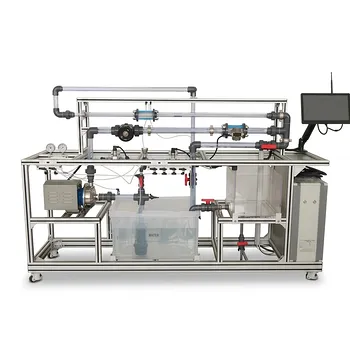
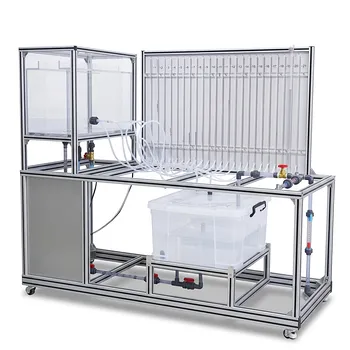
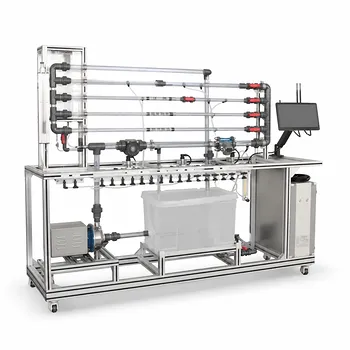
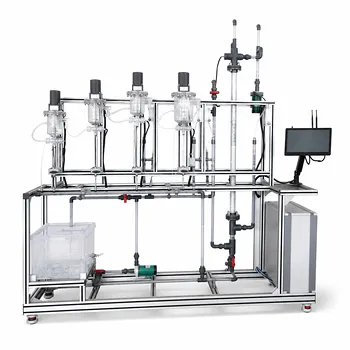
Choosing the right instrumentation is critical to teaching real-world engineering trade-offs. LABPARK designs and manufactures state-of-the-art Educational and Vocational Unit Operations Pilot Plants in chemical engineering, bioprocess & biotech, and environmental & water treatment.
We help universities, research institutes, and enterprises build highly visual, reliable, and energy-efficient training systems tailored to your curriculum and research goals.
Ready to elevate your engineering facility?
Contact LABPARK today to discuss your custom pilot plant requirements and receive a detailed technical proposal.
Related Products
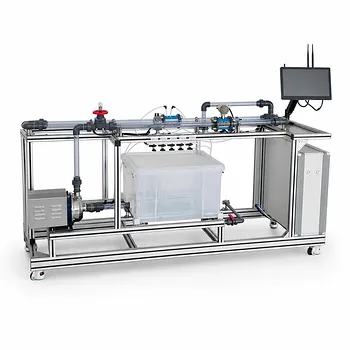
- Orifice and Venturi Flowmeter Calibration Educational Pilot Plant for Fluid Mechanics Laboratory
- Two Phase Flow Pattern Velocity Resistance Measurement Educational Pilot Plant
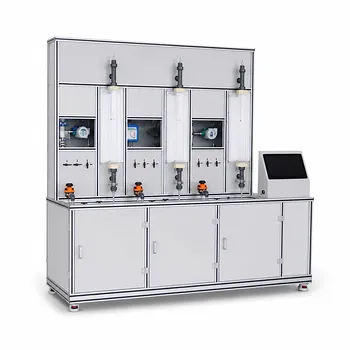
- Quantitative Dosing and Liquid Flow Control Educational Unit Operations Pilot Plant
- Fluid Reynolds Number Demonstration Educational Unit Operations Pilot Plant
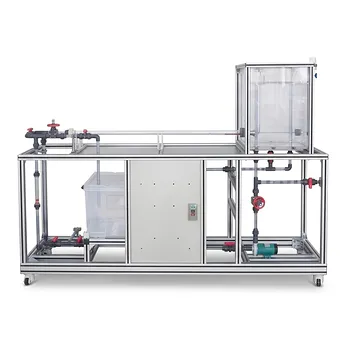
- Centrifugal Pump Performance and Orifice Flowmeter Calibration Educational Pilot Plant
People Also Ask
- What is the difference between static and stagnation pressure? Master Pilot Plant Flow Measurement
- How do pilot plants demonstrate siphon pressure variations? Visualizing Bernoulli's Energy Balance
- How do fluid mechanics training pilot plants facilitate the visualization and calculation of laminar and turbulent flows?
- How to update chemometric calibration models in pilot plants? Best practices for process engineers.
- Why are the laws of similitude critical in fluid flow pilot plants? Scale Up Safely