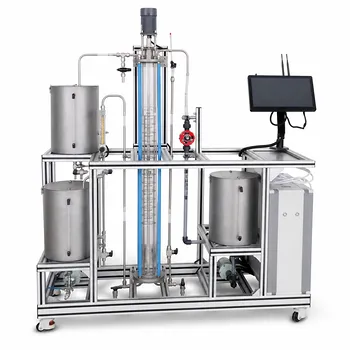
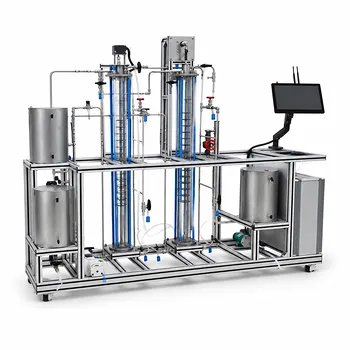
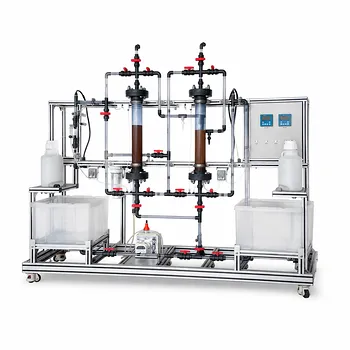
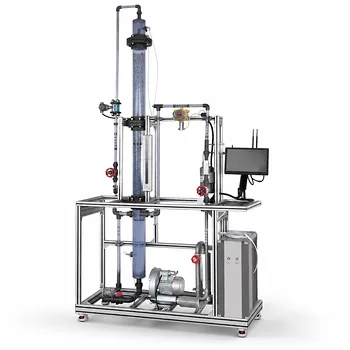
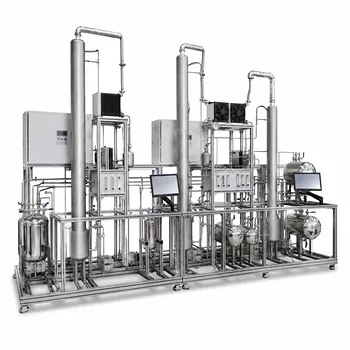
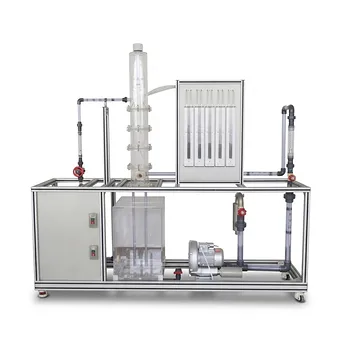
The heart of the decision lies in contact pattern, student forgiveness, and what you want to demonstrate. Plate columns operate with discrete, stage-wise contact—gas and liquid mix and separate on individual trays, creating a clear concentration step at each level. Packed columns use continuous, differential contact where liquid flows as a film over packing material and gas passes through the voids, producing a smooth concentration gradient along the column height. For an educational pilot plant, plate columns deliver great operational flexibility, easy visual learning, and simpler maintenance; packed columns offer far lower pressure drops and higher separation efficiency per meter, but require tighter control over liquid distribution.
The primary operational difference is that plate columns provide a robust, visually intuitive stage-by-stage process ideal for teaching fundamental distillation concepts, while packed columns deliver superior separation performance and minimal pressure drop for advanced studies—but at the cost of added sensitivity and maintenance complexity. Choosing between them means balancing pedagogical clarity against process performance.
The Fundamental Difference: Stage-wise vs. Continuous Contact
Plate Columns: Discrete Steps and Clear Visualization
In a plate column, gas bubbles through a liquid layer held on each tray.
This creates a sharp change in composition from one tray to the next—a true stepwise mass transfer.
Students can literally see the bubbling action, observe liquid levels, and watch how flooding or weeping develops.
Because the behavior is so visible, plate columns are exceptional for teaching concepts like plate efficiency, hydraulic limits, and the physical meaning of a theoretical stage.
They also make manual sampling between stages straightforward, showing how concentration jumps along the column.
Packed Columns: A Smooth, Continuous Gradient
In a packed column, liquid wets the surface of structured or random packing while vapor flows upward through the same void spaces.
Mass transfer happens continuously along the entire packed height, with no distinct breaks.
The result is a smooth composition profile—students measure a gentle gradient rather than step changes.
This makes packed columns perfect for demonstrating Height Equivalent to a Theoretical Plate (HETP) and the impact of mass transfer kinetics under idealized conditions.
The continuous nature also naturally aligns with absorption processes where low liquid loads and a gentle pressure drop are prized.
Key Operational Factors for an Educational Setting
Turndown Ratio and Operational Elasticity
Plate columns keep their efficiency over a much wider flow range because the downcomer seal and tray hydraulics remain functional even at low vapor rates.
This wide operating elasticity (high turndown ratio) means students can experiment with extreme flow variations without the column instantly failing.
Packed columns lose transfer efficiency rapidly at low liquid loads.
When liquid velocity falls too low, the packing surface wets incompletely, causing channeling and severe reduction in mass transfer.
This steep decline in performance demands tighter feed control, which can be frustrating in a teaching lab.
Pressure Drop Characteristics
The pressure drop difference is dramatic. Packed columns typically range from 0.01 to 0.27 kPa per theoretical stage, while plate columns land between 0.4 and 1.1 kPa per stage.
That’s a factor of ten or more, making packed columns the default choice for vacuum distillation demonstrations and energy-sensitive studies.
Low pressure drop also lets students explore how column hydraulics affect boiling point control and energy consumption, connecting directly to industrial vacuum tower design.
Liquid Holdup and Sensitivity to Disturbances
Plate columns hold more liquid on each tray—this high liquid holdup acts as a stabilizing buffer.
It makes the column more forgiving to rapid feed rate or composition changes, which is a huge plus when novices are operating the unit.
Packed columns, with their low liquid holdup, respond quickly to control changes but also react more violently to disturbances.
That can be educationally valuable for teaching dynamics, but it raises the risk of column upsets and makes steady‑state operation trickier for basic lab exercises.
Maintenance, Cleaning, and Fouling
Plate columns are relatively easy to disassemble, inspect, and clean.
Manways allow direct tray inspection, and fouled plates can be scrubbed or replaced individually—perfect for repeated student use and occasional missteps.
Packed columns, by contrast, are not recommended for suspended solids or polymerization‑prone fluids.
Solids can plug the packing, creating dead zones, while polymer fouling permanently destroys packing performance.
For an educational pilot plant that may see a variety of test mixtures, this cleanliness factor can tilt the balance strongly toward trays.
Cost Considerations
Plate columns generally come with lower equipment costs because the vessel is simpler and trays are a mature, standardized technology.
Packing can be expensive—especially high‑performance structured packing—and its cost scales with the material’s corrosion resistance.
In a budget‑conscious academic setting, a tray column with a few valve or sieve trays often delivers more teaching value per dollar.
However, if the curriculum demands a packed column, many pilot plants allow users to swap internals, giving you both worlds without doubling the capital outlay.
Separation Efficiency on a Per‑Height Basis
Packed columns achieve a remarkably higher separation per meter.
Industrial designs frequently exceed 10 theoretical stages per meter of packed height, whereas a typical plate column delivers roughly 2 stages per actual tray.
For an educational unit, this means you can demonstrate very high purity separations in a compact space—but students must grapple with the sensitivity of HETP to pre‑wetting, distribution quality, and flow rates.
It’s a powerful lesson in the trade‑offs inherent in advanced separation design.
Understanding the Trade-offs
No column type is universally superior.
Every advantage carries an operational burden that matters deeply in a teaching environment.
Plate column limitations:
- Higher pressure drop may mask vacuum distillation behavior or distort energy balances.
- Efficiency per height is lower, so the column must be taller for the same separation—impractical for some lab ceilings.
- Tray hydraulics can bring complex failures like weeping, entrainment, and downcomer flooding that require careful troubleshooting.
Packed column limitations:
- Under low liquid loads, wetting becomes incomplete, causing drastic efficiency loss that can mislead inexperienced students.
- Liquid distribution is critical; without a high‑quality distributor, channeling and performance collapse follow.
- Not suited for dirty, solids‑laden, or polymerizing streams—common student test mixtures must be clean and well‑filtered.
- Packing cost and replacement may exceed maintenance budgets, especially if students handle corrosive materials.
The compromise: interchangeable pilot plants.
The best educational investment is often a unit where you can swap between trays and packing (both random and structured).
This lets students directly compare pressure drop, HETP, turndown, and visual behavior on the same system, transforming abstract theory into measurable, memorable insight.
How to Apply This to Your Curriculum
Your choice depends on the fundamental concepts you want students to internalize and the practical constraints of your lab.
- If your primary focus is teaching the basics and ensuring easy operation: Choose a plate column. The wide turndown, visual clarity, and forgiving holdup will keep students engaged without constant intervention, and they can directly observe stage‑by‑stage concentration changes.
- If your primary focus is advanced mass transfer, vacuum distillation, or energy‑efficient design: Integrate a packed column. The low pressure drop and high HETP enable experiments no tray column can replicate, though you must plan for precise liquid distribution and clean feed streams.
- If your curriculum demands a side‑by‑side comparison of both modes: Invest in a pilot plant with interchangeable internals, or run parallel units. This bridges theoretical parameters (plate efficiency, HETP, Fenske‑Underwood shortcuts) with direct operating experience and is the gold standard for comprehensive education.
Empower your students with the right tool for the lesson—plate for robust, visual fundamentals, packed for efficiency‑driven discovery—and they will leave with a deep, practical understanding of mass transfer that no textbook alone can deliver.
Summary Table:
| Operational Parameter | Plate Columns | Packed Columns |
|---|---|---|
| Contact Pattern | Stage-wise (discrete steps) | Continuous (smooth gradient) |
| Visual Learning | Excellent (bubble/liquid levels visible) | Limited (requires measurement of HETP) |
| Pressure Drop | High (0.4 to 1.1 kPa per stage) | Very Low (0.01 to 0.27 kPa per stage) |
| Turndown Ratio | High (forgiving to low flow rates) | Low (prone to channeling/incomplete wetting) |
| Maintenance & Cleaning | Easy (individual trays can be cleaned) | Harder (packing is prone to fouling/blocking) |
Enhance Your Engineering Lab with LABPARK Pilot Plants
Choosing the right column technology is vital for preparing the next generation of engineers. LABPARK designs and delivers industry-grade Educational and Vocational Unit Operations Pilot Plants in chemical engineering, bioprocess & biotech, and environmental & water treatment for universities, research institutes, and enterprises.
Our pilot plants feature customizable and interchangeable column internals, allowing students to compare plate and packed column hydraulics, pressure drops, and efficiencies on a single, robust system.
Boost your curriculum's pedagogical value and operational efficiency—contact our technical specialists today to configure your custom pilot plant.
Related Products
- Continuous Sieve-Plate Distillation Pilot Plant for Unit Operations Laboratory Education
- Multi-Functional Special Distillation Educational Pilot Plant
- Multi-Modal Distillation Unit Operations Training Pilot Plant
- Continuous Batch Extractive Distillation Educational Pilot Plant
- Dual-Mode Rectification Pilot Plant for Practical Training Unit Operations
People Also Ask
- What are the primary reflux ratio control strategies? Master Distillation Unit Operations
- How does catalyst water concentration affect distillation pilot plant design? Key separation train choices.
- Why is vacuum operation capability an essential feature for a distillation unit operations pilot plant? Unlock Efficiency
- How can real-time carbon number prediction improve distillation pilot plants? Optimize control.
- How to select the right activity coefficient model (Wilson, NRTL, UNIQUAC) for distillation pilot plants?