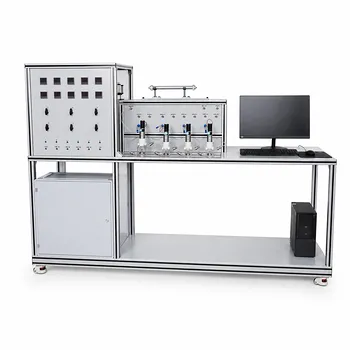
For homogeneous reactions in educational unit operations pilot plants, a PFR generally achieves higher conversion per unit volume than a CSTR for positive-order single reactions, while a CSTR offers easier heat transfer, mixing, instrumentation, and control. For series reactions such as (A \rightarrow P \rightarrow R), a PFR is usually preferred when the objective is to maximize the intermediate (P), because minimizing backmixing reduces its further conversion to (R).
A PFR is the stronger choice for volumetric efficiency and intermediate-product yield; a CSTR is the stronger choice for simple operation, uniform conditions, and teaching heat and mass transfer or process control. A modular educational plant containing both reactor types provides the most useful comparison.
How the Reactors Differ
Continuous stirred-tank reactor operation
A CSTR is continuously mixed, so the concentration and temperature throughout the vessel are approximately equal to those in the outlet stream.
The reaction rate is therefore evaluated at the lowest reactant concentration present in the reactor. For a positive-order reaction, this is generally less favorable than the higher reactant concentration near the inlet of a PFR.
Plug flow reactor operation
A PFR has minimal axial mixing. Fluid enters at a high reactant concentration, reacts progressively along the reactor, and leaves at the target outlet concentration.
Because the reaction rate is typically highest near the inlet, the PFR uses this high-rate region efficiently before the reactant concentration declines downstream.
Why the distinction matters educationally
A CSTR demonstrates steady-state mixing, residence time distribution, dynamic response, and uniform temperature control.
A PFR demonstrates spatial concentration gradients, changing reaction rates, axial temperature profiles, and the relationship between local reaction behavior and total conversion.
Comparing Single-Reaction Performance
Reactor volume for the same conversion
For an isothermal homogeneous reaction with a positive reaction order, a PFR requires less volume than a single CSTR to reach the same conversion under identical feed conditions.
On a Levenspiel plot, the CSTR volume corresponds to a rectangle based on the exit reaction rate. The PFR volume corresponds to the area under the curve, allowing it to benefit from the higher reaction rates near the reactor inlet.
Effect of conversion level
At low conversion, the volume difference between a CSTR and a PFR may be relatively small.
At high conversion, the difference becomes much more significant because the CSTR operates throughout its volume at the relatively low rate associated with the final concentration. For a first-order reaction, for example, the CSTR-to-PFR volume ratio increases substantially as conversion rises.
CSTRs in series
Several CSTRs arranged in series reduce the degree of backmixing compared with one large CSTR.
As the number of stages increases, the overall performance approaches that of a PFR. This makes a staged CSTR system valuable for teaching reactor-network design and showing how equipment configuration affects conversion.
Selecting a Reactor for Series Reactions
Maximizing the intermediate product
For a consecutive reaction,
[ A \rightarrow P \rightarrow R, ]
the desired intermediate (P) can continue reacting to form (R). The reactor must therefore create enough residence time for (A) to form (P) without exposing (P) excessively to the conditions that promote its further reaction.
A PFR is generally preferred because its concentration changes progressively along the reactor, with limited return of downstream material to upstream regions.
Why backmixing can reduce intermediate yield
In a CSTR, the intermediate product is mixed throughout the vessel and is exposed to the same reactor conditions as the outlet stream.
This can cause (P) to remain in contact with the reaction environment after it has formed, increasing its opportunity to convert to (R). Backmixing also prevents the reactor from maintaining the favorable progression of concentrations found in plug flow.
Residence-time control
The best reactor is not determined by flow pattern alone. The residence time must be selected so that intermediate formation is high while secondary conversion remains limited.
An educational PFR allows students to measure conversion and concentration along the reactor length, making this optimum easier to observe experimentally. A CSTR allows comparison with a uniformly mixed system operated at a similar overall residence time.
Choosing for Educational Objectives
When a CSTR is more useful
A CSTR is particularly effective when the teaching objective includes:
- Steady-state material and energy balances.
- Mixing and residence time distribution.
- Temperature control and heat-transfer behavior.
- Dynamic process response.
- Operation under uniform concentration and temperature conditions.
Its well-mixed behavior also simplifies sampling and instrumentation. Students can relate one measured reactor condition directly to the outlet stream and the steady-state design equation.
When a PFR is more useful
A PFR is particularly effective when the teaching objective includes:
- Comparing local and average reaction rates.
- Demonstrating concentration gradients.
- Studying conversion per unit reactor volume.
- Investigating consecutive-reaction selectivity.
- Measuring axial temperature or concentration profiles.
It provides a direct physical demonstration of how reaction conditions evolve through a reactor rather than remaining uniform.
Why a modular plant is often preferable
A pilot plant containing interchangeable or parallel CSTR and PFR modules supports controlled side-by-side experiments.
Students can hold feed flow rate, feed concentration, temperature, and reaction chemistry constant while comparing conversion, residence time distribution, reactor volume, and product composition.
Understanding the Trade-offs
The PFR is not automatically superior
Although a PFR is generally more volume-efficient for positive-order reactions, it may be harder to heat, cool, instrument, and control uniformly.
Temperature excursions can also be more difficult to manage in strongly exothermic reactions because reaction conditions change along the reactor length. Safety systems, material compatibility, pressure control, and reliable temperature measurement remain essential in an educational plant.
The CSTR sacrifices volume efficiency
A single CSTR often requires more volume for the same conversion, particularly at high conversion.
That apparent disadvantage can be acceptable when uniform operating conditions, straightforward control, easy sampling, or strong heat-transfer performance is more important than minimizing reactor volume.
Reaction order changes the comparison
The PFR-versus-CSTR volume advantage described here applies primarily to positive-order reactions. Zero-order or negative-order kinetics can produce different comparisons, so reactor selection should be based on the actual rate law rather than on a general rule.
Intermediate yield depends on kinetics
For (A \rightarrow P \rightarrow R), a PFR is usually advantageous when backmixing promotes the undesired secondary reaction. However, the quantitative optimum still depends on the relative rate constants, reaction orders, temperature, and target operating point.
Pilot plant experiments should therefore measure both conversion of (A) and formation and disappearance of (P), rather than judging performance from conversion alone.
How to Apply This to Your Project
The appropriate selection depends on whether the educational priority is reaction efficiency, intermediate selectivity, controllability, or comparison of reactor fundamentals.
- If your primary focus is high conversion with limited reactor volume: Select a PFR for positive-order homogeneous single reactions, especially at high target conversion.
- If your primary focus is heat transfer, mixing, instrumentation, and process control: Select a CSTR because its uniform concentration and temperature simplify operation and interpretation.
- If your primary focus is maximizing an intermediate in (A \rightarrow P \rightarrow R): Select a PFR and control residence time to limit the subsequent conversion of (P) to (R).
- If your primary focus is demonstrating reactor staging: Use multiple CSTRs in series and compare their performance with a PFR.
- If your primary focus is broad student experimentation: Choose a modular plant with both CSTR and PFR configurations so conversion, kinetics, residence time distribution, and selectivity can be evaluated under matched conditions.
The most informative educational choice is usually not a single “best” reactor, but a safely controlled pilot plant that lets users observe why CSTR and PFR performance diverges.
Summary Table:
| Evaluation factor | CSTR | PFR |
|---|---|---|
| Single-reaction conversion | Usually requires more volume for positive-order reactions | Generally achieves higher conversion per unit volume |
| High-conversion performance | Less efficient as outlet concentration decreases | Maintains higher reaction rates near the inlet |
| Intermediate yield in A → P → R | Backmixing can increase secondary conversion of P to R | Often improves intermediate selectivity through limited backmixing |
| Mixing and temperature | Uniform concentration and temperature; easier to control | Conditions change along the reactor length |
| Heat transfer and instrumentation | Easier sampling, measurement, and heat-transfer control | Requires careful axial temperature and concentration monitoring |
| Educational applications | Material and energy balances, mixing, dynamics, and process control | Kinetics, concentration profiles, conversion, and consecutive reactions |
| Best configuration for broad training | Multiple CSTRs in series demonstrate reactor staging | Modular PFR supports profile and selectivity experiments |
| Recommended use | Choose for controllability, uniform conditions, and simple operation | Choose for volumetric efficiency, high conversion, or intermediate-product yield |
Planning an educational or research-scale reactor system? Contact LABPARK to discuss a modular unit operations pilot plant tailored to your objectives. LABPARK provides Educational and Vocational Unit Operations Pilot Plants featuring CSTR and PFR configurations for homogeneous reaction studies, reactor staging, conversion measurement, residence-time analysis, heat-transfer training, and consecutive-reaction selectivity. Our systems help universities, research institutes, and enterprises deliver practical chemical engineering, bioprocess and biotech, and environmental and water-treatment training with safe, controllable, and repeatable experiments. Tell us your reaction chemistry, teaching or research goals, throughput, and instrumentation requirements, and our team will help identify the right reactor combination and pilot plant configuration.
Related Products
- Multi-Stage Stirred Tanks in Series Residence Time Distribution and Mixing Performance Determination Educational Pilot Plant
- Multi-Reactor Educational Pilot Plant for Reaction Engineering Unit Operations
- Multi Functional Catalytic Reaction and Reactor Evaluation Educational Unit Operations Pilot Plant
- 100L Continuous Loop Hydrogenation Educational Unit Operations Pilot Plant
- Residence Time Distribution and Reactor Flow Characteristics Determination Educational Pilot Plant
People Also Ask
- CSTR Multiplicity: Which physical variables map to universal unfolding?
- How does impeller configuration affect RTD & reactor performance? Optimize mixing and conversion in pilot plants.
- How do multiple CSTRs in series affect stability? Master Complex Pilot Plant Dynamics
- How does MRF model impeller rotation in CFD? Key Boundary Conditions Explained
- How can a CSTR pilot plant demonstrate reactor staging? Visualize volume savings.