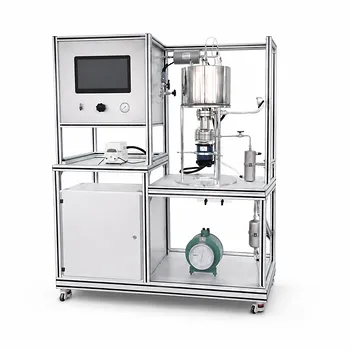
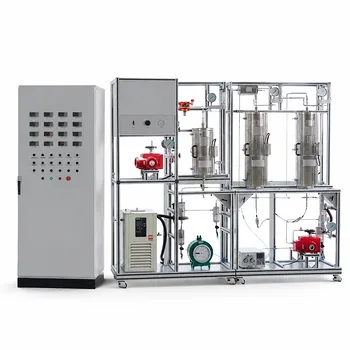
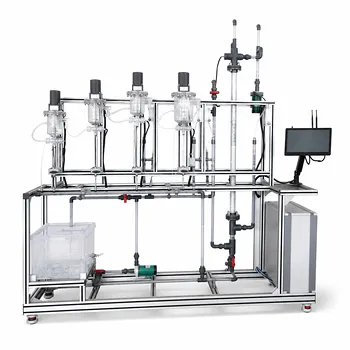
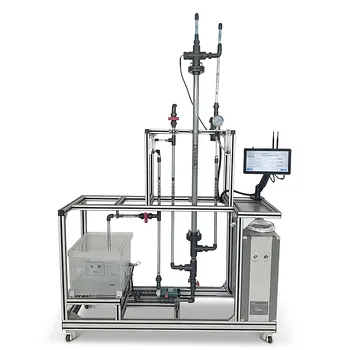
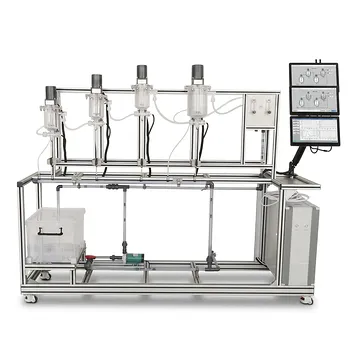
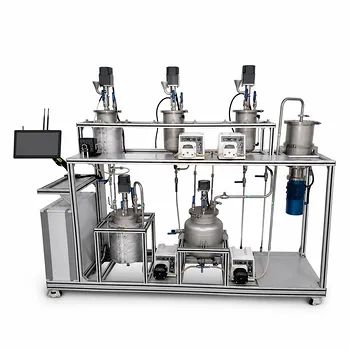
Your pilot plant must be a chameleon for chemistry and a hawk for temperature. For esterification and transesterification kinetics, the non-negotiable features are interchangeable vessels with broad chemical compatibility (like borosilicate glass and specialized alloys) and a precision thermal control system with jacketed heating/cooling and PID controllers. Without these, your kinetic data will be compromised by side reactions, material degradation, or thermal drift.
To extract meaningful kinetic parameters from esterification and transesterification, your pilot reactor must first solve a material puzzle—resisting acid corrosion or base moisture sensitivity—and a control puzzle—maintaining a precise thermal profile to accurately calculate activation energies and prevent runaway exotherms.
Catalyst Compatibility: The Material Foundation of Reliable Kinetics
The heart of your research is the catalyst. The reactor must not react with it or the reaction medium. This isn't just about durability; it's about data purity. If the vessel corrodes or leaches ions, you're measuring decay, not kinetics.
The Acid Challenge: Corrosion as a Data Killer
Acid-catalyzed esterifications often use sulfuric or hydrochloric acid. At elevated temperatures, these become aggressively corrosive. A standard stainless steel vessel can rapidly degrade, contaminating your sample with iron or chromium ions that act as unintended catalysts.
Borosilicate glass is the gold standard here. It offers exceptional corrosion resistance and full visibility into the reaction mixture. This visual insight is invaluable for spotting phase separation, color changes, or crystal formation during kinetic runs.
For high-temperature, uncatalyzed runs approaching 250°C, you need specialized alloys like Hastelloy. These resist acid attack under pressure, but you sacrifice transparency. The primary reference rightly emphasizes having interchangeable vessels to cover this spectrum.
The Base Sensitivity: A Silent Experiment Ruiner
Base-catalyzed transesterifications using sodium methoxide are exquisitely sensitive to moisture. Water saponifies the ester, consuming your catalyst and skewing your yield data. The reactor system must ensure a truly anhydrous environment.
This demands more than just a dry vessel. Consider fittings, seals, and the purge gas system. A reactor with a high-integrity nitrogen blanket and quick-connect couplings for sealed transfers is critical. Materials like 316L stainless steel work well here, but the system's airtightness is the real feature.
Fixed-Bed and Heterogeneous Catalysis
Modern green chemistry routes use solid acid catalysts or ion-exchange resins. Your pilot plant must adapt from slurry reactions to a fixed-bed configuration. This means having a catalytic basket or insert that holds the solids while allowing precise flow and temperature control.
A truly versatile pilot plant will offer a stirred tank base that can accept a fixed-bed head, all within the same thermal jacket. This interchangeability, highlighted in the primary reference, is what lets you explore the full catalytic space.
Thermal Control: The Precision Behind Every Data Point
Kinetics is the study of rate constants, and rate constants are slaves to temperature. The Arrhenius equation demands it. If your temperature control is sloppy, your calculated activation energy is fiction.
Beyond Simple Setpoints: PID and Ramp/Soak Programming
A simple on-off heater won't suffice. You need a PID controller linked to a jacketed vessel and a thermowell positioned directly in the reaction medium. The jacket circulates a heating/cooling fluid, while the PID loop corrects for the reaction's own exotherm or endotherm.
For esterification, which can be moderately exothermic, this active heat removal prevents a thermal runaway that would invalidate a kinetic experiment. The ability to run temperature-programmed steps—like a controlled ramp to study reaction onset—is equally vital for extracting robust kinetic models.
The Information Goldmine: Calculating Activation Energy
Precise, steady-state temperature control lets you run the same reaction at multiple fixed points. The supplementary references correctly note that this directly enables the calculation of activation energy ($E_a$) via an Arrhenius plot. Without tightly maintained isothermal conditions, the error bars on your $E_a$ will be enormous.
Furthermore, the probing thermowell is your truth-teller. Don't trust a jacket temperature; the reaction mixture itself can be at a different temperature due to heat transfer lag. The pilot plant must have a differential measurement capability to quantify this, a key mass transfer parameter.
Understanding the Trade-offs in Reactor Selection
No single pilot plant configuration is perfect. Your choice involves navigating a few fundamental tensions.
- Transparency vs. Pressure/Corrosion Limits: Glass offers visibility and corrosion resistance but is fragile and pressure-limited. Metal alloys handle pressure and bases well but obscure the view and struggle with strong acids unless exotic.
- Slurry vs. Fixed-Bed Versatility: A fully baffled stirred tank optimizes liquid-liquid mixing for homogeneous catalysts. A fixed-bed basket is perfect for solid catalysts. A convertible system is ideal but adds complexity and cost.
- Moisture Sensitivity vs. Ease of Use: A truly anhydrous system with glove-box connections and rigorous purge protocols is tedious to operate. A more open system is simpler but unusable for base-catalyzed kinetics. Compromising here leads to non-reproducible results.
- Thermal Precision vs. System Complexity: Adding a sophisticated circulator, PID controller, and data-logging thermocouples increases the initial setup complexity and points of failure. However, it's the only path to publishable kinetic data.
Making the Right Choice for Your Research Goal
Your specific focus area will dictate which features become non-negotiable. Use these goal-driven recommendations to guide your selection.
- If your primary focus is strong acid (e.g., H₂SO₄) esterification at high temperatures: Demand a borosilicate glass jacketed vessel with a PTFE-covered thermowell. Transparency is critical for observing this often complex, multi-phase chemistry.
- If your primary focus is base-catalyzed (e.g., NaOCH₃) transesterification for biodiesel: Prioritize a moisture-free 316L stainless steel system with a nitrogen purge manifold and sealed transfer ports. The thermal control should include an efficient cooling jacket to handle the reaction's initial exotherm.
- If your primary focus is heterogeneous or green catalyst screening (ion-exchange resins, enzymes): The ability to interchange between a stirred slurry vessel and a fixed-bed catalytic basket is your top feature. This flexibility justifies the added system cost.
- If your primary goal is the rigorous determination of activation energy ($E_a$): Insist on a jacketed reactor with a PID-controlled circulator that has precise ramp/soak programming and a high-accuracy immersion thermowell. Data logging fidelity is paramount.
Ultimately, the right pilot plant doesn't just run reactions—it asks the right questions of them. Prioritize the features that protect the integrity of the answer.
Summary Table:
| Research Focus | Recommended Reactor Setup | Critical Control Feature |
|---|---|---|
| Acid Esterification | Borosilicate glass (PTFE thermowell) | High corrosion resistance & visibility |
| Base Transesterification | 316L Stainless Steel | Moisture-free N2 purge & cooling jacket |
| Heterogeneous Catalysis | Convertible stirred tank / fixed-bed | Catalytic basket & insert compatibility |
| Activation Energy ($E_a$) | Jacketed vessel with PID controller | Precision immersion thermowell |
Elevate Your Research with LABPARK Pilot Plants
Achieving precise, publishable kinetic data requires high-performance equipment designed for chemical accuracy. LABPARK provides premium Educational and Vocational Unit Operations Pilot Plants in chemical engineering, bioprocess & biotech, and environmental & water treatment.
Tailored for universities, research institutes, and enterprises, our pilot plants feature flexible catalyst configurations and industry-leading thermal control to eliminate data drift and material corrosion.
Ready to optimize your laboratory's capabilities? Contact our engineering experts today to find the ideal pilot plant solution for your research goals.
Related Products
- Fixed-Bed Chemical Reaction and Gas Dust Tar Removal Unit Operations Pilot Plant
- Multi-Reactor Educational Pilot Plant for Reaction Engineering Unit Operations
- 100L Continuous Loop Hydrogenation Educational Unit Operations Pilot Plant
- Fixed Bed Gas Solid Catalytic Reaction Educational Pilot Plant
- Internal Circulation Gradient Free Catalytic Reaction Educational Pilot Plant
People Also Ask
- When to transition from PID to adaptive control in pilot plants? Key process indicators.
- How do deviations in estimating latent heat impact pilot plant thermal systems? Avoid hardware mis-sizing.
- Why Compare Predicted and Experimental Excess Enthalpy? Key to Accurate Pilot Plant Scale-up
- How to study gasification in pilot plants? Compare exit gas composition & efficiency
- Why Use PTFE & Hastelloy in Chemical Pilot Plants? Prevent Corrosion & Ensure Safety