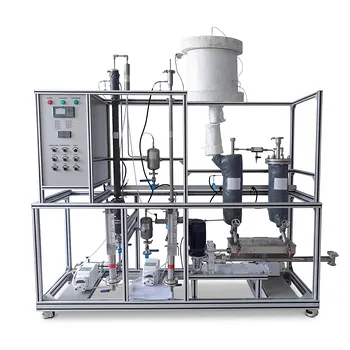
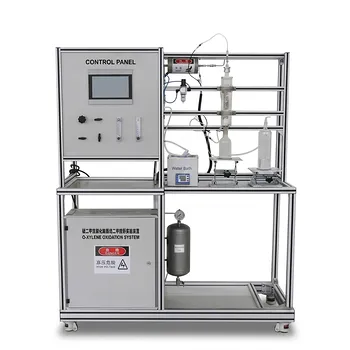
Selecting a reactor for a methanol synthesis pilot plant is essentially choosing your heat management philosophy.
An isothermal reactor uses a jacket or external loop with a heat-transfer fluid to keep the entire catalyst bed at a steady, narrow temperature range—typically 250–255°C. This flat profile yields high single-pass conversion and very low byproduct formation, but it demands a complex cooling infrastructure and high water consumption. A tube-cooled reactor replaces the external jacket with a double-pipe design where the cold feed gas is preheated inside an inner tube while boiling water on the shell side removes the reaction heat. This eliminates external preheaters and recovers energy, but introduces a higher pressure drop and a slightly less uniform temperature profile.
Core Takeaway: An isothermal reactor gives you the cleanest, most controllable temperature environment for studying kinetics and catalyst behavior, while a tube‑cooled reactor is a compact, energy‑integrated design that mirrors industrial practice but trades some temperature uniformity for lower utility demand.
How the Two Reactor Designs Manage Heat
The Isothermal Jacketed Reactor
The catalyst is placed in tubes or a single bed surrounded by a circulating heat-transfer fluid (often boiling water or thermal oil). Because cooling is applied continuously along the entire length, the bed temperature stays almost perfectly flat—no dangerous hot spots. This precision is ideal when you need to isolate kinetic effects, but it comes at a cost: the cooling loop and its water treatment system are complex and utility‑intensive.
The Tube‑Cooled Reactor
Here, the reactor itself becomes a heat exchanger. In a double‑pipe configuration, the cool synthesis gas flows through an inner tube, absorbing heat from the reacting gas flowing in the annular catalyst space. Simultaneously, boiling water on the shell side removes the remaining exotherm. The result is a self‑contained heat recovery loop—no external feed preheater is needed—but the flow path is longer and tighter, causing a noticeably higher pressure drop than an isothermal unit.
Thermal Control: Uniformity vs. Energy Integration
Isothermal Designs Prevent Hot Spots
A flat temperature profile means the catalyst never sees a temperature spike that could sinter it or drive unwanted side reactions. This tight control makes isothermal reactors the gold standard for collecting reproducible, noise‑free data on reaction kinetics and catalyst deactivation.
Tube‑Cooled Designs Embrace a Managed Gradient
The feed preheating step creates an inherent temperature ramp from the inlet to the point where boiling‑water cooling dominates. While still well below damaging levels, this gradient means the catalyst experiences a wider temperature window. For educational purposes, this demonstrates real‑world heat integration, but for pure kinetic research it introduces an extra variable you must account for.
Reaction Efficiency: Conversion, Byproducts, and Hydraulics
Single‑Pass Conversion and Selectivity
Because an isothermal reactor keeps the entire bed in the optimal temperature sweet spot (250–255°C), it consistently achieves high methanol yield per pass with minimal side products like higher alcohols or hydrocarbons. In a tube‑cooled design, the slightly lower average temperature in the preheating zone can reduce the effective per‑pass conversion, though this is often compensated by recycling unconverted gas in a full loop simulation.
Pressure Drop and the Hidden Efficiency Penalty
The tube‑cooled reactor’s narrow annular channels and longer flow path raise the pressure drop significantly. Every extra bar of pressure drop translates to higher compression work in a continuous pilot plant, which can partially offset the energy savings gained from eliminating the feed preheater. In contrast, the more open design of a jacketed isothermal bed typically yields a lower delta‑P, reducing the parasitic load on the recycle compressor.
Understanding the Trade-offs
Operational Simplicity vs. Heat Recovery
An isothermal reactor is conceptually simple—cool the whole bed uniformly—but requires a dedicated cooling water system, circulation pump, and often a steam drum. A tube‑cooled reactor collapses feed‑effluent exchange and steam generation into a single vessel, eliminating several pieces of auxiliary equipment. The trade‑off is that the integrated design is less forgiving to changes in throughput or gas composition, as the preheat and cooling duties are tightly coupled.
Water and Utility Consumption
Isothermal configurations demand high volumes of boiler feed water to remove the reaction heat, and that heat is often rejected to the environment unless you install a separate steam recovery system. A tube‑cooled reactor generates byproduct steam directly from the shell‑side boiling water, turning a waste stream into a useful utility; this mirrors large‑scale methanol plants and demonstrates energy integration principles clearly.
When an Adiabatic Quench Reactor Enters the Comparison
While not the focus of this comparison, many educational pilot plants also include an adiabatic quench reactor with its characteristic saw‑tooth temperature profile. The quench design is mechanically simpler and cheap to build, but it offers uneven temperature control and typically lower per‑pass conversion. Placing it alongside both isothermal and tube‑cooled rigs lets students observe the full spectrum—from staged cold‑shot cooling to continuous heat removal to integrated preheat.
Making the Right Choice for Your Pilot Plant Goal
- If your primary focus is precise kinetic studies and catalyst characterization: Choose the isothermal reactor. Its flat temperature profile eliminates thermal gradients as a variable, letting you collect clean conversion and selectivity data.
- If your primary focus is demonstrating industrial heat integration and energy recovery: Opt for the tube‑cooled reactor. It teaches how feed‑effluent heat exchange and steam generation can be combined into a single unit operation, closely mirroring commercial methanol loops.
- If your primary focus is comparing multiple heat‑removal strategies in one educational platform: Invest in a modular skid that can switch between an isothermal jacket, a tube‑cooled insert, and an adiabatic quench stage, giving students a hands‑on understanding of the engineering trade‑offs.
The right pilot‑plant reactor is not the one with the most features—it is the one that most faithfully answers the specific research question or learning objective you have set out to explore.
Summary Table:
| Feature | Isothermal Jacketed Reactor | Tube-Cooled Reactor |
|---|---|---|
| Temperature Profile | Flat & uniform (~250-255°C); no hot spots | Gradual gradient; inlet preheating |
| Heat Integration | Low; requires external cooling utility | High; self-contained feed-effluent exchange |
| Methanol Yield | High single-pass conversion & selectivity | Slightly lower per-pass; requires recycle loop |
| Pressure Drop | Lower delta-P | Significantly higher due to narrow channels |
| Best Suited For | Kinetic studies & catalyst characterization | Industrial simulation & energy integration |
Optimize Your Chemical Engineering Lab with LABPARK
Choosing the right reactor configuration is critical for accurate research and effective training. LABPARK provides high-quality Educational and Vocational Unit Operations Pilot Plants in chemical engineering, bioprocess & biotech, and environmental & water treatment.
Tailored for universities, research institutes, and enterprises, our modular pilot plants enable hands-on mastery of thermal control, energy integration, and reaction kinetics.
Ready to elevate your teaching and research capabilities? Contact LABPARK today to customize your pilot plant setup!
Related Products
- Methanol Synthesis and Catalyst Performance Evaluation Educational Unit Operations Pilot Plant
- Carbon Dioxide Hydrogenation Methanol Synthesis Educational Unit Operations Pilot Plant
- Carbon Dioxide Hydrogen Methanol Synthesis Educational Unit Operations Pilot Plant
- Methane Cracking Educational Unit Operations Pilot Plant
- Steam Methane Reforming Hydrogen Production and Purification Educational Pilot Plant
People Also Ask
- Why is a purge system necessary when operating a gas recirculation loop in a methanol synthesis pilot plant? (Guide)
- How do temp & pressure affect methanol synthesis pilot plants? Optimize equilibrium and catalyst performance.
- Why do modern methanol pilot plants operate at lower pressures? Catalyst & Feed Requirements Explained
- What are the operational requirements for catalyst activation? Safe Methanol Pilot Plant Operation
- Why Compare Predicted and Experimental Excess Enthalpy? Key to Accurate Pilot Plant Scale-up