Knowledge Environmental and Water Treatment Education Why does magnesium appear in effluent before calcium? Guide to pilot plant ion exchange chemistry
Author avatar

Tech Team · LABPARK

Updated 2 months ago

Why does magnesium appear in effluent before calcium? Guide to pilot plant ion exchange chemistry


Magnesium breaks through first, not by accident, but by chemistry. In a cation exchange pilot plant, magnesium appears in the effluent before calcium as the resin bed nears exhaustion because the resin holds calcium more tightly. While this sequence is a reliable field indicator of bed health, the fundamental driver is not atomic weight, but the difference in how these ions interact with water.

The order of breakthrough is a direct result of ion exchange selectivity. Calcium ions fit better and bind more strongly to the resin’s functional groups. Magnesium, being less preferred, is pushed off the resin first by incoming hardness ions. Understanding this selectivity, not memorizing a weight rule, is what allows you to predict breakthrough and protect downstream equipment.

Decoding the Breakthrough Sequence

The primary goal of a pilot plant is to predict the behavior of a full-scale system. Monitoring which hardness ion appears first gives you a clear signal to start regeneration. To act on that signal, you need the correct chemical reasoning.

Why the Resin Prefers Calcium

The affinity of a strong acid cation resin for one ion over another is called selectivity. For ions with the same charge, the key differentiator is the hydrated ionic radius.

Calcium and magnesium both carry a +2 charge, so charge density alone does not explain the difference. However, a magnesium ion has a stronger electric field at its surface because it is smaller in its unhydrated form. This stronger field attracts water molecules more intensely, creating a larger hydration shell.

The Real Mechanism Behind Magnesium’s Early Leakage

Because calcium’s hydration shell is smaller, it can get closer to the fixed negative charge of the resin’s functional group. This close approach allows for a stronger electrostatic bond.

As the bed becomes saturated during exhaustion, incoming hardness ions must compete for the remaining exchange sites. The incoming calcium ions easily displace the less tightly held magnesium ions. This displacement pushes a wave of magnesium ahead of the primary calcium front, causing magnesium to appear in the effluent first. This is the correct chemical explanation, a nuance often simplified in classroom exercises.

From Theory to Practical Monitoring

A pilot plant’s value is built on translating this theoretical sequence into an actionable operational plan. The moment you see magnesium, you must act.

Plotting the True Breakthrough Curve

A standard breakthrough curve plots concentration against time or bed volumes. You will see two distinct waves:

  • The Magnesium Front: This emerges first, marking the early warning stage. At this point, the bed is still removing the bulk of the calcium.
  • The Calcium Front: This follows later, representing a harder failure where total hardness quickly rises to the inlet level.

Using calcium as your primary monitoring parameter means you are flying blind until the problem is severe. Tracking magnesium gives you a critical process control window.

Understanding the Trade-offs and Limitations

While the selectivity principle is robust, accepting an oversimplified rule can lead to errors. A "higher atomic weight" explanation must be discarded because it fails under other conditions.

Where the Simplified Rule Breaks Down

Pilot plant operators often test different water chemistries. Consider these scenarios where atomic weight would give the wrong prediction:

  • A potassium ion (atomic weight 39) is preferred by many resins over both calcium and magnesium despite its single charge, because selectivity is driven by more than one factor.
  • Different resin types, like weak acid cations, have a vastly different selectivity order, often showing an extreme preference for calcium that has nothing to do with atomic weight.

Factors That Can Shift the Sequence

In a pilot environment, you must be aware that selectivity is not perfectly rigid.

  • Concentration Effects: At very high total dissolved solids (TDS), the selectivity difference between calcium and magnesium diminishes slightly, but the sequence typically remains the same.
  • Resin Cross-Linking: A highly cross-linked resin exerts a stronger sieving effect, which can further exaggerate the preference for the smaller hydrated calcium ion.
  • Temperature: Cold water increases the viscosity of the water and can slow the kinetics of exchange, potentially smearing the magnesium and calcium fronts, making the separation less sharp.

Making the Right Choice for Your Pilot Operation

Your approach to monitoring and control should be directly tied to your pilot's objective. The correct application of ion exchange selectivity will determine the quality of your data.

  • If your primary focus is teaching fundamentals: Use the magnesium-first observation to dismantle the atomic weight misconception. Demonstrate how hydrated radius dictates ion movement, a far more transferable piece of knowledge for your students.
  • If your primary focus is protecting downstream pilot equipment: Set your online hardness analyzers with a magnesium sensitivity. An alarm triggered by the magnesium front gives you ample time to switch columns or initiate regeneration before a full hardness leak causes scaling on membranes or boilers.
  • If your primary focus is optimizing chemical regeneration: Correlate the volume between the magnesium and calcium breakthroughs with your regenerant dose levels. A shrinking gap can be an early indicator of resin fouling or insufficient chemical contact time.

By understanding the "why" behind the sequence, you move beyond simply observing data and start controlling the process.

Summary Table:

Parameter Magnesium ($Mg^{2+}$) Calcium ($Ca^{2+}$)
Hydrated Radius Larger (weaker electrostatic bond) Smaller (stronger electrostatic bond)
Resin Affinity Lower selectivity Higher selectivity
Breakthrough Order First (Early warning indicator) Second (Total bed exhaustion)
Operational Value Triggers regeneration/process control Signals system failure/scaling risk

Optimize Your Water Treatment Research & Training with LABPARK

To effectively study ion exchange kinetics and train the next generation of engineers, you need reliable, high-performance equipment. LABPARK provides advanced Educational and Vocational Unit Operations Pilot Plants in chemical engineering, bioprocess & biotech, and environmental & water treatment for universities, research institutes, and enterprises.

  • Accurate Process Simulation: Replicate real-world industrial phenomena like selective hardness breakthrough and regeneration cycles.
  • Robust Vocational Training: Help students and operators transition from theoretical chemistry to hands-on process monitoring.
  • Tailored Configurations: Custom-engineered systems designed to meet your specific research objectives and academic curricula.

Ready to elevate your laboratory capabilities? Contact LABPARK today to explore our pilot plant solutions!

Related Products

People Also Ask

Related Products

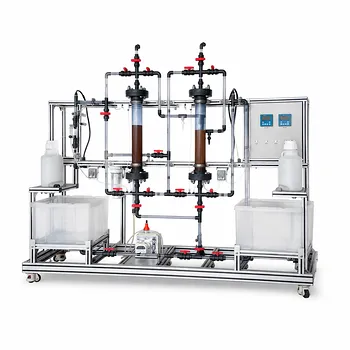
Ion Exchange Water Purification Educational Pilot Plant for Engineering Unit Operations

Ion Exchange Water Purification Educational Pilot Plant for Engineering Unit Operations

This bench-scale ion exchange pilot plant trains engineering students in water purification. Dual transparent columns simulate industrial softening and demineralization. Students observe fluid dynamics, perform resin regeneration, and analyze breakthrough curves. The corrosion-resistant frame ensures durability in unit operations experiments.

Electrochemical Water Treatment Educational Unit Operations Pilot Plant

Electrochemical Water Treatment Educational Unit Operations Pilot Plant

Enhance engineering education with this pilot-scale electrochemical water treatment plant. Designed for hands-on learning of efficient salt removal, electrolytic reactions, and real-time data acquisition. Features multi-mode control, corrosion-resistant PVC, low-voltage safety, and wireless connectivity for modern teaching labs.

Thermal Desorption Exhaust Gas and Tail Water Treatment Educational Pilot Plant

Thermal Desorption Exhaust Gas and Tail Water Treatment Educational Pilot Plant

Bench-scale educational pilot plant for treating thermal desorption exhaust gas and tail water integrates condensation, Fenton oxidation, precipitation, filtration, and carbon adsorption. Ideal for chemical engineering and environmental labs, teaching unit operations, process control, and real-time data analysis.

Alkaline Membrane Water Electrolysis Educational Pilot Plant Unit Operations Training System

Alkaline Membrane Water Electrolysis Educational Pilot Plant Unit Operations Training System

Hands-on educational pilot plant for alkaline membrane water electrolysis hydrogen production, integrating unit operations training with industrial PLC control, real-time data logging, customizable design, durable 316L stainless steel construction, explosion-proof safety, and modern 5G connectivity for university laboratories.

Multi-Functional Special Distillation Educational Pilot Plant

Multi-Functional Special Distillation Educational Pilot Plant

Versatile multi-functional special distillation pilot plant for chemical engineering education. Supports continuous, vacuum, azeotropic, reactive, extractive distillation. Transparent glass columns enable real-time visual observation of hydrodynamics and separation processes.

Continuous Batch Extractive Distillation Educational Pilot Plant

Continuous Batch Extractive Distillation Educational Pilot Plant

Versatile pilot plant for continuous, batch, and extractive distillation training. High-borosilicate glass column for visualizing hydraulics, 15.6-inch touchscreen with data logging, precise reflux ratio control 1-99, and durable corrosion-resistant frame. Ideal for chemical engineering education and process research.

Dual-Mode Rectification Pilot Plant for Practical Training Unit Operations

Dual-Mode Rectification Pilot Plant for Practical Training Unit Operations

Industrial-scale dual-mode rectification pilot plant for chemical engineering practical training. Features real-material and simulated-material operation modes, sieve-plate column with sight glasses for visual observation of hydrodynamics, and customizable SCADA control for safe, hands-on learning of unit operations and mass transfer.

Water Electrolysis Hydrogen Production and Storage Educational Pilot Plant

Water Electrolysis Hydrogen Production and Storage Educational Pilot Plant

Integrated pilot-scale training system for higher education engineering labs. Features AWE/PEM electrolysis, adjustable DC power, PLC controls, gas-liquid separation, and pressurized hydrogen storage. Hands-on learning in green hydrogen, process control, and safety, ideal for chemical and energy departments.

Multi Functional Membrane Crystallization Educational Unit Operations Pilot Plant

Multi Functional Membrane Crystallization Educational Unit Operations Pilot Plant

Integrated bench-scale membrane crystallization pilot plant for engineering education. Provides hands-on training in advanced separation technologies, combining membrane distillation crystallization and process intensification. Features variable scaling vessels, industrial-grade flow control, and interactive digital data acquisition. Customizable for university labs.

Constant Pressure Filtration Educational Unit Operations Pilot Plant

Constant Pressure Filtration Educational Unit Operations Pilot Plant

Hands-on educational pilot plant for constant pressure filtration. Classic plate and frame filter press allows students to study kinetics, determine specific cake resistance, perform cake washing and evaluate washing rates. Ideal for chemical engineering curriculum. Mobile, customizable, safety-compliant design.

Ethyl Acetate Synthesis Unit Operations Pilot Plant for Practical Training

Ethyl Acetate Synthesis Unit Operations Pilot Plant for Practical Training

Modular and customizable pilot plant for ethyl acetate synthesis practical training. Integrates esterification reaction, liquid-liquid extraction, neutralization, and sieve-plate distillation unit operations. Bridging theory and real-world industrial processes. Designed for university chemical engineering labs

Multifunctional Membrane Separation Educational Pilot Plant with Ultrafiltration, Nanofiltration, Reverse Osmosis

Multifunctional Membrane Separation Educational Pilot Plant with Ultrafiltration, Nanofiltration, Reverse Osmosis

An integrated laboratory bench-scale membrane separation system for higher education engineering labs combining Ultrafiltration, Nanofiltration, and Reverse Osmosis processes. Features industrial PLC control with touch-screen HMI, transparent piping, and academic assessment software. Ideal for chemical and environmental engineering curricula.

Fixed-Bed Chemical Reaction and Gas Dust Tar Removal Unit Operations Pilot Plant

Fixed-Bed Chemical Reaction and Gas Dust Tar Removal Unit Operations Pilot Plant

Integrated educational pilot plant for studying catalytic gas-solid reactions and downstream gas purification. Features dual fixed-bed reactor, three-stage heating, and touchscreen control for hands-on engineering training. Ideal for chemical and environmental engineering curricula.

Electrolytic Hydrogen Production Educational Unit Operations Pilot Plant

Electrolytic Hydrogen Production Educational Unit Operations Pilot Plant

Bench-scale electrolytic hydrogen production pilot plant designed for university engineering labs. Provides hands-on training in water electrolysis, gas-liquid separation, and process safety. Fully customizable system with digital PID control, corrosion-resistant components, and hydrogen gas detector. Ideal for chemical engineering curricula.

Electrolyte Distillation Purification and Formulation Educational Pilot Plant

Electrolyte Distillation Purification and Formulation Educational Pilot Plant

Integrated bench-to-pilot scale educational pilot plant for electrolyte distillation, purification, and formulation with borosilicate glass construction, PLC automation, touchscreen HMI, and advanced industrial safety features for hands-on chemical process training, ideal for chemical engineering and materials science curricula.

Natural Product Extraction Unit Operations Training Pilot Plant

Natural Product Extraction Unit Operations Training Pilot Plant

Integrated natural product extraction pilot plant for chemical engineering training bridges theory and industrial practice with modular extraction and evaporation/concentration units, hybrid touchscreen and manual control, realistic process simulation, and self-contained softened water and vacuum utilities.

Carbon Material Thermal Pretreatment Multiphase Separation Educational Pilot Plant

Carbon Material Thermal Pretreatment Multiphase Separation Educational Pilot Plant

Educational pilot plant for carbon material thermal pretreatment and multiphase separation. Features jacketed agitated reactor, separation column, and modern controls for hands-on unit operations training in heat transfer, fluid flow, and process safety with industrial-grade materials and wireless data acquisition.

Comprehensive Liquid-Liquid Extraction Pilot Plant for Engineering Education

Comprehensive Liquid-Liquid Extraction Pilot Plant for Engineering Education

Comprehensive liquid-liquid extraction pilot plant for engineering education, integrating rotary and vibratory columns for hands-on observation of phase behavior, flooding limits, and mass transfer efficiency, enabling precise HTU and mass transfer coefficient calculations.

Multi Functional Catalytic Reaction and Reactor Evaluation Educational Unit Operations Pilot Plant

Multi Functional Catalytic Reaction and Reactor Evaluation Educational Unit Operations Pilot Plant

Bench-scale educational pilot plant for catalytic reaction and reactor evaluation, integrating fixed bed, fluidized bed, and stirred tank reactors. Students compare reactor designs, evaluate catalysts, and study reaction kinetics and hydrodynamics. Perfect for unit operations labs in chemical engineering curricula.

Multi-Functional Membrane Separation Educational Pilot Plant for Unit Operations Lab

Multi-Functional Membrane Separation Educational Pilot Plant for Unit Operations Lab

The Multi-functional Membrane Separation Educational Unit Operations Pilot Plant is an integrated bench-scale laboratory system designed for teaching undergraduate engineering education. It features Ultrafiltration, Nanofiltration, and Reverse Osmosis modules in a compact, mobile unit for practical hands-on learning.


Leave Your Message