The simple answer is that alkaline species in boiler or alkaline water samples will neutralize the very acid produced by the hydrogen-form cation exchange resin, rendering it invisible during titration. In an ion exchange column for total cation determination, water passes through a strong acid cation resin in the hydrogen form (R‑H). The resin swaps H⁺ ions for metal cations (Na⁺, Ca²⁺, etc.) and releases an equal amount of mineral acidity (like HCl or H₂SO₄) into the effluent. You titrate this effluent with a base to calculate how many cations were originally present. If the sample contains alkalinity—hydroxide (OH⁻), bicarbonate (HCO₃⁻), or carbonate (CO₃²⁻)—those anions immediately consume the exchanged H⁺ to form water or carbonic acid (H₂CO₃). Because neither water nor carbonic acid behaves as a strong acid during titration, the apparent acid content drops, severely underestimating the true cation load. Pre‑neutralizing the sample with a standard acid converts the alkaline species into neutral salts, which then react with the hydrogen resin to release a fully titratable mineral acidity. Alternatively, you can mathematically add the sample’s total M‑alkalinity to the titrated effluent value to get the correct total cation concentration.
Even a perfectly operated hydrogen‑form cation column will give a false‑low reading if alkalinity goes unaddressed. The alkalinity in boiler water acts like a hidden acid trap—consuming the exchanged H⁺ before it can ever reach your titration flask. Neutralizing the sample before it hits the resin (or accounting for the M‑alkalinity) is the only way to unlock the true total cation number.
The Core Principle: Hydrogen‑Form Cation Exchange
How the Resin Generates a Measurable Acid
The resin bead holds sulfonic acid groups (–SO₃H). When a neutral salt solution like sodium chloride (NaCl) flows through, the reaction is straightforward:
R‑H + NaCl → R‑Na + HCl
One equivalent of H⁺ is released for each equivalent of Na⁺ captured. The resulting hydrochloric acid can be titrated with a standard base, giving a direct count of the sodium ions that were in the original sample.
The Hidden Trap: Alkalinity Neutralizes the Acid Effluent
Boiler water and highly alkaline process waters contain free OH⁻, HCO₃⁻, and CO₃²⁻. The moment the resin swaps H⁺ for Na⁺ or K⁺, those freed protons encounter the alkaline anions before they can leave the column as a strong acid.
The result is no net mineral acidity from these compounds. The acid is consumed by internal neutralization, so your downstream titration finds nothing to titrate from that portion of the sample.
The Chemical Mechanism Explained
What Happens with Hydroxide
Sodium hydroxide (caustic) is a common boiler water treatment chemical. When a caustic‑containing sample hits the hydrogen resin, two steps occur:
- Ion exchange: R‑H + NaOH → R‑Na + H₂O
- The produced H⁺ instantly reacts with OH⁻ to form water.
There is no residual acid to titrate. Every Na⁺ originating from NaOH is completely “invisible” to the final acid‑base titration.
What Happens with Bicarbonate and Carbonate
Sodium bicarbonate (NaHCO₃) and sodium carbonate (Na₂CO₃) follow a similar pattern:
- R‑H + NaHCO₃ → R‑Na + H₂CO₃
- 2R‑H + Na₂CO₃ → 2R‑Na + H₂CO₃
Again, no strong acid appears. The carbonic acid (H₂CO₃) is a weak acid that barely moves the titration curve; it is not registered as mineral acidity. All those sodium ions slip through without contributing to the titrated acid total.
Why No Acid Appears in the Effluent
The cation resin does its job perfectly—it releases one H⁺ for every cation trapped. But because the alkaline anions are still in the water (they are not removed by the resin), they act as a built‑in acid neutralizer. The net effluent is just neutral water or a weak carbonic acid solution, both of which are invisible to a standard strong‑base titration.
The Solution: Neutralization Before Analysis
Converting Alkaline Species to Neutral Salts
Before the sample touches the resin, you titrate it with a standard acid (e.g., sulfuric acid) to the methyl orange endpoint (around pH 4.3). This step converts all alkaline compounds into inert salts:
- 2NaOH + H₂SO₄ → Na₂SO₄ + 2H₂O
- 2NaHCO₃ + H₂SO₄ → Na₂SO₄ + 2H₂O + 2CO₂
- Na₂CO₃ + H₂SO₄ → Na₂SO₄ + H₂O + CO₂
The sample now contains only neutral sodium sulfate (Na₂SO₄) and is free of OH⁻, HCO₃⁻, and CO₃²⁻. When this neutralized sample passes through the hydrogen resin, the reaction becomes identical to a simple salt:
2R‑H + Na₂SO₄ → 2R‑Na + H₂SO₄
The sulfuric acid is fully titratable, and you can correctly determine the total sodium content—no hidden losses.
Alternative: Mathematical Correction Using M‑Alkalinity
If pre‑neutralization is skipped (or if you want to teach students the principle), you can still recover the correct value by measuring the sample’s total M‑alkalinity separately. The equivalents of alkalinity represent the amount of acid that was neutralized inside the column. Adding those equivalents to the titrated effluent acid gives the true cation count:
True cations (eq) = Titrated acid (eq) + M‑alkalinity (eq)
This method is often used to demonstrate the buffering effect, but it requires an accurate and independent alkalinity determination—a skill students practice regularly in environmental pilot plants using standard acid and a mixed indicator (e.g., methyl red‑bromocresol green).
Understanding the Trade‑offs
Common Pitfalls of Pre‑neutralization
- Over‑titration risk: Adding too much acid before the resin replaces one alkaline problem with an excess‑acid problem, falsely inflating the apparent cation content.
- Sample degassing: Neutralizing carbonate‑rich water releases CO₂. If the sample is not gently boiled or agitated to expel CO₂ before the ion exchange step, the carbonic acid can still interfere with the final titration.
- Time and operator skill: Manual pre‑neutralization adds a step that requires careful endpoint recognition, which can introduce variability in a training environment.
Limits of the Mathematical Correction
- Assumes no interfering substances: The correction only works if all alkalinity is due to OH⁻, HCO₃⁻, and CO₃²⁻. Other buffering species (phosphates, silicates) can contribute to M‑alkalinity and distort the correction.
- Requires an accurate alkalinity value: If the alkalinity titration is rushed, over‑titrated, or affected by sample temperature, the mathematical add‑back will carry that error straight into the cation result.
Making the Right Choice for Your Training Pilot Plant
The approach you choose should align with your learning objectives and operational constraints.
- If your primary focus is teaching the fundamental principle of ion exchange and the hidden alkalinity effect: Perform the analysis without pre‑neutralization and have students calculate the correction. This vividly demonstrates why alkalinity must be accounted for.
- If your primary focus is obtaining the most accurate and straightforward total cation value during a routine plant run: Pre‑neutralize the sample exactly to the methyl orange endpoint with a standardized acid before passing it through the column. This strips the alkalinity and lets the resin do its job without interference.
- If your primary focus is integrating multiple analytical skills (alkalinity titration + ion exchange): Use the mathematical correction method. It reinforces the connection between alkalinity and cation determination and mirrors real‑world troubleshooting when pre‑neutralization is missed.
- If your primary focus is speed and simplicity in a high‑throughput training scenario: Pre‑neutralize directly with a measured excess of acid and back‑titrate. This avoids the uncertainty of a precise endpoint while still destroying alkalinity, though it requires careful blank correction.
Mastering why and how to handle alkalinity in cation exchange analysis transforms a simple column test into a powerful lesson in water chemistry—exactly the kind of insight that turns a pilot plant operator into a true process expert.
Summary Table:
| Alkaline Species | Reaction with Resin (R-H) | Effect on Effluent Titration | Recommended Solution |
|---|---|---|---|
| Hydroxide (OH⁻) | R-H + NaOH → R-Na + H₂O | Protons form neutral water (undetectable) | Pre-neutralize with standard acid to pH 4.3 or apply mathematical correction |
| Bicarbonate (HCO₃⁻) | R-H + NaHCO₃ → R-Na + H₂CO₃ | Protons form weak carbonic acid (undetectable) | Pre-neutralize with standard acid to pH 4.3 or apply mathematical correction |
| Carbonate (CO₃²⁻) | 2R-H + Na₂CO₃ → 2R-Na + H₂CO₃ | Protons form weak carbonic acid (undetectable) | Pre-neutralize with standard acid to pH 4.3 or apply mathematical correction |
Elevate Your Practical Education with LABPARK
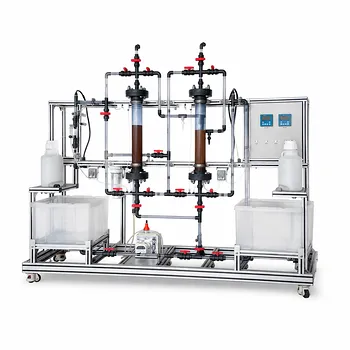
Are you looking to bridge the gap between classroom theory and real-world water treatment operations? LABPARK provides state-of-the-art Educational and Vocational Unit Operations Pilot Plants designed specifically for universities, research institutes, and enterprises.
Our custom-built pilot plants for environmental & water treatment, chemical engineering, and bioprocess & biotech give students and technicians hands-on experience with ion exchange columns, filtration systems, and chemical process control.
- Boost practical learning outcomes with robust, industrial-grade equipment.
- Prepare future engineers with real-world troubleshooting scenarios.
Contact LABPARK today to request a quote and customize your laboratory training plant!
Related Products
- Ion Exchange Water Purification Educational Pilot Plant for Engineering Unit Operations
- Educational Rotary Disc Liquid-Liquid Extraction Pilot Plant
- Absorption and Desorption Educational Unit Operations Pilot Plant
- Comprehensive Liquid-Liquid Extraction Pilot Plant for Engineering Education
- Packed Bed Absorption Educational Unit Operations Pilot Plant
People Also Ask
- How to Prevent Ion Exchange Channeling? Expert Solutions for Pilot Plants
- How does ion exchange work in water treatment pilot plants? Cost & process guide.
- What operational precautions should lab operators take for resin volume changes and air pockets? Key Guide
- How to use ion exchange pilot plants to verify alkalinity? A hands-on guide for engineering students.
- Why does iron degrade cation resin & how to demonstrate capacity recovery? Step-by-Step Lab Guide