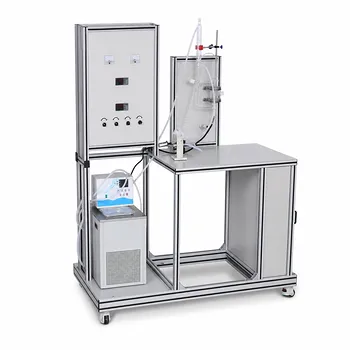
Temperature is the single most dominant process parameter, but its power is fully realized only when orchestrated with two other critical variables: the initial reactant ratio and the membrane contact efficiency.
In a pervaporation-assisted esterification unit, you are not just running a reaction; you are running a hybrid process that couples a reaction with a separation. The parameters that matter most are the ones that simultaneously govern reaction kinetics and separation flux, allowing you to smash through the equilibrium ceiling that normally limits esterification yield.
The core control strategy is to accelerate the forward reaction while maximizing the selective removal of the inhibitory product, water. This shifts Le Chatelier's principle into a dynamic, continuous mode. While temperature is the master lever affecting both, its effectiveness is conditional on the composition you start with and the membrane system's ability to remove the water produced.
The Triad of Primary Control Parameters
Your experimental observations will be a direct consequence of how you manage these three interconnected parameters.
1. Temperature: The Master Kinetic and Thermodynamic Lever
Temperature’s influence is profound because it acts as a dual accelerator. It speeds up the esterification reaction itself, following Arrhenius behavior, and it simultaneously enhances pervaporation performance.
On the reaction side, a higher temperature provides the activation energy needed to form the ester bond, dramatically increasing the rate at which product water is generated.
On the separation side, a higher temperature increases the vapor pressure of the water on the feed side of the membrane. This amplified driving force leads to a significantly higher transmembrane water flux. The faster you remove the water, the more you pull the reaction toward products, creating a virtuous, self-reinforcing cycle.
2. Initial Molar Ratio: The Thermodynamic Starting Point
A slight excess of one reactant, typically the alcohol, is often used to drive the esterification toward completion. However, the pervaporation unit changes this calculus. The primary reference notes a point that requires correction: a perfectly stoichiometric ratio is rarely the ideal for a conventional reactor due to reversible kinetics, but when coupled with water removal, you can operate much closer to stoichiometry.
The deep need here is cost and energy efficiency. Any significant excess of a reactant must eventually be recovered from the product stream in a downstream separation step, which is often expensive and energy-intensive. By using in-situ water removal to achieve high conversion, you can design your initial molar ratio to approach the true reaction stoichiometry, minimizing the burden of post-reaction purification.
3. Membrane Area to Reaction Volume Ratio (A/V): The Flux Multiplier
This is a parameter unique to hybrid membrane reactors. It’s not a typical chemical engineering lever like temperature, but it is equally decisive.
For a batch reactor, the membrane area-to-volume ratio (A/V) directly dictates the system's water-removal capacity. A larger membrane area provides more "gateways" for water molecules to escape the reaction mixture per unit volume, drastically reducing the time needed to reach a target conversion.
For a continuous stirred-tank reactor (CSTR), the equivalent control parameter is the feed flow rate, which dictates residence time. A slower flow rate gives the mixture a longer contact time with the catalytic membrane, allowing for more complete water removal and, therefore, higher per-pass conversion. These parameters, along with the feed channel geometry's hydrodynamics, must mimic industrial conditions to ensure scalable performance data.
Hidden but Essential Enabling Parameters
While the triad above exerts the primary control, two other parameters must be tightly regulated to make their influence possible. They are "enablers" rather than independent drivers.
The Vacuum/Permeate Pressure Setting
The permeate-side pressure is the negative side of the driving force equation. The supplementary references emphasize that permeate-side partial vapor pressure, defined by the total vacuum pressure and condensation temperature, is critical for translation to industrial scale.
A deep vacuum on the permeate side maximizes the partial pressure difference of water across the membrane. If this vacuum is poorly controlled or insufficient, the water flux collapses, the equilibrium shift stops, and temperature and A/V ratio become irrelevant. This parameter must be measured and controlled with high precision.
Hydrodynamics and Concentration Polarization
High conversion isn't just about the bulk mixture's properties; it's about what's happening at the membrane surface. As water is selectively removed, the liquid layer immediately adjacent to the membrane can become depleted in water, a phenomenon called concentration polarization.
Matching the feed flow regime (hydrodynamics) , as noted in the supplementary references, is vital. Sufficient cross-flow velocity over the membrane surface creates turbulence that disrupts this depleted boundary layer, lowering mass transfer resistance and maintaining the effective water flux needed for high conversion. Ignoring this leads to data that underestimates real-world performance.
Understanding the Trade-offs
Optimization is not about blindly maximizing every parameter. It's a negotiation between competing effects.
- Temperature vs. Side Reactions: Exceeding the optimal temperature window, even by a few degrees, can massively accelerate undesirable side reactions that produce colored byproducts or oligomers, degrading product quality and yield.
- Temperature vs. Membrane Stability: A polymeric membrane's selectivity and mechanical integrity are temperature-dependent. Operating near its thermal limit for a short-term flux gain can cause swelling, plasticization, or morphological collapse, leading to a rapid, irreversible loss of water selectivity.
- Excess Reactant vs. Purification Cost: While a high alcohol excess drives conversion, it creates a massive separation problem downstream. The cost of recovering and recycling this excess often negates the yield improvement. The goal is to find the minimum excess that, when combined with pervaporation, achieves the target conversion.
Making the Right Choice for Your Experimental Goals
Your experimental design must reflect your ultimate objective. There is no universal "best" setting, only the optimal combination for your specific goal.
- If your primary focus is maximum reaction rate: Maximize the reaction temperature and ensure your feed flow hydrodynamics are turbulent to minimize concentration polarization. The membrane A/V ratio will then become the bottleneck you must optimize next.
- If your primary focus is achieving a near-100% single-pass conversion: Carefully determine the accurate reaction stoichiometry, start with a minimally excess molar ratio, and rely on a deep, stable permeate vacuum and high A/V to drive the reaction to completion, eliminating the need for a complex product purification train.
- If your primary focus is generating scalable, industrially representative design data: You must replicate the exact feed channel geometry and permeate-side pressure of the target industrial module. Operating temperature and flow rate should then be varied systematically to build an empirical model, as these are the primary knobs an industrial operator will turn.
Mastering a pervaporation-assisted process is about managing these interacting forces, not just monitoring a single readout.
Summary Table:
| Parameter | Role in Pervaporation-Assisted Esterification | Impact on Conversion |
|---|---|---|
| Temperature | Dual accelerator for reaction kinetics and vapor pressure driving force | Single most dominant parameter |
| Initial Molar Ratio | Determines thermodynamic starting point | Maximizes yields closer to stoichiometry |
| Membrane A/V Ratio | Controls system's selective water-removal capacity | Bypasses the reaction equilibrium ceiling |
| Permeate Vacuum | Establishes crucial pressure driving force across membrane | Essential enabler of continuous water flux |
| Hydrodynamics | Minimizes concentration polarization at membrane surface | Maintains peak mass transfer efficiency |
Elevate Your Lab Operations with LABPARK Pilot Plants
Optimizing pervaporation-assisted esterification requires highly precise control over temperature, pressure, and flow rates. LABPARK offers advanced Educational and Vocational Unit Operations Pilot Plants in chemical engineering, bioprocess & biotech, and environmental & water treatment.
Designed specifically for universities, research institutes, and enterprises, our pilot plants bridge the gap between academic theory and industrial reality, providing scalable, high-accuracy experimental data.
Ready to transform your laboratory training and research? Contact us today to request a quote!
Related Products
- Ethyl Acetate Synthesis Unit Operations Pilot Plant for Practical Training
- Educational Pressure Swing Adsorption Ethylene Capture Unit Operations Pilot Plant
- Green Anhydrous Ethanol Purification Extractive Distillation Unit Operations Training Pilot Plant
- Natural Product Extraction Unit Operations Training Pilot Plant
- Supercritical High-Gravity Flash Evaporation Educational Unit Operations Pilot Plant
People Also Ask
- How do pilot plants demonstrate esterification? Visualizing Chemical Engineering Equilibrium
- Why is the chemical plant startup schedule crucial? De-risk scale-up with pilot plants.
- Why are particle density, bulk density & voidage critical in pilot plants? Master Bed Fluid Dynamics
- When to transition from PID to adaptive control in pilot plants? Key process indicators.
- Why Use PTFE & Hastelloy in Chemical Pilot Plants? Prevent Corrosion & Ensure Safety