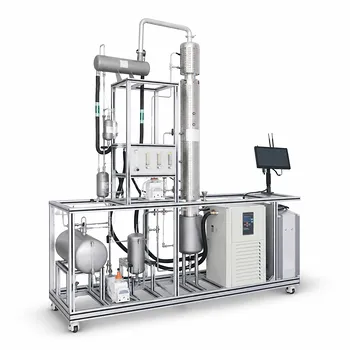
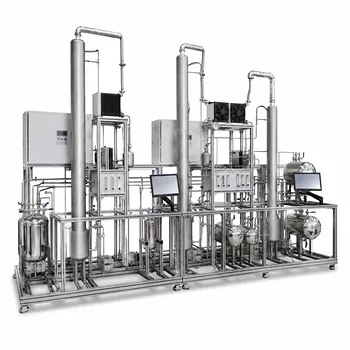
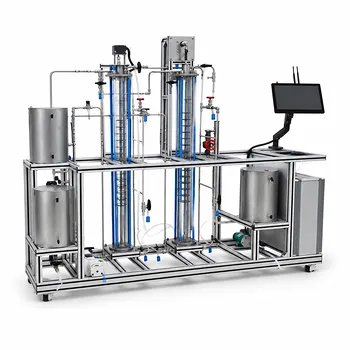
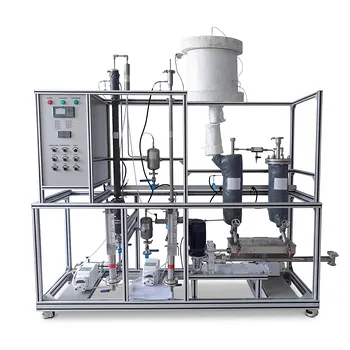
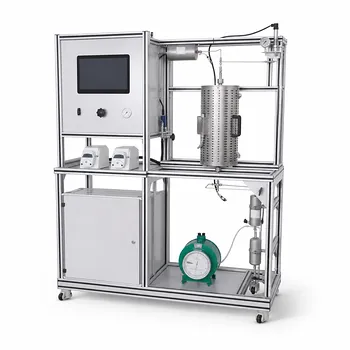
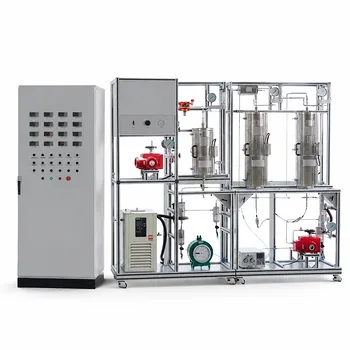
Switching from strip-and-replace to constant-level distillation is not a matter of preference—it’s a decision driven by the separation’s intrinsic difficulty. In a batch pilot plant, strip-and-replace distillation strips away an undesirable solvent to a target volume, then adds a replacement solvent, repeating until the desired composition is achieved. When the relative volatility between the two key components is low (e.g., α ≈ 2.4 for n-heptane over ethanol), this cyclic method becomes highly inefficient. In such cases, constant-level distillation—where fresh solvent is fed continuously to match the distillate removal rate—dramatically improves solvent exchange efficiency and reduces overall cycle time.
The core insight: Strip-and-replace works well when the components separate easily, but constant-level distillation is the superior technique for low-relative-volatility systems, offering over 50% solvent savings and faster turnaround. The threshold for switching sits around α < 5.
Understanding Strip-and-Replace Distillation
The Typical Batch Solvent Exchange Procedure
In a pilot plant, you start by charging the still with the mixture that contains an unwanted solvent.
You then boil the mixture and distill off a portion of that solvent until the liquid volume in the still drops to a predetermined level. After that, you add fresh replacement solvent, and the entire strip-and-add cycle repeats. Over multiple cycles, the still composition shifts gradually toward the replacement solvent, and the target volume is met at the end.
Why It Fails with Low Relative Volatility
Each stripping step removes some of the unwanted solvent, but it also carries away a significant amount of the replacement solvent because they boil at similar temperatures.
With low relative volatility, the vapor you draw off is not rich enough in the component you want to remove. You end up discarding a vapor that still contains a large fraction of the valuable replacement solvent, forcing you to run many cycles and consume excessive amounts of fresh solvent. The process becomes time-consuming and wasteful in both energy and materials.
Understanding Constant-Level Distillation
How Constant-Level Operation Works
Here, the pilot plant is configured to maintain a constant liquid level in the still. A feed pump delivers fresh replacement solvent into the still at exactly the same rate that distillate is being drawn off.
You are simultaneously removing the undesirable solvent and replenishing the still with the replacement solvent. The liquid volume never drops, and the concentration of the unwanted component decreases continuously without the stop‑start cycles of the strip‑and‑replace approach.
The Efficiency Gain: Solvent Savings and Cycle Time
Because the vapor leaving the still is always in equilibrium with a liquid that has a lower concentration of the unwanted solvent, you remove less of the replacement solvent per unit of distillate.
In practice, for systems where relative volatility stays below 5, constant-level distillation can reduce fresh solvent consumption by more than 50%. The continuous operation also shortens the overall batch time, as you eliminate the repeated draining, heating, and mixing cycles.
The Deciding Factor: Relative Volatility
What Is Relative Volatility?
Relative volatility (α) quantifies how easily two components can be separated by distillation. It is defined as the ratio of their volatility coefficients, often simplified to the ratio of their saturated vapor pressures (α = pₐ⁰ / p_b⁰).
An α greater than 1 means separation is possible; the larger the α, the fewer theoretical stages and the lower the reflux ratio you need. When α = 1, the components form an azeotrope and ordinary distillation fails.
How α Shapes the Solvent Exchange Strategy
- High α (α >> 5): The components are easy to separate. A simple strip-and-replace approach works efficiently because almost all of the unwanted solvent vaporizes early, leaving behind the replacement solvent.
- Moderate to low α (α ≈ 2–5): The vapor is only modestly enriched in the unwanted component. Each strip removes a substantial amount of replacement solvent alongside the target, making the cyclic method inefficient.
- Very low α (α → 1): Special techniques like extractive or azeotropic distillation are needed; neither simple batch mode will be effective.
The Threshold: α < 5
The supplementary benchmark of α < 5 is a practical rule of thumb in pilot plant operations. Below this threshold, constant-level distillation becomes the clear winner because it avoids the compounding losses that occur with each strip‑and‑add cycle. The exact crossover point depends on the acceptable solvent consumption and batch time, but the 50% solvent saving figure is a compelling reason to switch.
Understanding the Trade-offs
Equipment and Control Complexity
Constant-level distillation requires precision liquid level control—typically via sensors or mass balance. You need a feed pump that responds dynamically to the distillate rate, which adds complexity and cost to the pilot plant.
Strip-and-replace, by contrast, is simple: you drain the still and manually charge fresh solvent. For teaching basic batch distillation principles, this simplicity can be an advantage.
Impact on Solute Stability and Temperature
In both methods, the still temperature rises as the heavier boiling component dominates, but constant-level distillation maintains a lower peak temperature by continuously diluting the high-boiling residue. This can protect thermally sensitive solutes from degradation—a silent benefit that becomes critical in pharmaceutical or specialty chemical research.
Making the Right Choice for Your Pilot Plant
Every solvent exchange in a batch pilot plant is a balance between simplicity, cost, and separation difficulty. Use these guidelines to decide.
- If your primary focus is an easy separation (α >> 5): Use strip-and-replace distillation. It is simple to implement, requires less control equipment, and works efficiently when the vapor can be highly enriched in the unwanted component.
- If your primary focus is a difficult separation with low relative volatility (α < 5): Switch to constant-level distillation. It will save more than half your solvent, slash cycle time, and deliver the target composition faster.
- If your primary focus is protecting a thermally sensitive solute: Prefer constant-level operation. The lower temperature profile over the course of the batch reduces the risk of thermal degradation.
- If your primary focus is teaching fundamental batch distillation dynamics: Strip-and-replace offers clear, stop‑start cycles that illustrate transient behavior, Rayleigh equation applications, and reflux ratio adjustments.
Ultimately, the decision rests on quantifying your mixture’s relative volatility—let that number guide your pilot plant design.
Summary Table:
| Feature | Strip-and-Replace Distillation | Constant-Level Distillation |
|---|---|---|
| Operation Mode | Cyclic (strip to target, then replace) | Continuous (fresh solvent feed matches distillate rate) |
| Ideal Relative Volatility (α) | High (α > 5) | Low to moderate (α < 5) |
| Solvent Efficiency | Low for low-α systems (high waste) | High (saves >50% solvent for low-α systems) |
| Control Complexity | Low (simple manual/semi-automated control) | High (requires precise level sensors & feed pumps) |
| Thermal Protection | Lower (higher peak temperatures) | Higher (dilutes solute, protecting heat-sensitive compounds) |
Enhance Your Chemical Engineering Lab with LABPARK
Whether teaching the fundamentals of batch distillation or conducting advanced separation research, choosing the right pilot plant configuration is key to efficiency and accuracy.
LABPARK offers premium Educational and Vocational Unit Operations Pilot Plants in chemical engineering, bioprocess & biotech, and environmental & water treatment. Tailored for universities, research institutes, and enterprises, our pilot plants feature the precise control systems needed to demonstrate both strip-and-replace and constant-level distillation effectively.
Contact LABPARK today to discuss your laboratory requirements and get a customized solution!
Related Products
- Continuous Batch Extractive Distillation Educational Pilot Plant
- Continuous Sieve-Plate Distillation Pilot Plant for Unit Operations Laboratory Education
- Multi-Functional Special Distillation Educational Pilot Plant
- Multi-Modal Distillation Unit Operations Training Pilot Plant
- Electrolyte Distillation Purification and Formulation Educational Pilot Plant
People Also Ask
- Wilson vs. UNIQUAC: How to Choose the Right Thermodynamic Model for Your Pilot Plant
- Why use non-ideal VLE calculations in distillation pilot plants? Ensure accurate scale-up & purity
- How does the feed thermal state influence distillation pilot plant design and utility consumption?
- How to Configure a Distillation Pilot Plant? Key Steps for Multi-Mode Setup
- How to Integrate Spectroscopy in Distillation Pilot Plants for Advanced Process Control