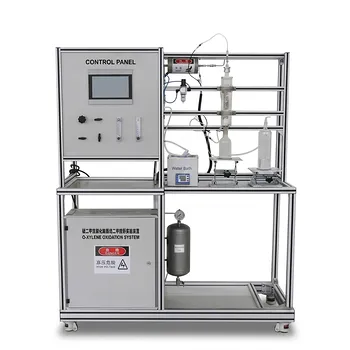
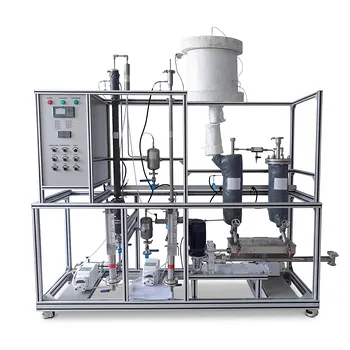
The core challenge of demonstrating free radical polymerization in a pilot plant is not just achieving conversion—it’s surviving it.
The Trommsdorff effect, or autoacceleration, triggers an uncontrolled spike in reaction rate and heat release typically between 20% and 40% monomer conversion. To address this and the resulting thermal runaway risk, pilot‑plant design must center on highly responsive temperature control, aggressive agitation to combat diffusion limitations, real‑time kinetic monitoring, and inherently safe pressure‑relief systems. These elements work together to dissipate the exothermic surge before it can cascade into a dangerous temperature excursion that compromises both safety and product quality.
Autoacceleration creates a positive feedback loop: as viscosity rises, termination slows, more radicals survive, rate and heat generation shoot up—and polymers’ poor thermal conductivity traps that heat. The only reliable defence is a reactor system engineered to detect, dilute, and quench that thermal spike instantly, while providing catastrophic pressure relief as a last resort.
Why Autoacceleration Turns a Demonstration into a Hazard
The Physics of the Trommsdorff (Gel) Effect
In bulk or solution free‑radical polymerizations, at around 20–40 % conversion the growing macromolecules severely restrict the mobility of other large radical chains. This diffusion‑controlled termination causes the termination rate constant (k_t) to plummet. Since the propagation rate constant (k_p) is far less affected, the overall polymerization rate (R_p \propto k_p/k_t^{1/2}) rises dramatically.
Simultaneously, the highly exothermic reaction—typically 15 to 20 kcal per mole of monomer—releases an immense amount of heat. Because the reaction medium now behaves like a viscous, insulating mass, that heat cannot escape quickly. The local temperature rises, which further accelerates the decomposition of initiator and the propagation rate, creating the conditions for thermal runaway.
Why Polymers Make Heat Removal So Difficult
Once the mixture becomes a poor thermal conductor, even well‑designed external cooling jackets struggle. The heat generated at the reaction front must travel through a thermally resistant layer of high‑viscosity fluid. Without mechanical disruption, the core of the reactor can be tens of degrees hotter than the wall within seconds.
Real‑world cases show that for a polymerization like ethylene, the reaction enthalpy is -95.0 kJ/mol, enough to produce an adiabatic temperature rise of roughly 1600 K if left uncooled. Above 570 K, the ethylene itself decomposes exothermically, releasing another -120 kJ/mol—a point‑of‑no‑return that no pilot plant can afford to reach.
Critical Design Features for Safe Pilot Plants
Rapid, Over‑Engineered Temperature Control
A pilot plant must integrate automated cooling jackets that can respond to a temperature spike within seconds, not minutes. Real‑time temperature sensors placed at multiple axial and radial positions feed signals to a control loop that can throttle coolant flow or even inject an inhibitor solution.
The objective is to never let the local temperature deviate more than a few degrees from the setpoint, because the autoacceleration kinetics are exponential with temperature. Early‑warning alarms set just 3–5 °C above normal operation give operators the margin to intervene before the runaway becomes irreversible.
Agitation That De‑insulates the Reaction
Efficient mixing is not just about homogeneity—it’s literally a heat‑transfer enabler. Agitators must be designed and powered to handle the dramatic, non‑Newtonian viscosity increase that accompanies the gel effect.
In pilot plants, this often means heavy‑duty anchor or helical‑ribbon impellers that constantly scrape the wall and transport viscous material from the core to the cooled surface. The power draw can spike rapidly; thus, variable‑speed drives and real‑time torque monitoring are essential. If the viscosity rises faster than the agitator can manage, localized dead zones will form, creating thermal runaways that propagate.
For post‑reaction handling, the same high‑viscosity challenge extends to pumping and conveying. Extruders often serve as both pumps and mixers, and downstream equipment like wiped‑film evaporators must be integrated to remove residual monomer—any leftover reactive mixture can continue generating heat even after the main reactor step.
Inherently Safe Overpressure Protection
When cooling and mixing fail, mechanical safety systems are the last line of defense. Autoclave‑style pilot reactors should be fitted with bursting disks mounted directly to the reactor wall to provide unrestricted relief. These disks act at low overpressures, quenching the decomposition products by rapid venting.
Tubular reactors, which have smaller internal volumes but high surface‑to‑volume ratios, need a different approach. Externally controlled dump valves and bursting disks positioned at multiple points along the tube length ensure that a pressure spike in one section doesn’t travel catastrophically downstream.
Stability Criteria and Real‑Time Kinetic Monitoring
Safe operation doesn’t mean over‑cooling to the point where the reaction quenches. Instead, engineers rely on critical stability parameters to stay inside the safe regime without overly restrictive limits. In tubular reactors, thermal runaway is highly sensitive to a dimensionless heat transfer parameter (effectively the heat transfer coefficient over the Damköhler number). A critical heat‑of‑reaction parameter (B_c) marks the boundary where the second and third derivatives of temperature with respect to conversion vanish; staying above this critical value guarantees stability.
To implement this, pilot plants must continuously monitor the temperature–conversion trajectory and compare it against the known runaway boundary. This requires real‑time inline spectroscopy or calorimetry combined with a validated kinetic model. When the trajectory drifts toward the unstable region, the control system can adjust inlet temperature, coolant flow, or even trigger an inhibitor injection—before the gel effect ever gains momentum.
Understanding the Trade‑offs and Pitfalls
The Cost of Over‑Safety Can Cripple Research
Engineering a reactor to survive every possible runaway scenario can result in such massive cooling capacity and agitation that the experiment no longer reflects real‑world industrial behavior. Exaggerated heat removal can artificially suppress autoacceleration, hiding critical kinetic phenomena that researchers are meant to observe.
The art is to design for a well‑characterized safe operating envelope and use rapid‑acting protection only as a true emergency layer, while still allowing the Trommsdorff effect to manifest in a controlled manner for study.
Sensor and Actuator Latency Is the Silent Killer
A common pitfall is trusting that a fast AI‑driven control loop will compensate for slow hardware. If the temperature sensor has a 5‑second response time and the cooling valve takes another 3 seconds to fully open, a runaway that develops in 2 seconds will not be caught. Pilot plants must select ultra‑fast thermocouples, low‑dead‑volume cooling circuits, and in some cases, pre‑charged quench systems (like inhibitor‑loaded rupture syringes) that can act in under one second.
The Viscosity – Heat Transfer Paradox
As agitation power increases to improve heat transfer, it also introduces shear heating. In highly viscous systems, over‑mixing can actually raise the bulk temperature locally, pushing the reaction closer to a runaway. The agitator design must be sized to maximize convective heat transfer without exceeding the shear rate that would degrade the polymer or overshoot the thermal limit.
Sensitivity to Minor Impurities and Fouling
Pilot plant experiments are inherently “dirtier” than idealized simulations. Feed impurities like ethyne can act as chain‑transfer agents that alter kinetics in unexpected ways, while reactor wall fouling reduces the effective heat transfer area over time. A robust design will incorporate on‑line purity monitoring and periodic cleaning‑in‑place (CIP) capabilities so that the safety critical parameters remain valid run after run.
Making the Right Choice for Your Goal
When building or selecting a pilot plant for a free‑radical polymerization demonstration, the right balance of design features depends on what you need to learn or validate.
- If your primary focus is demonstrating fundamental autoacceleration kinetics: Invest in a highly instrumented, jacketed glass or metal reactor with in‑situ spectroscopy and ultra‑fast temperature sensors. Accept that you’ll need gentle cooling that lets the Trommsdorff effect develop while the safety system catches the spike.
- If your primary focus is scaling up to industrial‑like conditions: Choose a pilot reactor that mimics the geometry and mixing constraints of the production vessel. This often means a tubular or loop reactor with distributed burst disks and dump valves, where you can run close to the critical heat‑transfer parameter boundary to map the safe operating window.
- If your primary focus is maximum inherent safety for student‑operated labs: Over‑specify the cooling and pressure‑relief systems. Use small reactor volumes, pre‑packaged inhibitor quench cartridges, and aggressive automatic shutdown protocols that halt the reaction the instant any temperature excursion is detected—even if that limits the depth of the kinetic study.
By marrying responsive temperature control, purposeful agitation, and a layered safety philosophy, you transform the Trommsdorff effect from a pant‑inducing hazard into a predictable, teachable phenomenon that enriches your pilot‑plant demonstration without ever crossing the line into thermal runaway.
Summary Table:
| Challenge | Key Risk | Pilot Plant Design Solution |
|---|---|---|
| Trommsdorff Effect | Viscosity spike & diffusion-controlled termination | Automated cooling jackets & multi-point temperature sensors |
| Exothermic Heat | Thermal runaway (up to 1600 K adiabatic rise) | Aggressive agitation (anchor/helical impellers) & torque monitoring |
| Overpressure | Reactor explosion / mechanical failure | Direct-mount bursting disks & multi-point dump valves |
| Latency & Fouling | Delayed response & reduced heat transfer | Ultra-fast thermocouples & Clean-in-Place (CIP) systems |
Achieve Safe and Reliable Polymerization Demonstrations with LABPARK
Are you looking to equip your laboratory with safe, high-performance pilot plants? LABPARK provides advanced Educational and Vocational Unit Operations Pilot Plants in chemical engineering, bioprocess & biotech, and environmental & water treatment designed specifically for universities, research institutes, and enterprises.
Our systems feature precision cooling, robust agitation, and multi-layered safety mechanisms to help you study complex kinetics like the Trommsdorff effect without the risk of thermal runaway.
Ready to upgrade your lab's capabilities? Contact LABPARK today to discuss your custom pilot plant requirements with our engineering experts!
Related Products
- Polymerization Granulation and Pellet Processing Educational Unit Operations Pilot Plant
- Internal Circulation Gradient Free Catalytic Reaction Educational Pilot Plant
- Solid Waste Pyrolysis and Refining Educational Pilot Plant for Unit Operations
- Ethyl Acetate Synthesis Unit Operations Pilot Plant for Practical Training
- O-Xylene Oxidation to Phthalic Anhydride Educational Unit Operations Pilot Plant
People Also Ask
- How do educational unit operations pilot plants bridge theory and design? Bridge the Engineering Gap
- How do educational unit operations pilot plants address safety and waste management when scaling up?
- What role do educational pilot plants play in scaling green chemistry? Bridging the Lab-to-Industry Gap
- Why Compare Predicted and Experimental Excess Enthalpy? Key to Accurate Pilot Plant Scale-up
- When to transition from PID to adaptive control in pilot plants? Key process indicators.