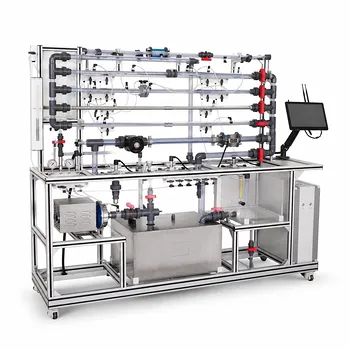
Mastering unit conversions is the critical bridge between textbook theory and the practical reality of a working unit operations pilot plant.
It's important because, while a modern experiment will likely be designed and monitored in SI units (Celsius, bar, L/s), the world it connects to—historical data, commercial equipment specifications, and established industry practice—still speaks the traditional languages of Btu, psi, and centipoise. A lab engineer who cannot instantly translate Btu/h to kW or cP to mPa·s cannot confidently size a pump, validate a heat exchanger’s performance, or interpret a safety data sheet.
The core purpose of a pilot plant is to bridge the gap between lab-scale research and full-scale manufacturing. Being fluent in both SI and traditional units is not a preference—it is a foundational operational skill that prevents costly miscalculations, ensures the correct interpretation of commercial hardware, and cultivates the practical intuition expected of every professional process engineer.
The Dual Language of Process Engineering
A unit operations pilot plant is a physical environment where the clean logic of modern design collides with the messy legacy of real-world infrastructure. This intersection creates a permanent need for bilingual engineers.
The SI Reality of Modern Design
Contemporary education and simulation software work almost exclusively in SI units. Students learn thermodynamics in Kelvin, fluid mechanics in Pascal, and heat transfer in Watts per square meter.
This is the language of fundamental science and removes the friction of arbitrary conversion factors. When you are programming a PID controller, entering a setpoint in °C or a flow rate in L/min is the intuitive path.
The Persistent Legacy of Traditional Units
Decades of invaluable experimental data and the entire installed base of industrial equipment were documented in traditional units. A landmark heat transfer correlation might be expressed solely in terms of Btu/(h·ft²·°F) .
Even today, commercial component catalogs frequently define their performance using traditional measures. A shell-and-tube exchanger’s specification plate, a pressure relief valve from a US supplier, or a pump curve might all show their ratings in psi and gpm, regardless of the modern project using them.
Where These Worlds Collide in the Pilot Plant
The pilot plant is the arena where these two languages must work in unison. Your data logger displays reactor temperature in Celsius, but the jacket sizing calculation on a vendor's spreadsheet requires the duty in Btu/h.
Similarly, you might measure a pressure drop across a filter in bar from a digital sensor, while the safety rating of that filter housing is stamped in psi. Without seamless conversion, you risk either grossly oversizing equipment or, worse, creating a dangerous overpressure scenario.
From Calculation to Commercial Reality: Why Fluency Matters
Moving beyond simple arithmetic, the ability to handle both unit systems is what determines the technical and economic success of pilot-scale work.
Accurate Equipment Sizing and Specification
This is the most direct application. To select a centrifugal pump, you must match its head-flow curve to your system's requirements.
Your process simulation might provide the required net positive suction head (NPSH) in meters. However, the pump manufacturer's datasheet almost certainly provides NPSH in feet of liquid. Converting a gpm target flow to m³/h, and then back to gpm for the specific impeller size, is a moment of truth where a decimal point error can lead to a $5,000 wrong-sized pump.
Interpreting Historical Data and Literature
Innovation is built on past work. A student researching a novel distillation process may find the definitive VLE (Vapor-Liquid Equilibrium) data in an older journal, with viscosity expressed in centipoise (cP) .
To insert this into a modern process simulator that expects milli-Pascal-seconds (mPa·s) , a conversion is unavoidable. More critically, recognizing that 1 cP exactly equals 1 mPa·s is what allows the engineer to instantly validate the model, rather than seeing an unfamiliar number and doubting the data source.
Ensuring Safe Operation and Troubleshooting
Safety interlocks often rely on absolute pressure readings. A high-pressure alarm could be set in bar by an engineer in one lab, but the main utility supply line's pressure gauge in the building might read in psi.
When an alarm triggers at 10 bar, the operating engineer must instantly recognize that this is roughly 145 psi—a number that should match a specific reading on the facility's supply panel—to diagnose whether the problem is a process upset or a loss of utility pressure. Confusion here directly impacts the speed of a critical safety response.
The Hidden Risk of Automated Over-Reliance
Modern software and digital displays offer instant unit switching. While convenient, this creates a new and subtle danger that students and engineers must actively manage via manual competence.
The Automation Trap: Losing Intuition
When a computer does the conversion, the engineer can lose touch with the physical meaning of the number. A heat duty of 34,000 Btu/h might not immediately feel wrong when entered into a simulation, but the 10 kW equivalent will be instantly recognizable as insufficient for the application by an engineer thinking natively in both systems.
The mental act of conversion forces a physical reality check. It is the difference between seeing a value and feeling its scale. This intuition is what detects gross errors that software logic checks might miss.
The Risk of Stacked Tolerances
Conversion factors introduce cumulative rounding errors. If you repeatedly convert back and forth with truncated decimals, your final pump sizing calculation can drift outside the required safety margin.
An engineer fluent in the original units can keep the calculation in its native format for as long as possible, converting only at the final interface. This preserves calculation integrity and is a hallmark of meticulous professional practice.
Making Unit Fluency a Core Competency
Building this skill is a deliberate act of practice, not a passive side effect of using dual-scale instruments.
- If your primary focus is designing new pilot-plant modules: Make a habit of sizing equipment directly from the manufacturer’s native datasheet units. Don't translate the sheet to SI; practice calculating the system curve in both gpm/ft and L/min/meter to build an intuitive feel for order-of-magnitude values in both systems.
- If your primary focus is safely operating an existing plant: Create a handwritten quick-reference card for your specific unit. List the critical alarm setpoints in every unit displayed by all local gauges and digital readouts. This manual act cements the relationship in your mind, making you the most reliable safety layer.
- If your primary focus is on educating future process engineers: Insist on manual calculations before allowing the software's unit-conversion button. A single hand-calculated problem translating a complex heat transfer coefficient from Btu/(h·ft²·°F) to W/(m²·K) teaches more about the physics of convection than a semester of corrected simulations.
The ultimate goal is to develop an engineering instinct so refined that the numbers themselves carry an immediate, correct physical weight, regardless of which unit system first presents them.
Summary Table:
| Measurement Type | SI Unit | Traditional Unit | Typical Pilot Plant Application |
|---|---|---|---|
| Pressure | bar / Pascal (Pa) | psi | Safety relief valves, filter ratings, utility lines |
| Volumetric Flow | L/min / $m^3/h$ | gpm (gallons per minute) | Centrifugal pump sizing and impeller selection |
| Heat Duty | Watt (W) / kW | Btu/h | Heat exchanger performance & jacket calculations |
| Viscosity | mPa·s | cP (centipoise) | Fluid mechanics modeling & VLE data interpretation |
Equip Your Lab for Real-World Engineering Success
Bridging the gap between textbook theory and industrial reality requires the right practical tools. LABPARK provides state-of-the-art Educational and Vocational Unit Operations Pilot Plants across chemical engineering, bioprocess & biotech, and environmental & water treatment.
Designed specifically for universities, research institutes, and enterprises, our modular systems help students and engineers build crucial hands-on skills—from mastering unit conversions to managing real-world scaling challenges safely.
Ready to elevate your training and research capabilities? Contact LABPARK today to find the perfect pilot plant solution for your facility!
Related Products
- Multi-Functional Drying Educational Unit Operations Pilot Plant
- General Purpose Cosmetics Production Unit Operations Training Pilot Plant
- Dual-Mode Rectification Pilot Plant for Practical Training Unit Operations
- Multi-Reactor Educational Pilot Plant for Reaction Engineering Unit Operations
- Multimodal Absorption and Desorption Pilot Plant for Unit Operations Training
People Also Ask
- How do deviations in estimating latent heat impact pilot plant thermal systems? Avoid hardware mis-sizing.
- How to study gasification in pilot plants? Compare exit gas composition & efficiency
- Why Use PTFE & Hastelloy in Chemical Pilot Plants? Prevent Corrosion & Ensure Safety
- Why is the chemical plant startup schedule crucial? De-risk scale-up with pilot plants.
- When to transition from PID to adaptive control in pilot plants? Key process indicators.