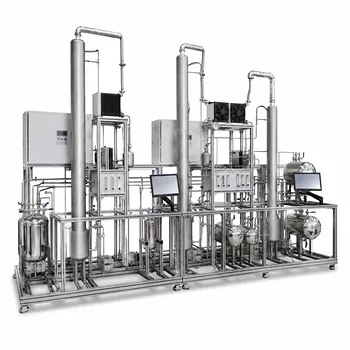
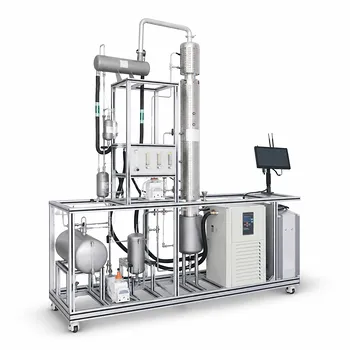
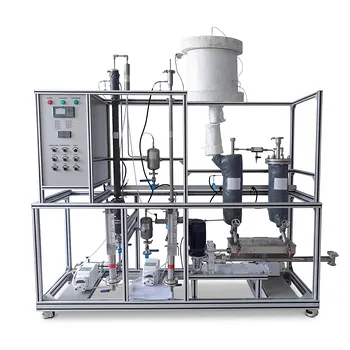
Fermentation temperature control and distillation reflux ratio are the two non-negotiable control parameters that make or break a student’s understanding of biomass-to-ethanol production. The pilot plant must demonstrate a seamless sequence of hydrolysis, fermentation, and rectification, where starch or cellulose is first broken into fermentable sugars, yeast then converts those sugars into dilute ethanol under precisely regulated thermal conditions, and a fractional distillation column concentrates the product to ~95% purity. For university education, these three process steps form the pedagogical backbone, while real-time mastery of fermentation temperature and reflux ratio management in the column deliver the core unit operations learning.
Designing an effective educational pilot plant isn’t about replicating an industrial facility in miniature—it’s about isolating the fundamental mass transfer, reaction kinetics, and process control principles that let students see theory become reality. The minimal viable workflow of hydrolysis, fermentation, and rectification gives them that direct line of sight, with temperature and reflux ratio serving as the primary levers that connect cause to effect.
The Core Process Flow: Three Steps Students Must Inhabit
Hydrolysis: Converting Biomass into Fermentable Sugars
The first stage turns starch or cellulose into glucose.
Without this step, yeast has nothing to eat.
In a teaching plant, the hydrolysis reactor demonstrates how feedstock selection, enzyme or acid dosing, pH, and temperature influence sugar release.
Students can track conversion yields and see the direct link between upstream preparation and fermentation performance.
Fermentation: The Living Heart of the Process
Yeast consumes glucose under anaerobic conditions, producing ethanol and carbon dioxide.
This is where biology meets engineering.
Because yeast activity is acutely temperature-sensitive, even a few degrees outside the optimum—typically around 30–37°C—can stall the culture.
An educational reactor must therefore make temperature trends visible and adjustable, giving students immediate feedback on gas evolution and ethanol titers.
Rectification: Breaking the Azeotropic Ceiling
Dilute beer from the fermenter is fed to a fractional distillation column.
Here, the ethanol is concentrated to approximately 95% (the azeotropic limit) through countercurrent vapor-liquid contacting.
For pedagogy, the column must be transparent enough—either literally or via instrumentation—that students can observe hydraulic loading, weeping, and flooding.
These hydrodynamic phenomena cement the concepts of vapor-liquid equilibrium and mass transfer driving forces.
The Two Essential Control Parameters for Educational Demonstration
Temperature Regulation in Fermentation
From the primary reference, temperature control is the essential parameter during fermentation.
It sustains yeast viability, governs reaction rate, and shapes by-product formation.
A jacketed bioreactor with a feedback temperature sensor and utility water circulation is the standard educational setup.
Students quickly learn that a stable 37°C setpoint isn’t just a number—it’s the difference between a clean ethanol yield and a stuck batch.
Reflux Ratio Control in Distillation
The primary reference identifies reflux ratio as the essential control parameter for rectification.
Increasing the reflux ratio sends more condensed liquid back down the column, enriching the vapor phase and improving separation.
In a teaching context, students manipulate this ratio and immediately see the effect on the overhead ethanol concentration and the column’s temperature profile.
It’s the single most powerful demonstration of the trade-off between product purity and energy consumption.
Expanding the Learning Landscape with Supporting Controls
While temperature and reflux ratio are the cornerstones, a well-rounded educational pilot plant weaves in additional monitoring to build complete process intuition.
Dissolved Oxygen and pH in Fermentation
Aerobic respiration and pH stability are crucial for yeast propagation and batch consistency.
Supplemental references highlight that a DO sensor regulating air sparge rate and pH probes driving acid/base dosing pumps give students hands-on experience with cascade control logic.
These systems turn the fermentation unit into a multi-loop control challenge.
Students learn to interpret dissolved oxygen profiles, titrate pH to optimal levels (often ~4.5–5.5), and understand how microbial metabolism shifts under oxygen limitation.
Column Pressure and Material Balance in Distillation
Steady-state operation demands a stable column pressure and a closed material balance.
Pressure fluctuations distort the vapor-liquid equilibrium relationship, while arbitrary changes in feed, distillate, or bottoms flow rates disrupt internal concentration gradients.
Teaching these interdependencies trains students to think holistically.
They’ll see that a seemingly isolated adjustment—like increasing distillate draw—forces a cascade of temperature and composition changes throughout the column.
Inferential Sensors for Process Intensification
Advanced pilot plants can integrate soft sensors that estimate biomass concentration in real time from temperature, pH, and DO data.
Multivariate models like Principal Component Analysis show how statistical correlations replace expensive or impractical hardware.
This exposes students to Industry 4.0 concepts without obscuring the foundational principles.
It also prepares them for modern bioprocess environments where virtual sensing is routine.
Understanding the Trade-offs
Reflux Ratio Versus Energy Cost
A high reflux ratio yields a purer distillate but demands considerably more reboiler steam and condenser cooling water.
In a teaching environment, students must be guided to find the economical sweet spot—enough stages and reflux to hit the target purity without exaggerating utility loads.
Batch Flexibility Versus Continuous Steady State
Fermentation is inherently batch in many educational setups, while distillation can be run continuously or in batch mode.
Batch distillation teaches the dynamic nature of compositions over time; continuous operation highlights the achievement of a steady-state profile.
Each mode has its own learning objectives.
A flexible pilot plant that supports both helps students grasp transient and equilibrium behaviors equally well.
Direct Measurement Versus Inferential Models
Direct biomass probes are expensive and delicate.
Soft sensors, while elegant, hide the underlying physics unless the model is transparent.
Educators must strike a balance: teach first with hard, interpretable measurements (e.g., optical density, off-gas CO₂).
Then layer on inferential techniques as an advanced module, showing how data-driven approaches complement—not replace—fundamental understanding.
Making the Right Choice for Your Educational Goal
The ideal pilot plant design is not one-size-fits-all; it depends on the core learning outcomes you want to emphasize.
- If your primary focus is basic unit operations mastery: Concentrate on a robust, visually demonstrative setup with hydrolysis saccharification, a jacketed fermenter with tight temperature control, and a glass fractional distillation column where reflux ratio can be manually adjusted and its impact instantly observed.
- If your primary focus is modern bioprocess control and Industry 4.0 skills: Supplement the core units with full P&ID-based automation, pH/DO loops, column pressure control, and a soft sensor module that teaches multivariate modeling. This broadens the parameter space but adds complexity.
- If your primary focus is downstream processing integration: Extend the plant with a vacuum evaporation unit and a chromatography column after distillation, showing the complete purification train. This illustrates how ethanol recovery fits into a larger bioseparations curriculum.
- If your primary focus is safe, budget-conscious operation: Strip back to the essentials: a simple stirred-tank fermenter with a reliable temperature controller and a packed distillation column with a reflux splitter. Steam distillation can be added to teach specialized separations without high-pressure hazards.
Pilot plant design for education is a story you ask students to live. Make sure the chapter they inhabit—whether it’s a single temperature loop or a full inferential control exercise—leads them to the same unmistakable truth: seeing the principles in action is what turns raw bioprocess knowledge into lasting engineering judgment.
Summary Table:
| Process Step | Core Objective | Key Control Parameter |
|---|---|---|
| Hydrolysis | Convert biomass into fermentable sugars | Dosing, pH, and temperature |
| Fermentation | Convert sugars to dilute ethanol via yeast | Jacketed temperature control (30–37°C) |
| Rectification | Concentrate ethanol to ~95% purity | Column reflux ratio |
| Monitoring | Ensure process stability and cascade logic | Dissolved oxygen, pH, and column pressure |
Elevate Engineering Education with LABPARK
Ready to bring theoretical mass transfer and reaction kinetics to life? LABPARK provides premium Educational and Vocational Unit Operations Pilot Plants in chemical engineering, bioprocess & biotech, and environmental & water treatment.
Tailored for universities, research institutes, and enterprises, our systems offer:
- Interactive Learning: Transparent columns and reactors that make fluid dynamics, weeping, and flooding visible.
- Precise Process Control: Industrial-grade control loops for temperature, reflux ratio, pH, and dissolved oxygen.
- Customizable Configurations: Flexible designs ranging from basic manual operations to advanced Industry 4.0 auto-control setups.
Contact LABPARK today to design the perfect pilot plant for your training and research goals!
Related Products
- Bio-fermentation Ethanol Production Practical Training Unit Operations Pilot Plant
- Green Anhydrous Ethanol Refining Practical Training Pilot Plant
- Green Anhydrous Ethanol Purification Extractive Distillation Unit Operations Training Pilot Plant
- Ethyl Acetate Synthesis Unit Operations Pilot Plant for Practical Training
- Multi-Functional Special Distillation Educational Pilot Plant
People Also Ask
- Why Use PTFE & Hastelloy in Chemical Pilot Plants? Prevent Corrosion & Ensure Safety
- Why Compare Predicted and Experimental Excess Enthalpy? Key to Accurate Pilot Plant Scale-up
- Why is the chemical plant startup schedule crucial? De-risk scale-up with pilot plants.
- When to transition from PID to adaptive control in pilot plants? Key process indicators.
- Why must batch and fed-batch fermentation pilot plants be designed to accommodate changing rheological conditions?