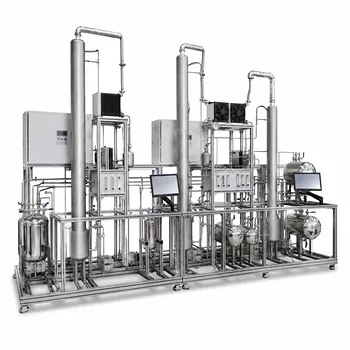
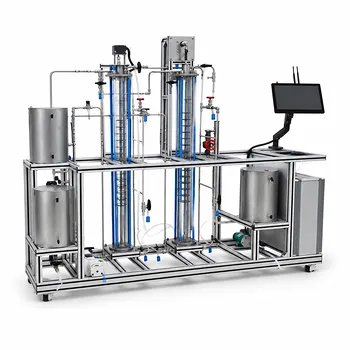
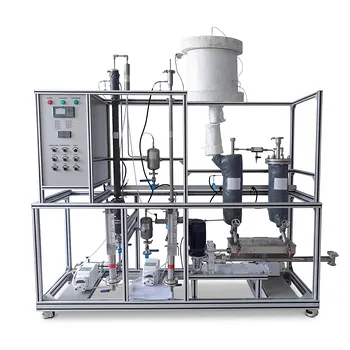
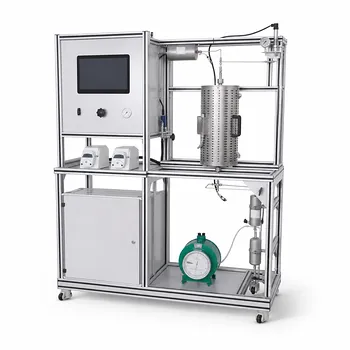
The choice isn’t about which column is “superior”—it’s about which matches your lab’s mission.
In a chemical engineering unit operations lab, a batch distillation pilot plant is preferred when your goals demand high flexibility for small, multi-product runs, the ability to handle fouling or variable-composition feeds, a single column that can separate multiple components sequentially, and an experimental platform that naturally teaches transient, unsteady-state process dynamics. It excels where continuous distillation’s steady-state paradigm and fixed two-product architecture would be a liability.
While continuous distillation dominates large‑scale commodity production, the batch pilot plant is purpose‑built for educational versatility and research agility. A single batch column can accomplish what would require multiple continuous columns in series—enabling multi‑fraction separations, safe handling of problematic feeds, and vivid demonstration of time‑dependent control strategies, all within a compact footprint.
The Core Drivers for Choosing Batch in a Unit Ops Lab
Unmatched Flexibility for Multiple Products and Small Batches
Batch distillation shines when you must process small, varying quantities of different mixtures using the same equipment.
By collecting fractions sequentially—from lights to heavies—one column can isolate multiple high-purity cuts without reconfiguration. This makes it ideal for campaign‑based research, pharmaceutical intermediates, or teaching diverse chemical formulations.
Varying Feed Compositions Without Redesign
In batch operations, the reflux ratio can be adjusted dynamically as the still pot composition changes.
This inherent adaptability means you can feed off‑spec or inconsistent streams into the same unit without pre‑engineering a dedicated continuous train. For academic labs that explore a wide range of experimental conditions, this tuneability is invaluable.
Safe Handling of Fouling, Solid‑Laden or Polymerizing Feeds
Continuous columns rely on feed preheaters, distribution plates, and downcomers that are prone to plugging with tars, suspensoids, or sticky materials.
A batch still eliminates these fragile internals; the charge is simply heated in the pot. This makes it the only safe choice for realistic pilot‑scale study of feeds that would cripple a continuous system—think coal tars, bio‑oils, or resin‑forming monomers.
System Simplicity and Smaller Footprint
A batch pilot plant requires significantly less ancillary hardware: no continuous‑feed pumps, level controllers, or complex reboiler‑surge tank arrangements.
For a teaching lab, this translates to lower capital cost, easier maintenance, and faster turnaround between experiments. You gain a fully capable distillation workstation without the sprawling pipe‑rack of a multi‑column continuous setup.
The Educational and Research Advantage
Teaching Transient Process Dynamics First‑Hand
Unlike the steady‑state world of continuous distillation, batch distillation is an intrinsically unsteady‑state process.
Students can watch column temperatures, compositions, and holdup evolve in real time. This invites exploration of critical concepts: variable vs. constant reflux strategies, composition front movement, and the effect of holdup on separation—all impossible to grasp on a purely steady‑state rig.
Demonstrating Multi‑Component Separation in a Single Column
A continuous distillation column typically yields only two product streams (distillate and bottoms).
To fractionate a ternary or quaternary mixture continuously, you’d need multiple columns in series. A single batch column, however, can sequentially draw off multiple high‑purity fractions during one operating cycle. This drastically cuts equipment cost and lab space while illuminating the principles of batch‑time optimization and cut‑point selection.
Understanding the Trade‑offs: When a Batch Pilot Plant Falls Short
It Will Not Teach Steady‑State Industrial Operations
Continuous distillation is the backbone of 24/7 commodity production with 90–95% utilization.
If your educational objective is to train students on steady‑state material and energy balances, continuous‑control loops, and large‑scale throughput, a batch pilot plant cannot substitute. It may even create misconceptions if not paired with continuous‑mode exposure.
Unsteady‑State Complexity Can Overwhelm Beginners
While batch equipment looks simpler, its dynamic behavior introduces control challenges.
Without careful reflux programming, product purity drifts, and students may struggle to decouple holdup effects from true separation. For a first‑semester unit ops course, that complexity can obscure the core distillation principles unless properly scaffolded.
Throughput Doesn’t Scale
Batch distillation is inherently limited in capacity per unit time.
If your research demands kilogram‑scale high‑purity products daily, a continuous micro‑plant may offer better productivity. Recognize that the batch plant’s value is versatility and clarity, not high‑volume output.
Making the Right Choice for Your Lab’s Goals
The best pilot plant is the one that most directly serves your learning outcomes and research demands. Use these priorities as your guide:
- If your primary focus is teaching fundamentals of process control and unsteady‑state dynamics: A batch distillation pilot plant’s evolving composition and temperature profiles provide a living textbook for transient operation—no other device matches this pedagogical value.
- If your primary focus is processing diverse, small‑batch R&D samples or specialty chemicals: The ability to sequentially separate multiple fractions in a single, easily cleaned unit gives you a research multiplier that a dedicated continuous train cannot offer.
- If your primary focus is handling sticky, fouling, or heat‑sensitive feeds safely: Eliminate the internal hardware that would clog or degrade—choose a batch still to enable realistic study of challenging streams without risky workarounds.
- If your primary focus is replicating 24/7 industrial commodity production and steady‑state control: A continuous distillation system becomes necessary; for maximum flexibility, consider a modular pilot plant that can be reconfigured to operate in both batch and continuous modes.
Anchor your decision in the specific learning or research outcomes you must deliver, and you’ll build a lab that isn’t just equipped—it’s empowered to turn curiosity into competence.
Summary Table:
| Decision Factor | Batch Distillation Pilot Plant | Continuous Distillation System |
|---|---|---|
| Product Flexibility | High; separates multiple fractions sequentially. | Low; fixed two-product separation per column. |
| Feed Adaptability | Excellent; handles variable or fouling feeds easily. | Low; requires consistent, clean feed streams. |
| Educational Value | Unsteady-state dynamics & transient controls. | Steady-state mass/energy balances & continuous loops. |
| Lab Footprint & Cost | Compact; fewer ancillary pumps and controls. | Larger; complex plumbing and continuous control systems. |
Are you designing or upgrading your chemical engineering laboratory? LABPARK provides premium Educational and Vocational Unit Operations Pilot Plants in chemical engineering, bioprocess & biotech, and environmental & water treatment for universities, research institutes, and enterprises. We help you select and configure the ideal pilot systems to match your teaching curriculum and research goals.
Contact LABPARK today to get a customized proposal and expert engineering guidance for your facility!
Related Products
- Continuous Batch Extractive Distillation Educational Pilot Plant
- Continuous Sieve-Plate Distillation Pilot Plant for Unit Operations Laboratory Education
- Multi-Functional Special Distillation Educational Pilot Plant
- Multi-Modal Distillation Unit Operations Training Pilot Plant
- Green Anhydrous Ethanol Purification Extractive Distillation Unit Operations Training Pilot Plant
People Also Ask
- Wilson vs. UNIQUAC: How to Choose the Right Thermodynamic Model for Your Pilot Plant
- How does the feed thermal state influence distillation pilot plant design and utility consumption?
- Why use non-ideal VLE calculations in distillation pilot plants? Ensure accurate scale-up & purity
- How to Configure a Distillation Pilot Plant? Key Steps for Multi-Mode Setup
- How to Integrate Spectroscopy in Distillation Pilot Plants for Advanced Process Control