In chemical engineering pilot plant laboratories, the weighing method is the definitive standard for calibrating volumetric glassware because it directly converts the mass of pure water into a highly accurate volume. This gravimetric approach is essential for eliminating systematic errors during mass balance calculations, reaction yield determinations, and process efficiency validations. To achieve this precision, three key environmental variables must be carefully corrected: the temperature‑dependent density of water, the buoyant effect of air on the balance, and the thermal expansion of the glass vessel itself.
The weighing method’s accuracy depends on the fact that mass is a fundamental, traceable quantity. However, simply weighing water is not enough—you must correct for how temperature changes the water’s density, the air’s buoyancy, and the glass’s dimensions. Using a single correction factor, (K(t)), bundled from these three effects streamlines the process and aligns the measured volume with the international standard reference temperature of 20 °C.
The Critical Role of Accurate Volumes in Pilot Plant Operations
Why Calibration Is Not Optional
Pilot plants bridge the gap between bench‑scale chemistry and full‑scale production. Every mass balance, every yield calculation, and every concentration reported to stakeholders relies on the assumption that the “delivered” or “contained” volume is exactly what the glassware’s nominal mark indicates.
Manufacturing variances, minor wear, and improper cleaning cause volumetric glassware to deviate from its stamped value. Without calibration, those tiny deviations propagate through an entire experimental campaign, distorting kinetic data, altering stoichiometric ratios, and undermining process scale‑up decisions.
The Connection to Chemical Engineering Fundamentals
In unit operations, material‑balance closure is the first check of process integrity. An uncalibrated 500 mL volumetric flask could actually contain 501.5 mL. Over dozens of dilutions and transfers, that error compounds, leading to false conclusions about reaction conversion or separation efficiency. The weighing method offers a direct, physics‑based path to eliminate this uncertainty at its source.
Why the Weighing Method is Preferred for Volumetric Calibration
Direct Traceability to a Primary Standard
Mass is the most reliably traceable measurement in a laboratory. A calibrated analytical balance compares the weight of the water to certified masses, creating an unbroken chain of traceability to national standards. Volume, by contrast, is a derived quantity with no practical absolute reference of comparable accuracy for small‑scale liquid handling.
Minimizing Systematic Errors in the Lab
Relative methods (e.g., comparing volumes between two vessels) can hide cumulative errors. The weighing method is absolute—it measures the true mass of water delivered or contained, then corrects for physics. This makes it the benchmark technique referenced by international standards like GB/T 12810‑2021, ensuring results are reproducible across different laboratories and operators.
The Three Temperature‑Dependent Variables You Must Correct
1. Density of Pure Water
Water’s density changes significantly with temperature. Without correction, a 1 °C deviation can alter the calculated volume by roughly 0.02 %—enough to affect high‑precision analyses. At 20 °C water’s density is about 0.9982 g/mL, but at 25 °C it drops to 0.9970 g/mL. The weighing method must use the exact density value corresponding to the water temperature measured during the calibration.
2. Air Buoyancy Acting on the Balance
A balance determines the apparent mass of an object, not its true mass, because the object displaces air. Water weighed in air experiences an upward buoyant force, making the reading slightly lighter. The magnitude depends on the density of the air (a function of barometric pressure, temperature, and humidity) and the density of the calibration weights. Failing to account for air buoyancy introduces a small but systematic error—often in the range of 0.1 % under standard conditions.
3. Thermal Expansion of the Glass Vessel
Volumetric glassware is calibrated to “contain” or “deliver” a specific volume at the reference temperature (typically 20 °C). If the glassware is at a different temperature during calibration, the glass itself expands or contracts. The cubic thermal expansion coefficient for borosilicate glass is approximately (2.5 \times 10^{-5}\ \text{°C}^{-1}). That means a 10 °C temperature shift alters the internal volume by about 0.025 %, a factor that must be corrected to avoid misaligning the vessel’s true capacity with the nominal mark.
Using Correction Factors and (K(t)) Tables
One Factor to Bundle the Three Effects
Rather than solving each variable separately, engineering standards provide a composite correction factor, (K(t)). (K(t)) encapsulates the combined influence of water density, air buoyancy, and glass expansion at a measured water temperature. The true volume at 20 °C is then simply: [ V_{20} = m_{\text{water}} \times K(t) ] where (m_{\text{water}}) is the apparent mass of the water weighed in air.
Practical Implementation
- Measure the temperature of the water immediately after collection or delivery (preferably to ±0.1 °C).
- Look up the corresponding (K(t)) from standard tables (e.g., those embedded in ISO 4787 or GB/T 12810‑2021).
- Multiply the mass by (K(t)) to obtain the calibrated volume at 20 °C.
- Always allow the apparatus and water to equilibrate to the room’s temperature before starting. A draft‑shielded balance further improves stability.
Common Pitfalls and Trade‑offs When Using the Weighing Method
Poor Cleaning and Preparation
Residual grease, dried salts, or water droplets alter the wetting behavior of glassware. Contain‑type vessels (volumetric flasks) must be completely dry before calibration; delivery‑type vessels (pipettes, burettes) need to be thoroughly rinsed but left wet. Any contamination changes the effective volume and renders the correction factors invalid.
Mixing “To Contain” and “To Deliver” Glassware
Volumetric flasks are calibrated TC (to contain). They are not designed to deliver that volume externally—the thin liquid film left behind makes the delivered amount less. Using a TC vessel as a delivery device introduces a systematic offset that no weighing correction can fix. Always calibrate and use glassware for its intended designation.
Time and Environmental Stability
The weighing method is precise but demanding. It requires a vibration‑free balance, steady temperature, and multiple repetitions to achieve the lowest uncertainty. In a busy pilot‑plant environment, this can be a throughput bottleneck. For routine checks where 0.1 % accuracy suffices, simpler relative methods may be adequate, but for calibration certificates and master standards, gravimetry is indispensable.
Making the Right Choice for Your Calibration Protocol
The weighing method should be your default when volumetric accuracy directly impacts critical process indicators. Adjust the frequency and rigor based on your operational risk tolerance.
- If your primary focus is certified master glassware and uncertainty below 0.1 %: Use the full gravimetric method with temperature, buoyancy, and glass‑expansion corrections per GB/T 12810‑2021. Document the water temperature to ±0.1 °C.
- If your primary focus is routine in‑lab checks of frequently used pipettes: Adopt a simplified gravimetric check using a pre‑calculated (K(t)) factor, but still enforce strict cleaning and temperature equilibration. Record any deviation from the nominal volume to set re‑calibration thresholds.
- If your primary focus is training or educational unit operations: Prioritize teaching the physics behind the three corrections. Even if time does not permit a full gravimetric calibration every session, ensure students understand why the weighing method is the reference and what errors occur when its corrections are ignored.
Remember, in chemical engineering pilot‑plant science, precision is not a luxury—it is the foundation of every safe scale‑up. The weighing method, correctly applied, transforms a simple flask into a trustworthy metering device that protects your data integrity from the very first experiment.
Summary Table:
| Variable | Physical Effect | How to Correct |
|---|---|---|
| Water Density | Density changes with temperature (e.g., drops ~0.02% per 1°C rise). | Measure water temperature and use density tables or the $K(t)$ factor. |
| Air Buoyancy | Displaced air exerts upward force, making water weigh lighter (~0.1% error). | Factor in air density and calibration weight density during calculation. |
| Glass Expansion | Glass volume expands or contracts if the environment is not at 20°C. | Apply the cubic thermal expansion coefficient of borosilicate glass. |
Bring Industrial-Scale Precision to Your Lab with LABPARK
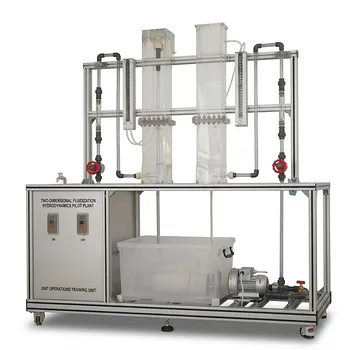
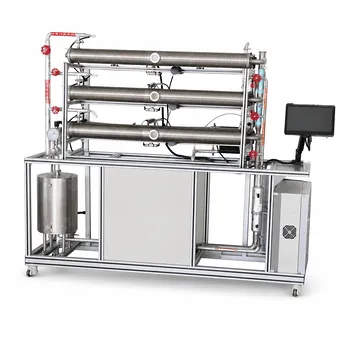
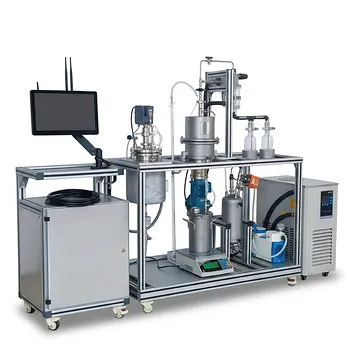
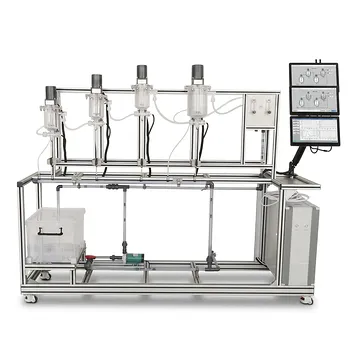
Accurate calibration is the foundation of reliable scale-up data. LABPARK provides high-quality Educational and Vocational Unit Operations Pilot Plants in chemical engineering, bioprocess & biotech, and environmental & water treatment. Designed specifically for universities, research institutes, and enterprises, our systems ensure your students and researchers work with industry-grade precision.
Ready to elevate your training and research capabilities? Contact LABPARK today to discover our customizable pilot plant solutions!
Related Products
- Multi-Functional Special Distillation Educational Pilot Plant
- Orifice and Venturi Flowmeter Calibration Educational Pilot Plant for Fluid Mechanics Laboratory
- Cavitation Phenomenon Demonstration and Analysis Educational Unit Operations Pilot Plant
- Bernoulli Equation Demonstration Unit Operations Pilot Plant
- Continuous Batch Extractive Distillation Educational Pilot Plant
People Also Ask
- Why does simple distillation yield higher efficiency than flash distillation? Key thermodynamic differences.
- Why is the acentric factor important in pilot plants? Fluid property prediction.
- How Batch vs Continuous Configuration Affects Distillation Pilot Plant Versatility & Footprint
- How does double temperature difference control improve distillation pilot plants? Stabilize purity.
- How to Estimate Distillation Pilot Plant Tray Efficiency? O'Connell's Correlation Guide