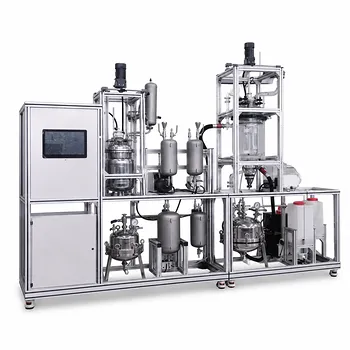
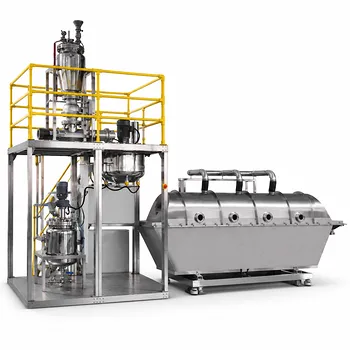
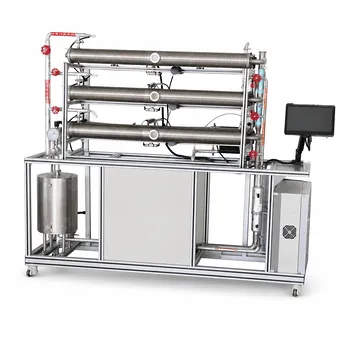
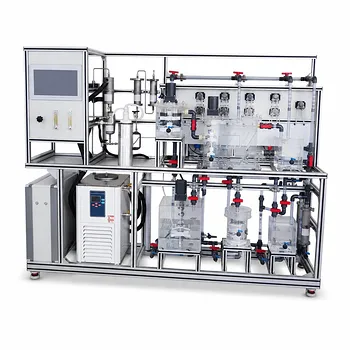
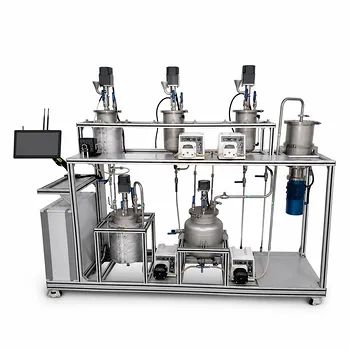
The academic study of ore roasting kinetics demands pilot plant configurations that balance controllability, safety, and pedagogical value. For most teaching and research settings, a combination of fluidized bed reactors and rotary kiln simulators is recommended. These systems directly mirror industrial operations while enabling the precise measurement of gas-solid reaction rates, heat transfer, and exhaust gas composition.
While fluidized beds and rotary kilns are the workhorses for roasting studies, the optimal academic pilot plant is a flexible, modular system. It should be reconfigurable between fixed, moving, and fluidized bed contact modes, allowing researchers to directly compare reaction regimes and isolate fundamental transport phenomena.
The Foundation: Why These Two Configurations Excel
Roasting is a high-temperature gas-solid reaction where sulfide or carbonate ores are converted to oxides. The primary reference correctly identifies fluidized bed reactors and rotary kiln simulators as the most instructive and research-ready choices. Let’s examine why.
Fluidized Bed Reactors for Kinetic Precision
A fluidized bed suspends solid particles in an upward gas flow, creating excellent mixing and heat transfer. This promotes uniform temperature and gas-solid contact, which is critical for obtaining reproducible kinetic data.
From an educational standpoint, the fluidized bed is ideal for studying rapid, exothermic reactions. Students can measure intrinsic reaction rates with minimal interference from heat or mass transport gradients, provided the flow is high enough to overcome external film resistance.
Rotary Kiln Simulators for Real-World Process Insight
A rotary kiln simulator mimics the dominant industrial configuration for ore calcination and roasting. It provides continuous solid throughput and a clear visual representation of particle residence time.
This configuration shines when the research goal shifts to practical process variables: kiln inclination, rotation speed, and fill percentage. It allows students to explore how these mechanical parameters affect heat transfer profiles and overall conversion, bridging the gap between idealized kinetics and applied reactor engineering.
Beyond the Basics: Expanding the Pilot Plant’s Educational Value
While fluidized beds and rotary kilns are the primary recommendations, a comprehensive academic pilot plant gains immense value from additional, easily swappable modules. The ability to compare contact modes is what transforms a demonstration into a deep learning experience.
The Fixed-Bed Mode as a Baseline
A fixed-bed reactor keeps solid particles stationary while gas flows through. It is the simplest configuration and serves as an excellent baseline for understanding pressure drop and diffusion limitations.
In teaching, the fixed bed demonstrates how reactions become controlled by mass transfer through the product layer, especially in the later stages of roasting where an oxide shell forms around the particle core. Students can visibly observe how flow rate has minimal effect once this diffusion barrier dominates.
The Moving-Bed Mode for Continuous Solids Flow
A moving-bed module allows solids to flow steadily under gravity while gas flows counter-currently. It is ideal for studying continuous, steady-state processes and for introducing the concept of plug flow of solids.
This configuration links the well-mixed fluidized bed and the near-plug-flow rotary kiln, giving researchers a way to examine axial temperature and conversion profiles in a controlled setting. It is especially valuable for projects scaling up from batch kinetic data to a continuous process design.
Understanding the Trade-Offs and Critical Limitations
No single reactor configuration is perfect. A trusted advisor must honestly address the downsides so you can make a fully informed decision on pilot plant investment.
Safety and Gas Handling Complexity
Roasting generates sulfur dioxide (SO₂) or carbon dioxide, which demand robust scrubbing and gas analysis systems. Fluidized beds, with their higher volumetric gas flows, produce a more dilute but larger volume of effluent, requiring careful design of downsteam treatment.
Educational setups must prioritize fume containment and gas monitoring. This often means the pilot plant's auxiliary systems (scrubbers, real-time gas analyzers) are larger and more expensive than the reactor itself. Plan the budget accordingly.
Scale and Representativeness
A pilot-scale rotary kiln simulator is mechanically complex and requires significant maintenance for moving seals at high temperatures. The much simpler fixed- or fluidized-bed modules may not fully capture the heat transfer limitations of a large industrial kiln.
For research focused on intrinsic kinetics, a differential fluidized bed (small, thin bed with near-perfect mixing) is ideal. However, if the goal is to predict kiln performance, ignoring the radial temperature gradients of a rotary tube leads to overly optimistic predictions. You must align the pilot configuration with the specific scale-up challenge.
Operational Flexibility vs. Experimental Purity
A modular system that swaps between fixed, moving, and fluidized modes offers unbeatable educational flexibility. The trade-off is that each reconfiguration introduces potential leaks, dead volumes, and sensor repositioning errors. For the purest kinetic measurements, a dedicated, hard-piped fluidized bed might be superior. Decide whether teaching versatility or research-grade precision is your primary driver.
Designing Experiments to Isolate Kinetic Mechanisms
A powerful teaching outcome of any roasting pilot plant is learning to diagnose the rate-controlling step. The system must allow students to systematically vary temperature and gas flow while keeping other parameters fixed.
- If changing gas flow rate (or agitator speed in a modified setup) dramatically affects the rate, the process is controlled by gas-film mass transfer. This is common at low flow rates in fixed beds.
- If only temperature changes the rate strongly (and flow does not), the chemical reaction at the surface limits the process. This regime is best studied in a fluidized bed where film resistance is minimized.
- If neither flow nor temperature has a major effect, diffusion through the solid product layer (ash layer) is controlling. This is typical in the later stages of roasting for large particles.
A well-designed academic pilot plant provides the instrumentation and controllability to run these diagnostic experiments safely and repeatedly.
How to Build an Academic Roasting Pilot Plant That Delivers
Your configuration should directly follow from your educational and research goals. Use these goal-based recommendations to prioritize your investment.
- If your primary focus is teaching fundamental reaction engineering: Select a modular system with fixed-bed and fluidized-bed modes. This allows clear, side-by-side comparisons of mass transfer, pressure drop, and temperature effects with minimal mechanical complexity.
- If your primary focus is advanced kinetics research for roasting: Invest in a high-precision fluidized bed reactor with rapid online gas analysis and differential operation capability. This minimizes transport disguises and yields the most reliable intrinsic kinetic parameters.
- If your primary focus is industrial process insight and scale-up: Include a rotary kiln simulator with adjustable tilt, rotation, and a counter-current gas flow path. Pair it with a moving-bed module to study continuous solids residence time distributions.
- If your primary focus is environmental and exhaust treatment studies: Ensure whichever reactor you choose is directly coupled to a real-time SO₂ analyzer and a small-scale wet or dry scrubber. This turns the pilot plant into a complete process loop, from ore feed to clean gas.
The most impactful academic pilot plant is not the most complex one—it’s the one most transparently connected to the core principles you need to demonstrate. Start with a fluidized bed and a rotary kiln as your foundations, and add fixed and moving bed modules as your curriculum and research questions evolve.
Summary Table:
| Configuration | Primary Application | Key Advantage | Target Study Area |
|---|---|---|---|
| Fluidized Bed | Kinetic Precision | Uniform heat & mass transfer | Rapid, exothermic reactions |
| Rotary Kiln | Process Simulation | Continuous solids throughput | Mechanical parameter effects |
| Fixed Bed | Baseline & Diffusion | Simple configuration | Pressure drop & ash diffusion |
| Moving Bed | Continuous Flow | Counter-current gas flow | Axial temperature profiles |
Elevate Your Chemical Engineering Lab with LABPARK
Are you looking to equip your university, research institute, or enterprise with state-of-the-art systems for teaching and research?
LABPARK provides highly reliable and modular Educational and Vocational Unit Operations Pilot Plants across chemical engineering, bioprocess & biotech, and environmental & water treatment. Our custom roasting systems enable safe, precise control over gas-solid kinetics, helping you bridge the gap between classroom theory and industrial application.
Contact LABPARK today to discuss your laboratory configuration needs with our experts!
Related Products
- Gallium and Indium Selective Extraction Educational Pilot Plant
- Methane Cracking Educational Unit Operations Pilot Plant
- Solid Waste Pyrolysis and Refining Educational Pilot Plant for Unit Operations
- Multi-Functional Special Distillation Educational Pilot Plant
- Natural Product Extraction Unit Operations Training Pilot Plant
People Also Ask
- How do pilot plants differentiate physical vs chemical extraction? Enhance Chemical Engineering Training
- Why is predicting multicomponent LLE from binary data more challenging than VLE? Master your pilot plant design.
- What is the significance of the isopycnic line in liquid-liquid extraction? Avoid Column Flooding
- How do droplet motion states affect kD in extraction pilot plants? Optimize Mass Transfer
- In a liquid-liquid extraction pilot plant, how is a ternary-phase diagram utilized to determine solvent feed requirements?