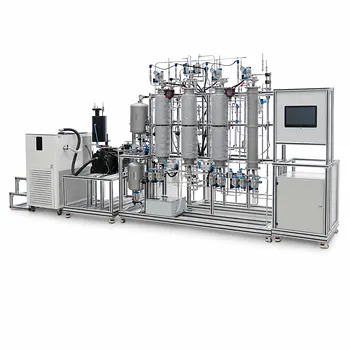
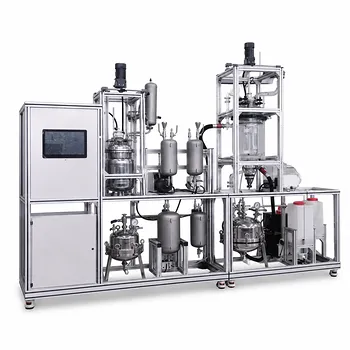
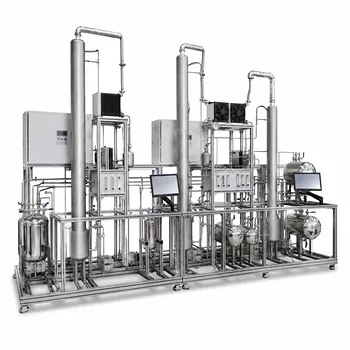
Here's the hard truth: enantiomers—molecules that are non-superimposable mirror images—are a classical separation nightmare because they share identical physical properties like boiling points. In biochemical engineering, you can't just crank up the heat. The recommended methods instead exploit very subtle chemical or solubility differences, primarily using crystallization, chiral chromatography, and specialized ion-exchange resins. Pilot plants dedicated to these unit operations bridge the gap between benchtop chemistry and industrial reality, giving you the hands-on muscle memory to scale a separation without destroying your product.
Separating mirror-image molecules requires abandoning thermal methods entirely. The winning strategy relies on creating a chiral environment—through a solid phase, a solvent, or a resolving agent—that interacts differently with each enantiomer. Pilot-scale training closes the critical knowledge gap between theoretical resolution and practical, reproducible manufacturing.
Why Thermal Separation Is a Dead End for Enantiomers
To appreciate the recommended methods, you first need to understand the fundamental roadblock that makes this challenge unique in biochemical engineering.
The Problem of Identical Physical Properties
Enantiomers possess precisely the same boiling point, melting point, and vapor pressure. A traditional distillation column, no matter how many trays you add, simply cannot distinguish between a left-handed and a right-handed molecule. The laws of thermodynamics offer no driving force for separation.
The Subtle Difference to Exploit
The key lies in their interaction with other chiral entities. While enantiomers behave identically in an achiral environment, they differ in a chiral one. The recommended unit operations all create this asymmetric environment—whether it's a chiral stationary phase in a column, a chiral resolving agent in a solvent, or a crystal lattice that favors one hand.
The Recommended Unit Operations: A Trio of Chiral Tools
These are the workhorses you will find in any advanced biochemical separation suite, each with its own mechanism and ideal use case.
Chiral Chromatography: The Gold Standard for Purity
This is often the first line of defense. In chiral chromatography, you pass the racemic mixture through a column packed with a chiral stationary phase. One enantiomer forms a slightly more stable transient complex with this phase and moves more slowly. The result is two distinct peaks, allowing you to collect each enantiomer with extremely high purity.
- Simulated moving bed (SMB) chromatography is the continuous, scale-up version of this process. It simulates a counter-current flow of solid and liquid, massively increasing throughput while using less solvent. Pilot plants running SMB teach the critical interplay of flow rates, switch times, and concentration profiles.
Preferential Crystallization: Exploiting Solubility Differences
This method turns the purification down a temperature-driven path. You create a supersaturated solution of the racemate. By seeding the solution with a pure crystal of the desired enantiomer, you force that specific hand to preferentially crystallize out of the solution, while the undesired enantiomer remains dissolved. This works because, in a chiral environment seeded by one hand, the solubility of identical molecules colliding with the growing crystal face is different. Pilot crystallization units train you in the delicate balance of cooling rates, seeding strategies, and solvent selection.
Chiral Ion-Exchange Resins: A Specialized Affinity Approach
These are specialized resins with chiral ligands bonded to their surface. They operate on a principle similar to affinity chromatography but are specifically designed for charged chiral molecules, like amino acids or certain pharmaceutical intermediates. The target enantiomer selectively exchanges ions with the resin's chiral site, binding more tightly. A change in pH or ionic strength then releases it in a pure form. Pilot systems give you the direct experience of optimizing elution gradients without denaturing your biological product.
How Pilot Plants Transform Training and Reduce Risk
A textbook diagram is no preparation for a burst filter housing or a crystallizer that refuses to nucleate. This is where pilot-unit operations become an indispensable educational tool.
The "Hands-On" Translation of Theory
Pilot plants allow you to manipulate exactly the parameters that control chiral separation. For chromatography, you will physically adjust mobile phase composition, flow velocity, and column loading. For crystallization, you will control the cooling profile and seed surface area. This tangible interaction cements the relationship between a dimensionless number like the selectivity factor and a real-world pressure drop.
Closing the Scale-Up Gap
A chiral method that resolves 5 milligrams on an HPLC is not an industrial process. Pilot systems—operating at kilogram-per-day scales—expose the non-linear effects of scale. Heat transfer in a large crystallizer is not uniform; column packing is less ideal. Training on these systems teaches you to identify the critical process parameters that must remain constant across scales, such as the residence time in a chromatographic bed, rather than just the flow rate.
Risk-Free Failure and Biosafety
Working with pilot-scale, non-hazardous training mixtures means you can safely cause a column to crash out or a crystallizer to oil out. You learn to troubleshoot these failures in a controlled setting. This is especially critical for biochemical engineering, where enriched enantiomers might be potent chiral drugs or biologicals that must be handled with care. A pilot plant provides a contained, safe environment to learn these protocols.
Understanding the Trade-offs and Limitations
A trusted advisor must also tell you what these methods won't do. None of them are a magic wand.
- Throughput vs. Purity: Crystallization can handle massive volumes, but often leaves a mother liquor rich in the unwanted enantiomer, requiring recycling and limiting yield. Chromatography delivers near-perfect purity but at the cost of huge solvent volumes and lower throughput. Pilot training teaches you to perform a cost-per-gram analysis that factors in solvent recovery and disposal, not just separation efficiency.
- The "Chiral Inventory" Problem: Developing a new chiral chromatography method is slow and expensive because you must screen potentially dozens of costly chiral stationary phases to find one that works. This screening is a skill best honed on a flexible pilot system where columns can be rapidly swapped.
- Not for Every Molecule: Some enantiomers stubbornly refuse to resolve by preferential crystallization and may show poor selectivity on any commercial chiral column. Here, the training shifts to alternative strategies, like diastereomeric salt formation—a chemical transformation influenced by chirality that can be separated by a more standard unit operation like crystallization.
Making the Right Choice for Your Training or Process Goal
The path you choose depends entirely on your target molecule's properties and your production objective. Pilot training should reflect this decision-making process.
- If your primary focus is achieving analytical-level purity: Spend the most time mastering chiral chromatography, including SMB. Focus on how changes in temperature and mobile phase modifiers affect the selectivity factor.
- If your primary focus is scaling a cost-sensitive bulk product: Immerse yourself in preferential crystallization. Learn to interpret a ternary phase diagram and to design a seeding strategy that delivers both high purity and high yield.
- If your primary focus is separating charged chiral biomolecules: Dive deep into chiral ion-exchange resins and ligand-specific interactions. Your pilot experiments should map the breakthrough curve against pH and conductivity to build a robust elution method.
The value of a pilot plant lies not just in proving a process works, but in giving you the lived experience of when and why it fails. Mastery of these chiral unit operations is the bridge that turns a fascinating chemical asymmetry into a viable, life-saving biologic.
Summary Table:
| Method | Mechanism | Best For | Pilot Training Focus |
|---|---|---|---|
| Chiral Chromatography | Chiral stationary phase interaction | High purity, smaller volumes | Flow rates, switch times (SMB) |
| Preferential Crystallization | Seed-induced selective solubility | Bulk scale, cost-sensitive | Cooling profiles, seeding strategy |
| Chiral Ion-Exchange | Ligand-specific charge interaction | Charged biomolecules | pH/conductivity, breakthrough curves |
Elevate Your Practical Training with LABPARK
Bridging the gap between biochemical theory and industrial execution requires hands-on experience. LABPARK provides state-of-the-art Educational and Vocational Unit Operations Pilot Plants in chemical engineering, bioprocess & biotech, and environmental & water treatment. Designed specifically for universities, research institutes, and enterprises, our pilot systems empower students and researchers to master complex separations like chiral chromatography and crystallization in a safe, controlled environment.
Ready to upgrade your laboratory capabilities? Contact us today to explore our pilot plant solutions.
Related Products
- Multi-Functional Membrane Separation Educational Pilot Plant for Unit Operations Lab
- Bio-fermentation Ethanol Production Practical Training Unit Operations Pilot Plant
- Bench Scale Dual Column Gas Separation and Capture Educational Pilot Plant
- Carbon Material Thermal Pretreatment Multiphase Separation Educational Pilot Plant
- Gas-Solid Heterogeneous Separation Demonstration Educational Unit Operations Pilot Plant
People Also Ask
- What are the key differences in membrane configurations? Choose the Right Unit Operations Pilot Plant
- How Do Pervaporation, Vapor, and Gas Permeation Differ in Pilot Plants? Key Comparison
- What are the advantages of membrane separation pilot plants? Energy-saving process intensification.
- Pervaporation vs. Vapor Permeation: Handling Suspended Solids in Membrane Pilot Plants
- How do PEI, PVDF, and PSU membranes compare in pilot plants? Find the best fit.