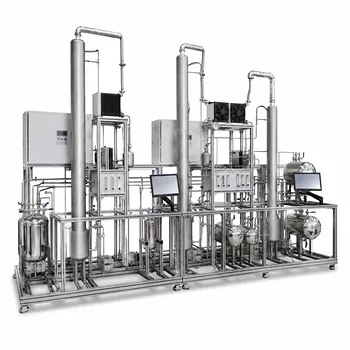
To observe the stark differences in equilibrium conversion that define thermal alkane cracking, your pilot plant reactor must be fundamentally designed for high-temperature service, capable of reaching at least 1100 K (approximately 827 °C). This upper limit is non-negotiable for demonstrating the high conversions of ethane, the smallest and most thermally stable alkane, while also allowing you to show that heavier alkanes like propane and isobutane achieve the same conversion levels at significantly lower temperatures. The core capability is not just hitting a peak temperature, but maintaining exceptional stability and precise control across a wide thermal window to make otherwise invisible thermodynamic principles a tangible, measurable reality for operators.
The core challenge in demonstrating equilibrium conversion differences between ethane and heavier alkanes isn't just about the reactor's material limits. It demands a system that can generate vivid, contrasting data sets across a broad temperature spectrum—from roughly 850 K to 1100 K—with unwavering stability. Only this level of control allows the fundamental thermodynamic lesson to emerge clearly from the experimental noise.
The Thermodynamic Demand: Why Ethane Needs More Heat
The primary reason a reactor must extend to 1100 K lies in the inherent molecular stability of small hydrocarbons. A successful demonstration does not simply run a reaction; it visually and computationally proves why temperature is the primary lever for cracking light feeds.
Molecular Stability and the Size Effect
Thermal cracking is driven by the breaking of carbon-carbon and carbon-hydrogen bonds. Smaller alkanes like ethane are uniquely stable because they lack the longer carbon chains where bond dissociation energies are lower. Consequently, ethane requires a much higher energy input—in the form of thermal severity—to initiate the free-radical chain reaction and achieve meaningful conversion. A pilot plant must explicitly showcase this size-stability relationship.
Mapping the Conversion-Temperature Curve
The practical manifestation of this stability is seen in thermodynamic equilibrium curves. To achieve high conversions, as reported for pressures around 1 bar, the temperature demands diverge sharply. Propane and isobutane can reach conversion levels above 80% at relatively modest high temperatures, typically in the range of 850 K to 950 K. In contrast, demonstrating the same >80% conversion for ethane demands a furnace capable of exceeding 1000 K. Without a reactor that can sustain 1100 K, the ethane demonstration will always appear as an under-performing outlier, failing to teach the complete principle.
From Theory to Demonstration: The Pilot Plant's True Mission
A unit operations pilot plant is a pedagogical instrument first. Its value is measured not by throughput, but by the quality and clarity of the data it generates, which means temperature capability is inseparable from control and measurement precision.
More Than Just a Hot Zone
The reactor's upper-temperature limit is important, but its ability to support educational analysis is paramount. Students and researchers use these systems to verify core thermodynamic theory, such as the van 't Hoff equation, by measuring product concentrations at different steady-state temperatures. This requires the reactor to not just reach, but precisely hold, a series of stable set points so that accurate equilibrium constants can be calculated and plotted. Without this stability, the relationship between temperature and conversion cannot be reliably mapped.
Precision as the Pedagogy
The difference between a successful and a failed demonstration lies in the resolution of the data. A furnace that drifts by even 10 K can obscure the predicted equilibrium shift. Precise temperature control is the tool that illustrates these thermodynamic differences. The system must regulate its heating elements with enough fidelity to allow an operator to isolate temperature as the single independent variable, proving that it, and it alone, is responsible for the observed shifts in product distribution between ethane and propane.
Understanding the Inescapable Kinetics-Thermodynamics Trade-off
Designing this demonstration reactor also means confronting a fundamental conflict in chemical engineering: the tension between speed and yield. The reactor must be more than a resistor-heated tube; it needs a configuration that allows for thermal profiling.
When Speed Masks Equilibrium
While the cracking reactions are endothermic and favored by high temperatures, the broader curriculum this pilot plant supports often includes exothermic reactions, where this trade-off is inverted and critically important. For example, in a shift conversion reaction, low temperatures favor equilibrium but kill the reaction rate. A well-designed reactor demonstrates this by having multi-zone temperature control. This allows an operator to deliberately decouple kinetics from thermodynamics—perhaps starting a reaction at a higher temperature for speed and then lowering it in a later zone to maximize conversion. This industrial priniple is exactly what a cracking demonstration aims to reveal about feedstocks.
Designing for Data, Not Just Reaction
To move from a simple "black box" demonstration to a true learning experience, the reactor must be heavily instrumented. Integrated temperature sensors along the catalyst bed or reaction zone, coupled with a data acquisition system, allow the operator to see the temperature profile over time. This profile is the key to connecting practical operation with theory, enabling them to verify calculations involving the Arrhenius equation and activation energy. The physical capability to reach 1100 K is the prerequisite, but the system's sensory and control architecture is what delivers proof of the thermodynamic concept.
Specifying the Ideal Reactor for Your Demonstration Goals
Your choice of reactor configuration and specification must align with the specific concept you need to highlight. The 1100 K capability is the starting point, not the complete specification.
- If your primary focus is demonstrating pure thermodynamic principles: A single-stage reactor with precise, stable heating up to 1100 K is essential. The key requirement is the ability to perform stepwise temperature holds with integrated data logging to plot conversion versus temperature and calculate equilibrium constants for both ethane and heavier feeds.
- If your primary focus is studying the interplay of reaction kinetics and thermodynamics: You need a system capable of rapid, controlled temperature ramping across the 850 to 1100 K window. Multi-point temperature sensors along the flow path are critical to create temperature profiles and generate Arrhenius plots.
- If your primary focus is emulating industrial process trade-offs: A configuration with multiple fixed-bed reactors in series, or a single reactor with multiple independently controlled zones, becomes necessary. This setup, operating within the required temperature range, allows you to demonstrate inter-stage cooling or thermal profiling, visually proving how industry balances high-rate, high-temperature zones with lower-temperature, high-equilibrium zones.
By prioritizing the 1100 K operational ceiling backed by high-fidelity control, your pilot plant transforms from a simple heating device into a definitive instrument for thermodynamic education.
Summary Table:
| Alkane Feedstock | Carbon Chain | Temp for >80% Conversion | Stability & Thermal Demand |
|---|---|---|---|
| Ethane (C₂H₆) | C2 (Shortest) | >1000 K (up to 1100 K) | Highly stable; requires extreme thermal severity. |
| Propane (C₃H₈) | C3 | 850 K - 950 K | Moderately stable; cracks at lower temperatures. |
| Isobutane (C₄H₁₀) | C4 (Branched) | 850 K - 950 K | Lower bond dissociation energy; easier to convert. |
Bring Complex Thermodynamics to Life in Your Lab
To demonstrate subtle thermodynamic shifts like alkane cracking, you need equipment designed for extreme stability and high-temperature precision.
LABPARK provides premium Educational and Vocational Unit Operations Pilot Plants in chemical engineering, bioprocess & biotech, and environmental & water treatment. Tailored for universities, research institutes, and enterprises, our advanced pilot plants deliver the control and data resolution required to turn theory into practice.
Ready to upgrade your lab's capabilities? Contact LABPARK today to find the perfect pilot plant solution!
Related Products
- Alkaline Membrane Water Electrolysis Educational Pilot Plant Unit Operations Training System
- Methanol Synthesis and Catalyst Performance Evaluation Educational Unit Operations Pilot Plant
- 100L Continuous Loop Hydrogenation Educational Unit Operations Pilot Plant
- Methane Cracking Educational Unit Operations Pilot Plant
- Fluidized Bed Gas Solid Catalytic Reaction Educational Pilot Plant
People Also Ask
- How do chemical engineering pilot plants demonstrate electrolysis? Bridge Theory & Industrial Scale
- How do alkaline and PEM electrolysis technologies differ in pilot plant operations?
- Why is the selection of electrode materials critical when configuring or operating educational electrolysis pilot plants?
- Bipolar vs Monopolar Electrolysis: Key Configuration Details to Analyze in Pilot Plants
- Which Electrolysis Pilot Plant Parameters Ensure Safety & Efficiency? Key Controls Explained