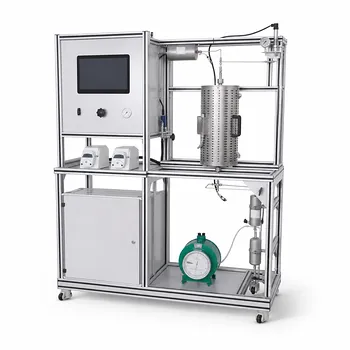
When modeling or operating a batch reactive distillation pilot unit, the Damköhler number (Da) is the linchpin that couples reaction extent to separation.
In the material balance equations, Da appears as a dimensionless parameter representing the ratio of the reaction rate to the convective mass transport rate within the reactive charge drum. It dictates how much chemical conversion you can pack into the liquid holdup between successive distillation cuts—and, most critically, determines whether your still path can cross reactive distillation boundaries to reach product purities unattainable by simple distillation.
The Damköhler number is not just a kinetic indicator. In a reactive distillation column, it’s the parameter that decides if the reactive drum can push composition past azeotropes and distillation boundaries—making it the single most important dimensionless group for feasibility and modeling of pilot-scale batch operations.
Decoding the Damköhler Number in a Reactive Distillation Context
What Da Represents Mechanistically
The Damköhler number compares two competing timescales:
how long a reacting liquid resides in the reactive drum (convection time) versus how fast the chemical reaction proceeds (characteristic reaction time).
In a batch reactive column—whether a rectifier, stripper, or middle vessel configuration—the reactive drum acts as a combined reactor and phase separator. Vapor flows in, liquid flows out, and simultaneous reaction alters the liquid composition. Da is derived from:
- The reaction rate constant (or equilibrium constant for reversible reactions).
- The liquid holdup volume in the reactive zone.
- The vapor and liquid flow rates that set the convective throughput.
A low Da (<0.1) means the reaction is too slow to keep up with the material turnover. A high Da (>10) means the reaction is so fast that the liquid reaches near-equilibrium before it even leaves the drum.
The Distinct Pilot‑Scale Challenge
At pilot scale, holdup volumes are small, and heat duties are often constrained. That makes Da an operational design target, not an afterthought. You cannot simply scale down a commercial unit and expect the same dimensionless ratio—you must actively engineer the reactive holdup, catalyst loading, or operating pressure to hit the Da window that makes the separation feasible.
The Mathematical Backbone: Da in Material Balance Models
Governing Equations for a Batch Reactive Rectifier
For a batch rectifier with a reactive charge drum, the differential material balance on any component i in the drum writes:
[ \frac{d(H x_i)}{dt} = V y_{i,1} - L_0 x_i + \nu_i , r \cdot H ]
- H = liquid holdup in the reactive charge drum.
- V, L₀ = vapor boil‑up and liquid reflux rates.
- νᵢ r = net generation rate of component i by reaction.
The reaction term directly introduces the Damköhler number. If we express the reaction rate r as a function of concentration and kinetic parameters, and normalize by the convective terms, the dimensionless group emerges as:
[ Da = \frac{k_f \cdot H}{V} \quad \text{(for a forward reaction rate constant (k_f) and vapor rate (V) representing the convective sweep)} ]
What the Equations Reveal
When Da is negligible (< 0.1), the reaction term is drowned out by the convective separation. The model collapses to simple batch distillation with a non‑reactive pot—no boundary crossing is possible.
When Da is sufficient (> 1) and the reactive zone is operated near equilibrium, the reaction term is large enough to continuously convert reactants into products. The still path (the trajectory of liquid composition versus time) deviates from the non‑reactive residue curve, pushing the system into product regions that lie beyond conventional distillation boundaries.
This is why Da is a feasibility parameter, not just a performance tweak. You can tune tray numbers and reflux ratios all you want—but without an adequate Da, the model will predict a bottlenecked composition that never reaches the target purity.
From Simulation to Reality: Da in Pilot‑Plant Operation
Da Determines How Fast Equilibrium is Approached
In a pilot column, the reactive drum’s composition evolves during a batch. A higher Da shortens the time needed to approach the reactive equilibrium composition within the drum, relative to the time needed for a single‑stage separation. This directly influences:
- The batch cycle time.
- The cut points for product collection.
- The yield of the desired product per batch.
Operators often vary the reactive holdup (by adjusting liquid level) or the catalyst amount to shift Da experimentally. Even small adjustments can mean the difference between a flat composition profile that stalls at an azeotrope and a clean crossing of the reactive distillation boundary.
Visualizing the Still Path Shift
In a simple batch distillation, the residue curve map defines natural barriers (distillation boundaries) the still path cannot cross. With reaction, these boundaries become reactive distillation boundaries—and the still path can cross them if Da is large enough to keep the liquid trajectory within the forward reaction region while continuously removing products.
For a recovering least‑volatile component at the bottom of a column, this is essential. Without reaction, that component would remain trapped on the wrong side of a boundary. With a properly sized Da, the reaction drives the composition into the product region, and the distillation removes the reaction products to pull the equilibrium forward—a synergistic loop that only works when Da is inside the required operating window.
Understanding the Trade‑offs
The Upside of a Higher Da
- Guarantees boundary crossing: Only a sufficiently high Da enables the reactive still path to punch through azeotropes.
- Shorter time to equilibrium: Faster approach to reactive equilibrium can reduce batch time.
- Higher single‑pass conversion: Maximizes reactant consumption within the drum, lowering recycle burden.
But Da is not a “more is always better” parameter.
When High Da Becomes a Liability
- Excessive reactive holdup demands larger equipment, higher heat input, and longer start‑up transients. In a pilot plant, this means higher capital cost and more difficult temperature control.
- Mass‑transfer limitations may appear: In the reactive distillation context, a very high Da can push the system into a mass‑transfer‑limited regime where liquid mixing or vapor‑liquid contact becomes the bottleneck, making further holdup increases ineffective.
- Side reactions and thermal degradation: Prolonged residence at elevated temperature (due to large holdup) can degrade catalysts, promote unwanted oligomerization, or produce off‑spec by‑products.
- Operational inflexibility: A pilot unit with an oversized reactive drum becomes sluggish; you cannot quickly shift operating conditions because the large inventory dampens composition changes.
The Sweet Spot
The optimal Da for a pilot unit is the minimum value that still guarantees the target product purity and yield, while keeping holdup as low as practical. This requires iteration between reaction kinetics, vapor‑liquid equilibrium (VLE) modeling, and pilot‑scale runs where Da is varied systematically.
Making the Right Choice for Your Pilot Unit
Whether you’re designing a new reactive distillation pilot rig or troubleshooting an existing one, focus Da decisions on the specific goal.
- If your primary focus is proving feasibility of a reactive separation: Start with a Da well above 1 using a generous reactive drum holdup. Confirm that the still path can cross the boundary. Then reduce holdup stepwise to find the minimum Da that still works—this teaches you the design threshold.
- If your primary focus is generating kinetic data: Operate at a low‑to‑moderate Da (0.1–1) so that the reaction is not artificially forced by gross holdup. This prevents the distillation from masking the true kinetic limitation and yields transport‑de‑coupled rate information.
- If your primary focus is optimizing batch cycle time for a given product purity: Tune Da by adjusting the reactive drum level or catalyst loading to minimize the titer time while meeting the purity specification, all while watching for signs of side reactions or product degradation.
- If your primary focus is scaling down a commercial process: Use dimensional analysis to match the Da (and other key groups like reflux ratio) from the production column. A mismatch in Da is a leading cause of pilot‑plant failure in reactive distillation scale‑up.
Ultimately, the Damköhler number turns reactive distillation from a hopeful arrangement into a predictable, model‑driven unit operation. Once you anchor your material balances in Da, you stop guessing and start engineering the separation that your process truly needs.
Summary Table:
| Damköhler Number (Da) | Regime / Kinetics | Operational Impact on Pilot Units |
|---|---|---|
| Low (Da < 0.1) | Reaction-limited (slow) | Acts like non-reactive distillation; cannot cross boundaries. |
| Moderate (0.1 - 10) | Coupled reaction & transport | Useful for collecting kinetic data & optimizing cycle times. |
| High (Da > 10) | Equilibrium-limited (fast) | Facilitates boundary crossing; risk of catalyst degradation. |
Optimize Your Process Engineering R&D with LABPARK
Bridge the gap between thermodynamic modeling and real-world operation. LABPARK provides state-of-the-art Educational and Vocational Unit Operations Pilot Plants in chemical engineering, bioprocess & biotech, and environmental & water treatment. Designed specifically for universities, research institutes, and enterprises, our pilot units help you accurately analyze dimensionless groups like the Damköhler number, accelerate scale-up, and train the next generation of engineers.
Ready to elevate your laboratory capabilities? Contact LABPARK today to request a technical consultation and quote!
Related Products
- Continuous Batch Extractive Distillation Educational Pilot Plant
- Multi-Functional Special Distillation Educational Pilot Plant
- Continuous Sieve-Plate Distillation Pilot Plant for Unit Operations Laboratory Education
- Multi-Modal Distillation Unit Operations Training Pilot Plant
- Dual-Mode Rectification Pilot Plant for Practical Training Unit Operations
People Also Ask
- Wilson vs. UNIQUAC: How to Choose the Right Thermodynamic Model for Your Pilot Plant
- Why use non-ideal VLE calculations in distillation pilot plants? Ensure accurate scale-up & purity
- How does the feed thermal state influence distillation pilot plant design and utility consumption?
- How to Configure a Distillation Pilot Plant? Key Steps for Multi-Mode Setup
- How to Integrate Spectroscopy in Distillation Pilot Plants for Advanced Process Control