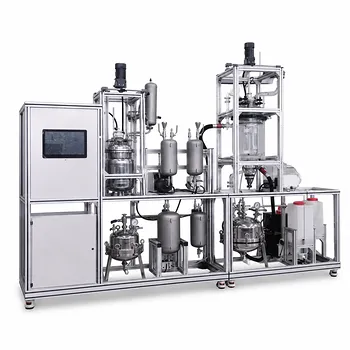
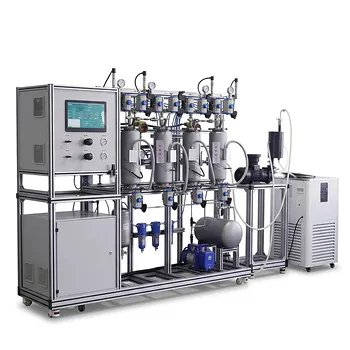
In gravity-based oil-water separation, time isn’t just a factor—it’s the deciding factor. Residence time sets the minimum vessel size required to let oil and water separate by buoyancy alone. If the oil phase doesn’t spend enough minutes in the separator, free water won’t settle out, and downstream stages will fail to meet target water cuts. Vocational pilot plants let you change flow rates and vessel setups to directly see how retention time governs split quality, giving you the data that underpins industrial sizing.
The core insight: Different separation goals demand vastly different residence times—free water knockout needs 30–60 minutes, while deep dehydration can stretch to 30 hours or more. Pilot plants transform this abstract sizing criterion into a tangible variable you can measure, optimize, and validate before scaling up.
Why Residence Time Governs Gravity Separation
Gravity separation works because water droplets, being denser than oil, settle downward while oil rises. The speed of this buoyant motion is limited by fluid properties and droplet size, which means the mixture must be held in a quiet vessel long enough for the bulk of the water to reach the bottom. That holding time is the residence time—the average length of time a fluid particle stays inside the separator.
A separator’s required volume is fundamentally determined by the equation Volume = Flow Rate × Residence Time. Double the flow rate and you either halve the residence time or need to double the tank size. Thus, residence time is the pivot point around which all gravity-based separator sizing revolves.
The Free Water Knockout: Minutes, Not Hours
The first stage of oil-water separation usually targets free water—large water droplets that settle quickly. According to liquid-liquid training system design, a water knockout (KO) tank typically operates with an oil-phase residence time of 30 to 60 minutes. This timeframe efficiently removes 30% to 60% of the total water, provided the water is present as free droplets rather than tight emulsions.
If the oil-phase residence time dips below 10 minutes, and especially if the feed contains more than 20% emulsion, primary separation becomes unreliable. In those cases, you either need a second stage or must extend residence time to at least 30 minutes to compensate. This threshold is a direct sizing rule-of-thumb that vocational pilot plants are designed to demonstrate.
The Dehydration Stage: The Long Wait for 1% Water
After free water is gone, the remaining water is trapped as small droplets or emulsions. Driving residual water content down to the typical 1% specification requires a much longer residence time in a dehydration tank.
Design guidelines for treating tanks (referenced in pilot-plant teaching modules) call for a minimum residence time of 16 hours—and many operating companies push that to 24 or even 30 hours to guarantee reliability. Primary dewatering may only need minutes, but deep dehydration routinely demands 8 to 30 hours, depending on oil gravity and viscosity. This dramatic difference is exactly why pilot plants are essential: they let you test where your particular oil falls on that spectrum.
How Oil Properties Reshape the Time Requirement
Two oil properties dominate the required residence time: density (API gravity) and viscosity.
- Heavy, viscous crudes: A 14°API oil with 72 cP viscosity can require more than 24 hours to reach 1% water, even under ideal conditions.
- Light, low-viscosity crudes: A 34°API oil may hit a 0.5% water cut in just 12 hours—half the time of a heavy oil.
Temperature changes and oil blending alter viscosity, which in turn changes residence time requirements. Pilot plants can be configured to manipulate oil temperature or blend ratios, allowing students to directly plot how viscosity shifts the needed retention time.
Understanding the Trade-offs
Residence time is not free. Making a tank larger to increase residence time raises capital cost, footprint, and weight—penalties that matter on offshore platforms or in modular skids. The trade-off extends to operations, too.
- Oversizing: You get excellent separation but pay for steel you don’t need and tie up inventory in process volume.
- Undersizing: Water carry-over hurts downstream equipment, raises heating costs, and can force costly chemical treatment later.
- Chemical reliance vs. retention time: Emulsion breaker chemicals can accelerate water dropout, effectively reducing the required residence time. But chemicals add operational cost and complexity. Pilot studies help you find the economic balance—minimizing both tank size and chemical consumption.
There’s also the hidden risk of dead zones. A poorly designed vessel can have lower-than-average residence time in certain areas, leading to channelling and underperformance even if the calculated average time looks correct. Vocational pilot units allow learners to spot and mitigate these flow distribution issues before they become plant problems.
The Vocational Pilot Plant as a Design Laboratory
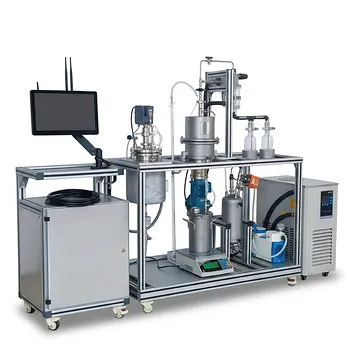
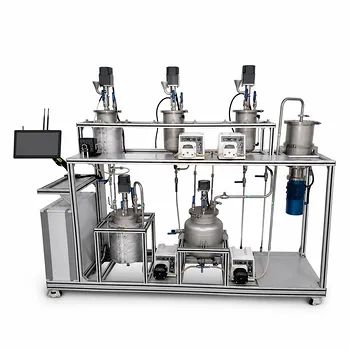
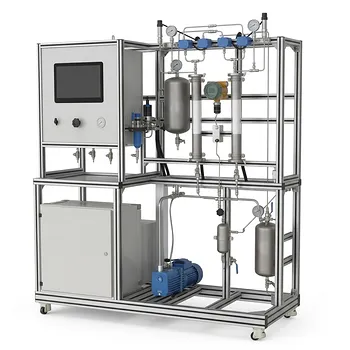
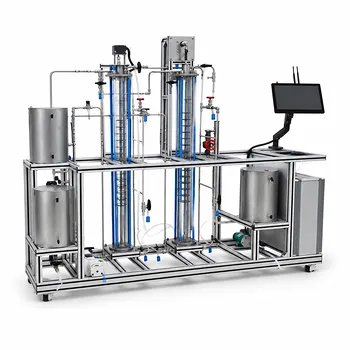
A vocational separation pilot plant is a scaled-down, instrumented system that replicates the core physics of an industrial separator. It turns residence time from an equation into an experimental variable.
Manipulating Flow and Configuration
Students adjust feed flow rate while keeping tank volume fixed, instantly changing residence time. They can also reconfigure stages—for example, running a single KO tank at 10, 30, or 60 minutes—and measure the outlet water cut each time. By seeing how the quality of the separated phases changes, they internalize why industrial separators are sized the way they are.
Generating Dehydration Curves
The most powerful learning outcome is the dehydration curve: a plot of residual water content versus residence time for a given oil viscosity and temperature. Students control either flow rate or viscosity (via temperature) and sample the oil outlet at multiple residence times. The resulting curve directly mirrors the settling equations used in industrial design codes. It provides a tangible link between textbook theory and real plant data.
Validating Beyond the Beaker
Field experience consistently shows that simple bottle tests can give overly optimistic settling times compared to what happens in a real continuous-flow vessel. Liquid-liquid training systems explicitly recommend running the actual pilot plant under operating conditions rather than relying solely on lab beaker data. The pilot plant includes the effects of continuous flow, inlet turbulence, and internal baffles—factors that can significantly alter effective residence time and separation efficiency.
Making the Right Choice for Your Goal
The way you size a separator—and the pilot study you design—depends entirely on your separation objective. Use these focus areas to guide your work:
- If your primary focus is free-water removal: Target an oil-phase residence time of 30–60 minutes in the knockout stage. In a pilot study, vary flow rates to confirm the point where free water separation drops below 30% efficiency, and verify whether a second stage is truly needed.
- If your primary focus is deep dehydration to a 1% spec: Plan for a minimum 16-hour residence time, extending to 24–30 hours for heavy crudes. Use the pilot plant to build a dehydration curve at multiple viscosities so your full-scale design isn’t based on a single optimistic data point.
- If you’re designing for variable crude types: Manipulate temperature and oil blending in the pilot plant to map out the residence time needed across your expected viscosity range. This ensures the final vessel is flexible enough without being grossly oversized.
Residence time drives gravity separation sizing; a vocational pilot plant transforms that driver from a theoretical number into a practical, validated design parameter you can trust.
Summary Table:
| Separation Stage / Oil Type | Required Residence Time | Primary Target / Output |
|---|---|---|
| Free Water Knockout | 30 - 60 Minutes | Removes 30% - 60% of free water |
| Deep Dehydration | 16 - 30 Hours | Achieves 1% (or less) residual water |
| Light Crude (34°API) | ~12 Hours | Down to 0.5% water cut |
| Heavy Crude (14°API) | 24+ Hours | Down to 1% water cut |
Optimize Your Separation Studies with LABPARK
Are you looking to bridge the gap between classroom theory and industrial application? LABPARK provides premium Educational and Vocational Unit Operations Pilot Plants in chemical engineering, bioprocess & biotech, and environmental & water treatment designed specifically for universities, research institutes, and enterprises.
Our separation pilot plants allow students and researchers to easily manipulate flow rates, temperature, and oil blending to validate residence time requirements and build accurate dehydration curves.
Ready to elevate your training and research capabilities? Contact us today to request a quote or custom design consultation!
Related Products
- Supercritical High-Gravity Flash Evaporation Educational Unit Operations Pilot Plant
- High-Gravity Emulsification and Mass Transfer Educational Pilot Plant
- Pressure Swing Adsorption Educational Unit Operations Pilot Plant
- Multifunctional Membrane Separation Educational Pilot Plant with Ultrafiltration, Nanofiltration, Reverse Osmosis
- Comprehensive Liquid-Liquid Extraction Pilot Plant for Engineering Education
People Also Ask
- How is the heat transfer area calculated for an evaporation unit operations pilot plant during experimental design? Guide
- How to select educational evaporator pilot plants for thermal & scaling solutions? Complete Guide
- What is the practical significance of Kb in pilot plant evaporation? Master process design.
- How do flash calculations relate to flash evaporation pilot plants? Bridge Theory and Practice
- How to Minimize Hazardous Inventory in Pilot Plants? Master Inherently Safer Design