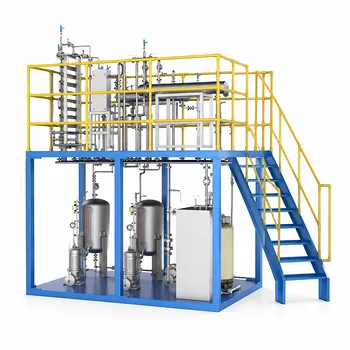
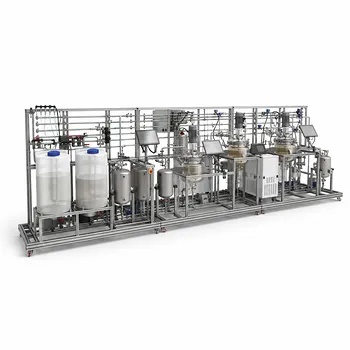
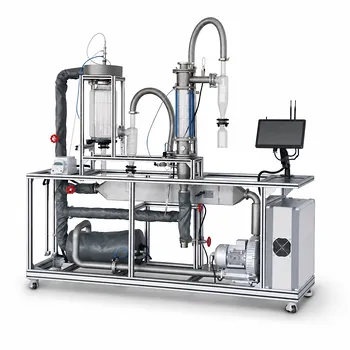
The key to reliable polymer erosion data isn’t just chemical formulation—it’s fluid physics.
Bioprocess and chemical unit operations pilot plants allow researchers to precisely replicate the hydrodynamic environment—fluid flow, mixing intensity, and temperature—that a controlled-release matrix will experience at production scale. By systematically varying shear stress and measuring its impact on polymer degradation, these pilot systems directly characterize dissolution rates and erosion kinetics, generating the empirical data needed to validate and refine mathematical models long before commercial scale-up.
A pilot plant transforms erosion kinetics from an abstract mathematical exercise into a defensible, scalable engineering reality. It is the only environment where you can simultaneously control the hydrodynamic forces governing surface erosion and the bulk conditions affecting polymer swelling, providing unequivocal data on whether your matrix releases by surface erosion, bulk erosion, or a hybrid mechanism.
Why Hydrodynamics Dictate Erosion Kinetics
Polymer matrices don’t degrade in a vacuum. Their dissolution and erosion are profoundly influenced by the surrounding fluid’s movement. A stirred tank, a flow loop, or a dissolution vessel all impose shear forces that directly alter mass transfer rates at the matrix surface.
The Surface vs. Bulk Erosion Divide
A matrix that erodes heterogeneously from the surface outward follows a different rate law than one that homogeneously swells and degrades throughout. The equation for pure surface erosion— ( M_t/M_\infty = 1 - (1 - k_0 t / a C_0)^n )—shows that the release rate is not diffusion-limited but governed by the erosion velocity ( k_0 ) and the device geometry.
Shear Stress as a Rate Modifier
In a poorly stirred vessel, the stagnant boundary layer thickens, and surface erosion is retarded because degraded polymer chains accumulate near the matrix. Increased agitation thins this boundary layer, accelerating fluid shear and removing fragmented polymer chains, which can either enhance or reveal the true surface-erosion rate. Pilot plants, with their instrumented tanks and calibrated impellers, allow you to quantify this relationship directly.
How a Pilot Plant Recreates Real-World Degradation
Laboratory shakers and small beakers cannot replicate the complex flow patterns of a 1,000-liter bioreactor or a continuous formulation line. Unit operations pilot plants bridge that gap by offering controlled, scalable environments.
Controlled Stirred Tanks and Flow Loops
A pilot plant’s stirred vessels are designed with geometric similarity to production reactors. You can set exact RPMs, record torque, and calculate tip speed and impeller Reynolds numbers. For flow systems, recirculating loops with inline sensors allow you to monitor concentration changes while exposing polymer matrices to consistent, measurable wall shear stresses.
Inline Monitoring and Real-Time Kinetics
Integrating online sensors—UV-Vis, Raman, or refractive index detectors—into the pilot plant’s flow path removes the need for manual sampling. This provides a high-frequency, real-time concentration profile, enabling precise calculation of the dissolution rate under operating conditions that match future scale-up rather than idealized lab settings.
Systematically Decoupling Mechanisms
Not all release is erosion-driven; diffusion and osmosis often coexist. A pilot plant can alter the dissolution medium’s osmotic pressure (by adding sucrose or saturating with drug) to shut down osmotic pumping. By comparing release rates with and without osmotic driving force, researchers can quantify the fraction of release due to convective osmotic flow versus pure Fickian diffusion, all while maintaining industrial-scale mixing.
Validating Mathematical Models with Empirical Data
Erosion-controlled delivery models are only as good as the assumptions behind them. Pilot plants provide the hard process data needed to stress-test these assumptions.
Confirming Model Inputs at Scale
Many models assume constant temperature, ideal mixing, and a uniform boundary layer. A pilot plant reveals where these assumptions break down. For example, if fluid velocity varies significantly near vessel walls, a surface-erosion model assuming uniform shear will overpredict release. The empirical data forces a correction factor that makes the model truly predictive.
Verifying Equipment Sizing and Operating Volumes
Dissolution and erosion often require precise minimum working volumes and specific power inputs for mixing. Pilot runs confirm that the selected vessel can prevent overfilling during swelling or agitation, and that the energy dissipation rate is sufficient to maintain the target erosion kinetics. This data feeds directly into process simulators, validating the mass and energy balances that underpin full-scale design.
Understanding the Trade-offs
While pilot plants are indispensable, they are not a perfect mirror of full-scale conditions. Recognizing their limitations prevents overconfidence and guides smarter experimental design.
Imperfect Hydrodynamic Matching
Despite geometric similarity, rotational speed alone cannot match all dimensionless parameters (e.g., Reynolds and Power numbers) simultaneously between a 50-liter pilot and a 5,000-liter reactor. Shear distribution will differ, especially in the bulk fluid, potentially changing the balance between surface scission and diffusion.
Resource Intensity
Pilot-scale testing demands significant amounts of polymer, active ingredient, and time. A single design of experiment matrix can consume materials worth thousands of dollars. This makes it essential to enter pilot trials only after lab-scale sensitivity studies have identified the most influential process parameters.
Complexity of Data Interpretation
Real-time inline sensor data can be noisy at pilot scale due to bubbles, fouling, or electrical interference. Robust chemometric models and careful sensor calibration are mandatory to extract accurate kinetic parameters, adding a layer of analytical complexity absent in a simple benchtop dissolution test.
How to Leverage a Pilot Plant for Your Formulation Project
Your specific goal dictates the pilot plant’s role and the parameters you must prioritize.
- If your primary focus is validating an erosion-controlled release model: Use the pilot plant to measure matrix dimension changes and release rates over a grid of impeller speeds. Fit the data to the surface-erosion model and identify the shear-dependent correction factor (( k_0 ) vs. Reynolds number) needed for scale-up.
- If your primary focus is optimizing a formulation for commercial scale: Run pilot trials with representative batch sizes to detect any mixing-induced changes in gel layer formation or polymer agglomeration, then adjust the polymer chemistry or particle size distribution based on the resulting erosion profile.
- If your primary focus is separating osmotic and diffusional contributions: Program the pilot system to replace the dissolution medium with a solution of matched osmotic pressure while maintaining constant stirring. The residual release under this condition isolates the purely diffusional pathway, quantifying the true osmotic component.
Credible scale-up of a polymer-based controlled-release system is never built on extrapolation from a beaker—it is hardened by the deliberate, hydrodynamic interrogation that only a unit operations pilot plant can provide.
Summary Table:
| Key Parameter | Pilot Plant Function | Scale-Up Benefit |
|---|---|---|
| Hydrodynamics | Replicates shear stress and mixing intensity | Simulates real production flow environments |
| Mechanisms | Decouples diffusion, osmosis, and surface erosion | Pinpoints exact drug release pathways |
| Validation | Generates real-time, empirical kinetic data | Corrects and refines mathematical models |
Bridge the Gap from Lab to Scale with LABPARK
At LABPARK, we provide specialized Educational and Vocational Unit Operations Pilot Plants in chemical engineering, bioprocess & biotech, and environmental & water treatment. Tailored for universities, research institutes, and enterprises, our pilot systems deliver the precise hydrodynamic control required to characterize polymer erosion kinetics, validate release models, and guarantee scale-up success.
Ready to optimize your formulations for commercial production? Contact LABPARK today to find the ideal pilot plant solution for your facility.
Related Products
- Bio-fermentation Ethanol Production Practical Training Unit Operations Pilot Plant
- Natural Product Extraction Unit Operations Training Pilot Plant
- Multi Pump Fluid Transport Process Piping Unit Operations Training Pilot Plant
- Multi-Modal Distillation Unit Operations Training Pilot Plant
- Multi-Reactor Educational Pilot Plant for Reaction Engineering Unit Operations
People Also Ask
- Why Use PTFE & Hastelloy in Chemical Pilot Plants? Prevent Corrosion & Ensure Safety
- Why Compare Predicted and Experimental Excess Enthalpy? Key to Accurate Pilot Plant Scale-up
- Why is the chemical plant startup schedule crucial? De-risk scale-up with pilot plants.
- When to transition from PID to adaptive control in pilot plants? Key process indicators.
- Why must batch and fed-batch fermentation pilot plants be designed to accommodate changing rheological conditions?