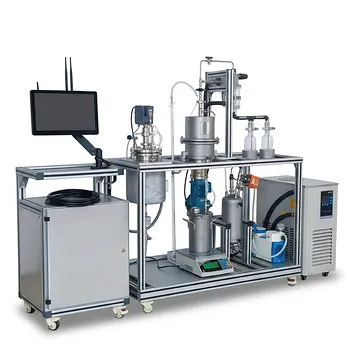
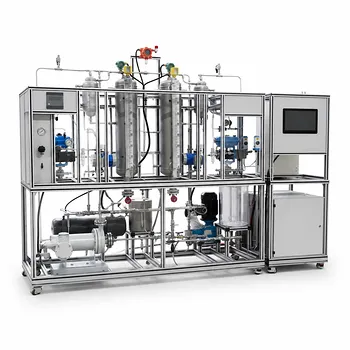
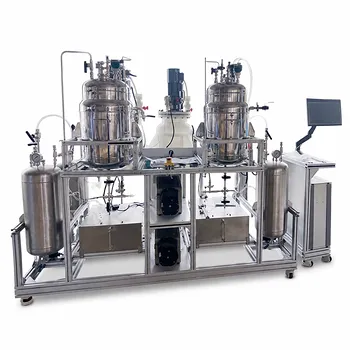
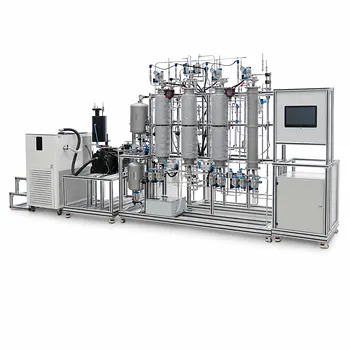
Controlling the liquid composition in real time is the defining challenge. An educational pilot plant for semiconductor liquid phase epitaxy (LPE) must confront the direct link between the melt’s chemical makeup and the thin film’s crystal structure. This means the system needs to actively sense and regulate element ratios (like Al/Ga) to sustain the phase equilibrium that grows high‑quality III‑V layers, while simultaneously serving as a hands‑on platform for teaching batch automation, safety, and process control fundamentals.
The central challenge is not just about growing a semiconductor – it is about transforming a subtle, composition‑sensitive growth process into a visible, controllable loop. The pilot plant must make the invisible visible, so students can explore both the deep materials science of phase equilibrium and the principles of modern batch control under one roof.
The Core Control Imperative: Liquid Composition Equilibrium
Why the Melt Dictates the Crystal
In LPE, a semiconductor layer precipitates from a liquid metal solution saturated with the elements to be deposited (e.g., Al, Ga, Sb). The composition of the grown crystal is a direct function of the liquid phase composition at the growth interface. If the Al/Ga ratio drifts, the film’s stoichiometry, bandgap, and doping will drift with it. The process control mandate is therefore dynamic equilibrium maintenance: the melt must be continuously monitored and the ratios actively adjusted to hold the desired phase state.
The Non‑Equilibrium Trap
Even when the bulk melt appears stable, the crystal surface can slide into a non‑equilibrium state. This mismatch alters sublattice occupation and directly corrupts the optical and electrical properties of the semiconductor. An educational pilot plant must let students provoke, measure, and correct such deviations. That requires sensors that can detect subtle changes at the crystal‑melt interface and control loops that can respond before the film quality is compromised.
Translating LPE Science into Process Control Challenges
Ultra‑Precise Temperature Management
LPE growth occurs within a narrow, near‑eutectic temperature window – often with gradients of just a few degrees. A multi‑zone furnace with independent PID loops is essential. The challenge is to combine this continuous regulatory control with the batch‑oriented dipping, soaking, and cooling ramps that define the process recipe.
Composition Sensing: Making the Invisible Measurable
Directly measuring melt composition in real time is non‑trivial. Industrial plants may use in‑situ optics or weight‑loss calculations. For education, the system must choose a sensing approach that is explainable and robust. A simplified gravimetric method (monitoring melt mass change) or a calibrated pyrometer can teach the feedback principle without obscuring it behind black‑box instrumentation. The key learning outcome is that every controlled variable needs a trusted sensor.
Contamination Control as a Process Variable
Oxygen, water vapor, and parasitic impurities will poison the melt and kill epitaxial growth. The pilot plant must integrate a glove‑box or a tightly sealed, purged environment. From a control standpoint, this means adding discrete interlocks (O₂ sensors, pressure switches) and sequencing logic – only when the atmosphere is verified safe does the PLC allow the furnace to heat or the substrate to be dipped.
The Batch Personality of LPE and Educational Standards
LPE is a Batch Process
Substrate loading, melt homogenization, temperature ramps, dipping, film growth, and cooling are all distinct, time‑driven steps. This sequence is exactly the kind of recipe‑driven operation defined by the IEC 61512 (ISA S88) standard. An educational pilot plant should explicitly map its control system to the S88 hierarchy: a top‑level scheduler, unit‑specific recipes, and physical PLC I/O.
Using a PLC to Teach Recipe Execution
The PLC becomes the perfect teaching tool. It handles the sequential logic (opening isolation valves for gas purging, lowering the substrate arm), adjusts regulatory controller setpoints (temperature reflux, melt temperature), and logs batch data. Students can program ladder diagrams with self‑holding circuits – just like a simple tank filling exercise – but applied to a real, high‑consequence semiconductor process. This bridges the gap between trivial level control and industrial batch automation.
Designing the Educational Pilot Plant itself
Safety and Hazardous Materials
III‑V semiconductor components often involve toxic substances (arsenic, antimony) and high temperatures. The control system must enforce mandatory safety sequences: exhaust scrubber flow checks before any heating, glove‑box pressure interlocks, and emergency quench procedures. These become powerful teaching moments about functional safety and risk‑based control design.
The Trade‑Offs You Must Accept
No educational plant will replicate a production foundry. The design involves deliberate compromises:
- Real‑time composition control vs. pedagogical clarity: an expensive in‑line ellipsometer gives great data but hides the physical principle; a simpler, slower manual sampling approach may teach more.
- Multi‑component complexity vs. a binary model system: a full Al‑Ga‑Sb system mirrors real complexity, while a binary Ga‑Sb system dramatically reduces the number of variables, making fundamental control laws easier to grasp.
- Fully automated batch sequencing vs. manual steps: full automation teaches S88 recipe management, but allowing students to manually trigger some steps (under PLC supervision) reinforces the cause‑and‑effect relationship.
Integrating Simulation with the Physical Plant
A digital twin of the LPE process – running thermodynamic models to predict melt depletion – can be run side‑by‑side with the real hardware. This enables students to test control strategies on the simulator first, then validate them on the melt, while never losing sight of the dangerous, real‑world constraints.
Making the Right Choice for Your Learning Objectives
Design decisions must be driven by the primary educational goal. Use this lens to choose your pilot plant’s control complexity:
- If your primary focus is core process control logic (PLC, batch, S88): Build a simplified binary system with reliable sensors and a strong emphasis on recipe sequencing and safety interlocks. Keep the chemistry as stable as possible so students spend their time on control code, not on chasing phase instabilities.
- If your primary focus is semiconductor materials physics: Invest in better in‑situ composition monitoring and a multi‑component melt. Let students explore the thermodynamic limits and actively adjust melt ratios, even if the automation layer remains basic.
- If your primary focus is industrial‑scale process transfer: Align the plant tightly with ISA‑88 batch control structures and include a full‑scale DCS or modern PLC‑based batch engine. The materials science becomes the “burden” that the control system must manage, exactly as in a fab.
- If your primary focus is safety and hazardous process operation: Put the glove‑box, gas scrubbing, and interlock logic at the center. Simplify the growth recipe so every student must trace every safety interlock before even energizing the furnace.
A well‑designed educational LPE pilot plant turns the delicate dance of phase equilibrium into a tangible, programmable task. By addressing these control challenges head‑on, you empower students to not only grow a crystal but to engineer the entire feedback loop that makes it possible.
Summary Table:
| Key Challenge | Control Focus | Educational Solution |
|---|---|---|
| Composition Equilibrium | Melt ratio (e.g., Al/Ga) drift | Simplified gravimetric or pyrometer sensing |
| Temperature Precision | Narrow near-eutectic window | Multi-zone furnace with independent PID loops |
| Contamination Control | Oxygen and water vapor purity | Glove-box integration with safety PLC interlocks |
| Batch Sequencing | Recipe-driven operation | ISA S88 hierarchy mapping in PLC programming |
Bring Advanced Process Control to Your Lab
Looking to equip your students and researchers with hands-on control engineering experience? LABPARK provides state-of-the-art Educational and Vocational Unit Operations Pilot Plants in chemical engineering, bioprocess & biotech, and environmental & water treatment. Designed specifically for universities, research institutes, and enterprises, our systems bridge the gap between complex thermodynamic theory and practical batch control automation.
Contact us today to customize your pilot plant solutions!
Related Products
- Liquid-Liquid Mass Transfer Coefficient Determination Educational Pilot Plant
- Ternary Liquid-Liquid Equilibrium Educational Pilot Plant
- Comprehensive Liquid-Liquid Extraction Pilot Plant for Engineering Education
- Two Phase Flow Pattern Velocity Resistance Measurement Educational Pilot Plant
- Rising and Falling Film Evaporation Educational Unit Operations Pilot Plant
People Also Ask
- Why Compare Membrane-Reservoir Models with Pilot Plant Data? Ensure Successful Process Scale-Up
- How does column packing affect absorption intensification, and how is it evaluated experimentally?
- What are the limitations of the Wilke-Chang correlation? Avoid critical mass transfer errors.
- What is the role of the Sherwood number ($Sh$) in pilot plants? Master mass transfer scale-up
- Why is the calculation of gas and liquid diffusion coefficients critical? Unlock Accurate Pilot Plant Scale-Up