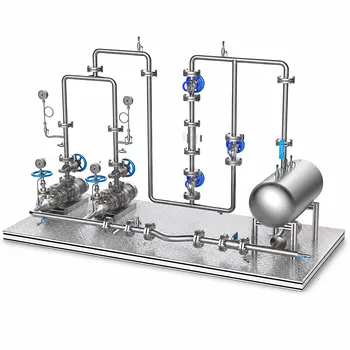
Cyclic operation generally offers stronger microbial and viral inactivation, while continuous operation usually offers higher throughput and steadier process control. The evaluation must therefore consider more than treatment time: engineers should compare pressure history, decompression rate, mechanical duty cycle, thermal behavior, throughput, control requirements, safety systems, and scale-up objectives. In high-pressure pilot units, the operating mode directly affects both process performance and equipment life.
The central choice is between transient treatment intensity and operational continuity. Cyclic pressure can produce approximately 3 to 5 log reductions under suitable conditions, but repeated pressurization and depressurization impose severe fatigue on vessels, valves, seals, and piping. Continuous pressure is mechanically and operationally steadier, but it may provide less inactivation for the same total exposure time.
Start With the Process Objective
Define the Required Inactivation
Cyclic pressure is attractive when the objective is maximum microbial or viral inactivation in a relatively short treatment period. Rapid decompression can cause severe structural damage to cell membranes, producing higher inactivation rates than continuous exposure of equal duration.
The comparison should use a defined performance target, such as the required log reduction, rather than pressure level alone. The relevant variable is the complete pressure-time history, including compression rate, hold time, decompression rate, and the number of cycles.
Define the Pilot Plant’s Purpose
A pilot unit intended to study transient behavior, cycle optimization, or microbial inactivation should be configured to capture rapid changes in pressure and temperature. Cyclic operation is particularly useful when the commercial process is expected to use repeated pressure treatments.
A pilot unit intended to demonstrate steady-state throughput, integrated heat exchange, recycling, or automated process control may favor continuous operation. Continuous systems better represent processes that must run for extended periods with stable feed, pressure, temperature, and product quality.
Match the Mode to the Product
Batch or cyclic processing is generally more suitable for low-volume, high-value, multi-product, or frequently changing operations. It also supports recipe changes, cleaning, sterilization, and studies involving variable cycle sequences.
Continuous processing is more appropriate when the process depends on stable flow, high utilization, consistent residence time, or integration with downstream unit operations. Product variety and cleaning requirements can make a continuous system more complex to operate.
Evaluate Pressure and Thermal Behavior
Compare the Complete Pressure Profile
Cyclic operation should be evaluated using the pressure ramp-up, hold period, decompression rate, minimum pressure, and cycle count. Decompression is especially important because rapid pressure release can drive the biological inactivation mechanism.
Continuous operation requires close attention to pressure stability, residence-time distribution, flow restrictions, and pressure drop through the unit. A nominally constant pressure does not guarantee uniform treatment if flow paths or residence times vary.
Account for Compression Effects
Water and other process fluids change volume under high pressure. Cyclic units may therefore require auxiliary water recovery systems or related volume-management equipment to accommodate repeated compression and decompression.
The design should also consider how compressibility affects pump sizing, fill volume, level measurement, and repeatability between cycles. These effects can become more significant as the vessel volume and operating pressure increase.
Control Adiabatic Temperature Changes
Pressurization can cause adiabatic heating, while decompression can produce cooling. In cyclic operation, these temperature excursions may occur repeatedly and can affect both inactivation performance and product quality.
Temperature control should be designed around the actual pressure trajectory rather than the nominal setpoint. Instrumentation should measure temperature at locations that reveal the process-fluid condition, not only the vessel wall or utility loop.
Consider Reaction and Material Limits
Where high-pressure pilot units also operate at elevated temperature, higher temperature may increase reaction rates and, for some endothermic reactions, improve equilibrium conversion. However, increasing temperature can reduce material strength and increase creep risk.
The vessel, piping, seals, and fittings must therefore be rated for the combined pressure and temperature envelope. Materials, allowable stresses, wall thickness, corrosion resistance, and applicable pressure-vessel code requirements should be verified for the actual operating conditions.
Assess Mechanical Duty and Equipment Life
Design for Repeated Fatigue
Cyclic processing exposes the pressure boundary to repeated stress changes. The primary concern is not simply whether the vessel can withstand the maximum pressure once, but whether it can withstand the intended number of pressure cycles over its service life.
The fatigue assessment should include the vessel, closures, nozzles, piping connections, valves, pumps, instrumentation connections, and any locations where stress concentrations occur. Cycle frequency and pressure range are key inputs to this evaluation.
Select Suitable Closures
High-duty cyclic vessels commonly use non-threaded closures with external yoke frames. These designs can be better suited to repeated opening, closing, and pressure cycling than conventional threaded arrangements, depending on the application and code design.
Closure selection should also consider sealing reliability, operator access, inspection requirements, locking verification, and protection against opening while the vessel remains pressurized.
Specify Fatigue-Resistant Valves and Seals
Valves in cyclic systems experience repeated pressure differentials and frequent actuation. Their seats, stems, bodies, and actuators must be evaluated for the expected duty cycle, pressure rating, chemical compatibility, and decompression conditions.
Seals are particularly vulnerable to extrusion, wear, thermal cycling, and chemical degradation. The selected seal material and geometry must remain reliable across the full pressure, temperature, and process-chemistry range.
Review Piping Flexibility
Repeated pressure changes can produce alternating loads in piping, supports, bends, and instrument connections. The layout should minimize unnecessary stress concentrations and provide adequate support without restraining expected movement excessively.
Flexible connections, expansion allowances, and fatigue-sensitive joints require specific assessment. Small-bore connections should receive particular attention because they can be disproportionately vulnerable to vibration and cyclic stress.
Compare Control and Instrumentation Requirements
Control Cyclic Transients
A cyclic system needs coordinated control of filling, pressurization, holding, decompression, depressurization, and product discharge. The control system must prevent incorrect sequencing, premature opening, uncontrolled decompression, and operation outside validated limits.
Pressure and temperature data should be recorded for every cycle. This creates a traceable process history and helps identify drift in cycle time, ramp rates, peak pressure, or thermal response.
Maintain Continuous Steady State
Continuous systems require stable feed conditions, flow control, pressure regulation, residence-time control, and reliable downstream handling. Their principal challenge is maintaining consistent treatment while the unit operates for long periods.
Instrumentation should detect changes in flow, pressure drop, temperature, and product composition. Recycle loops and integrated heat exchange networks may improve efficiency, but they also introduce additional control interactions and failure modes.
Validate Measurement Quality
Pressure transducers, temperature sensors, flow meters, and control valves should be selected for the expected transient response and accuracy. Slow or poorly located instruments can hide short pressure spikes and temperature excursions.
Calibration, redundancy for critical measurements, alarm limits, interlocks, and data logging are essential for both operating modes. Cyclic systems generally place greater emphasis on high-speed acquisition and sequence validation.
Address Safety and Containment
Prevent Overpressure Events
Both modes require a properly sized pressure-relief system based on credible failure scenarios. These may include blocked outlets, control-valve failure, thermal expansion, pump malfunction, abnormal concentrations, and hazardous side reactions.
Relief devices, vent systems, isolation valves, and flame arrestors should be integrated according to the process hazard assessment and applicable regulations. Relief discharge must be routed safely and must not expose personnel or adjacent equipment to hazardous material.
Control Decompression Hazards
Rapid decompression can create high fluid velocities, pressure waves, flashing, aerosol formation, and mechanical loads. The discharge path, receiver, valves, and containment system must be designed for the actual decompression rate.
The process should also include safeguards that confirm the vessel is at a safe pressure before opening or transferring material. Interlocks should prevent operators from bypassing critical pressure verification.
Protect Operators During Frequent Cycles
Cyclic units may involve frequent loading, unloading, closure operation, and inspection. Ergonomic access and clear status indication are therefore safety requirements, not secondary conveniences.
The pilot plant should provide physical guarding where needed, remote or shielded operation for hazardous cycles, emergency stops, controlled venting, and procedures for abnormal pressure or temperature behavior.
Understanding the Trade-offs
Cyclic Operation: Higher Treatment Intensity
The principal advantage of cyclic operation is its ability to combine pressure exposure with rapid decompression. Under suitable conditions, this can produce substantially higher microbial and viral inactivation, including reported reductions of approximately 3 to 5 logs.
The disadvantages are mechanical fatigue, more complex sequencing, greater thermal fluctuation, and potentially lower throughput because the vessel must be filled, processed, decompressed, and reset repeatedly.
Continuous Operation: Better Throughput and Stability
Continuous operation supports steady-state studies, higher throughput, long-duration operation, and integration with continuous downstream units. It is often easier to evaluate for stable residence time, automated control, recycling, and heat integration.
Its limitation is that continuous exposure may deliver less inactivation than a cyclic treatment of equal duration. It can also be more difficult to clean, sterilize, change between products, or operate economically at low production volumes.
Avoid Comparing Only Capital Cost
Cyclic systems may require more robust pressure boundaries, specialized closures, stronger valves, advanced control systems, and auxiliary water and temperature-management equipment. Continuous systems may require more extensive feed conditioning, downstream handling, recycle control, and steady-state instrumentation.
The comparison should include maintenance, seal and valve replacement, downtime, cleaning, validation, energy use, product losses during startup and shutdown, and the expected number of pressure cycles over the equipment’s life.
Avoid Ignoring Scale-Up Effects
A cycle that works in a laboratory vessel may not produce the same pressure and temperature uniformity in a pilot unit. Larger volumes can change filling behavior, compression response, heat transfer, mixing, and decompression dynamics.
Continuous scale-up introduces its own risks, including residence-time distribution, flow maldistribution, pressure drop, and unstable interactions between unit operations. Pilot testing should measure these effects directly rather than relying only on nominal equipment ratings.
How to Apply This to Your Project
The appropriate evaluation should connect biological performance, mechanical integrity, operating economics, and the intended commercial process.
- If your primary focus is maximum microbial or viral inactivation: Prioritize cyclic testing with controlled pressurization and decompression rates, validated temperature measurement, and equipment designed for high fatigue duty.
- If your primary focus is throughput and steady-state operation: Prioritize continuous pressure control, residence-time uniformity, reliable feed and discharge systems, and long-duration equipment reliability.
- If your primary focus is flexible pilot research: Favor a configurable batch or cyclic unit that supports recipe changes, cleaning, repeated cycle sequences, and detailed transient data collection.
- If your primary focus is commercial scale-up: Select the mode that reproduces the expected production process, then verify fatigue life, relief protection, thermal behavior, controls, maintenance, and downstream integration at pilot scale.
The right choice is the one that meets the required treatment performance while remaining mechanically durable, controllable, safe, and representative of the intended full-scale operation.
Summary Table:
| Evaluation factor | Cyclic pressure operation | Continuous pressure operation |
|---|---|---|
| Primary strength | Higher microbial and viral inactivation potential | Higher throughput and steadier operation |
| Process focus | Pressure ramps, hold time, decompression rate, and cycle count | Flow rate, pressure stability, residence-time distribution, and pressure drop |
| Thermal behavior | Repeated adiabatic heating and cooling | More stable temperature profile, with heat-integration considerations |
| Equipment duty | High fatigue duty on vessels, closures, valves, seals, and piping | Long-duration duty on pumps, controls, piping, and downstream systems |
| Control requirements | Precise sequencing, rapid data acquisition, and cycle validation | Stable feed, flow, pressure, residence time, and discharge control |
| Best suited for | High-value batches, flexible research, and maximum inactivation studies | High-volume processing, steady-state testing, and integrated production |
| Key scale-up risks | Pressure uniformity, compression response, heat transfer, and decompression dynamics | Flow maldistribution, residence-time variation, pressure drop, and control interactions |
Planning a high-pressure pilot plant for microbial inactivation, bioprocessing, chemical engineering, or environmental and water treatment? Contact LABPARK to discuss the right unit for your project. LABPARK provides Educational and Vocational Unit Operations Pilot Plants for universities, research institutes, and enterprises, with configurable cyclic and continuous systems designed for representative scale-up studies, reliable pressure and temperature control, safe operation, detailed process data, and long-term equipment performance. Our team can help you compare treatment intensity, throughput, fatigue life, automation, maintenance, and downstream integration before you invest.
Related Products
- Carbon Dioxide Hydrogen Methanol Synthesis Educational Unit Operations Pilot Plant
- Methanol Synthesis and Catalyst Performance Evaluation Educational Unit Operations Pilot Plant
- High-Gravity Emulsification and Mass Transfer Educational Pilot Plant
- Constant Pressure Filtration Educational Unit Operations Pilot Plant
- Supercritical High-Gravity Flash Evaporation Educational Unit Operations Pilot Plant
People Also Ask
- How do temp & pressure affect methanol synthesis pilot plants? Optimize equilibrium and catalyst performance.
- Why is a purge system necessary when operating a gas recirculation loop in a methanol synthesis pilot plant? (Guide)
- Why do modern methanol pilot plants operate at lower pressures? Catalyst & Feed Requirements Explained
- What are the operational requirements for catalyst activation? Safe Methanol Pilot Plant Operation
- Why are particle density, bulk density & voidage critical in pilot plants? Master Bed Fluid Dynamics