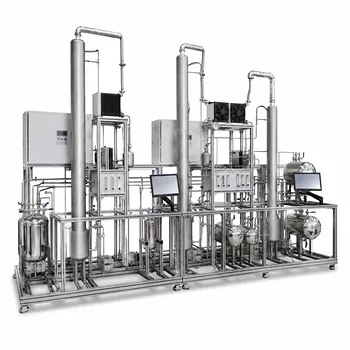
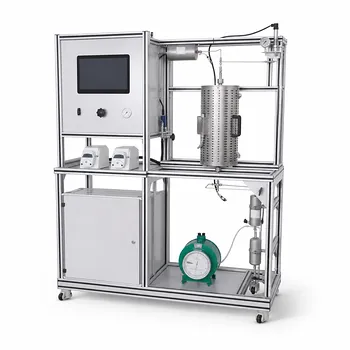
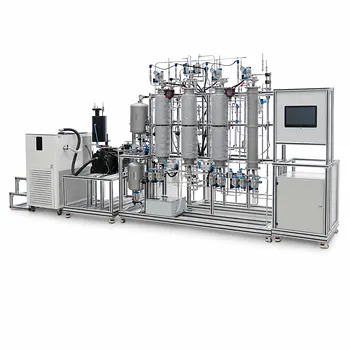
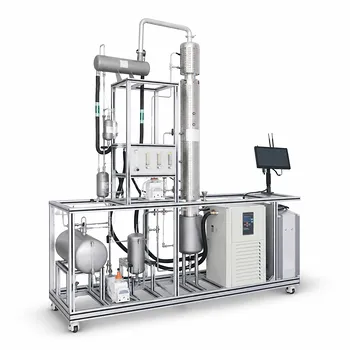
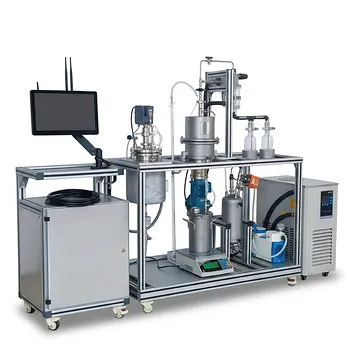
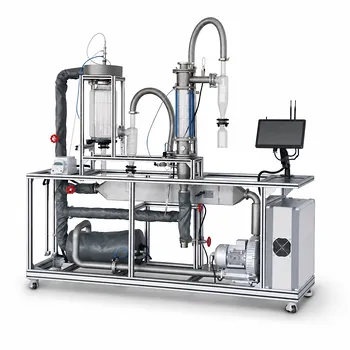
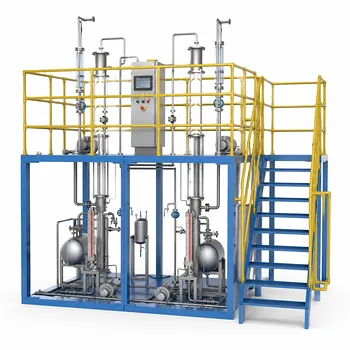
The efficiency and final purity of ethanol dehydration in a pervaporation pilot plant are not simply a matter of membrane quality—they are the result of a precise interplay between the transmembrane driving force, the operating temperature, and the hydrodynamic conditions at the membrane surface. Specifically, the purification limit is primarily defined by the partial pressure gradient of water across the membrane and its intrinsic selectivity, while the rate of dehydration is further dictated by how effectively concentration polarization is minimized.
While membrane selectivity sets the theoretical purity ceiling, achieving that limit and a high processing rate demands careful control of the permeate vacuum level, the feed temperature, and the flow velocity through the module. The true bottleneck is often not the membrane itself, but the management of the boundary layer on the feed side.
The Driving Force: The Partial Pressure Gradient and Vacuum
The fundamental condition for any transport is a difference in the partial pressure of water between the feed liquid and the permeate vapor. Without this gradient, no separation occurs.
The Role of Permeate Pressure
Lowering the absolute pressure on the permeate side directly increases the driving force. A vacuum of 20 mbar, for instance, pulls the partial pressure of water on the permeate side close to zero.
This maximizes the gradient because the feed liquid's water partial pressure remains significant, especially at elevated temperatures.
Impact on the Purity Limit
As water is removed, its concentration in the retentate drops. Transport only stops when the partial pressure of water in the feed equals that on the permeate side.
Consequently, the deeper the vacuum, the lower the achievable water concentration in the final ethanol product. A strong vacuum is non-negotiable for reaching the purity levels typical of fuel-grade or analytical-grade ethanol.
Temperature: A Dual Force on Flux and Selectivity
Raising the operating temperature is the most direct way to boost flux, but it comes with critical side effects that must be accounted for in a pilot study.
Effect on Water Activity and Vapor Pressure
Temperature elevates both the saturation vapor pressure of water and its activity coefficient in the ethanol mixture. At 100°C, for example, the activity coefficient of water can rise to around 2.75.
This magnifies the partial pressure driving force on the feed side, resulting in a much higher transmembrane flux without requiring a harder vacuum.
The Balance with Membrane Stability
Higher temperatures can reduce a membrane’s selectivity over time or cause physical swelling of the polymer matrix. In a pilot plant, one must track whether the initial gain in flux is eventually offset by a drop in selectivity, identifying the optimal temperature window for both speed and purity.
Membrane Selectivity and the Solution-Diffusion Mechanism
The membrane's inherent ability to separate water from ethanol is a combined effect of how well it dissolves water and how quickly water moves through it.
How Solubility and Diffusion Work Together
In hydrophilic pervaporation membranes, water is more soluble than ethanol in the polymer, and it also diffuses at a faster rate. Both factors reinforce each other.
This synergy means the membrane can achieve a high separation factor even when the feed mixture contains only small amounts of water, making it possible to polish ethanol to extreme purities.
Quantifying the Purity Potential
Under optimized laboratory conditions, a highly selective membrane can deliver a retentate with an ethanol purity exceeding 99.9% by weight. For instance, a water molar fraction of 0.00694 in the retentate corresponds to roughly 99.7% purity; pushing that fraction down to the 0.0007 range yields purity levels of 99.97% by weight or more.
The final limit is set by the equilibrium solubility of water in the membrane at the prevailing temperature and permeate pressure.
Overcoming Concentration Polarization: The Overlooked Parameter
Even with an excellent membrane and the right vacuum, the measured flux can be severely throttled by a phenomenon that occurs entirely on the feed side.
The Need for Turbulent Flow
As water is removed, an ethanol-rich layer can build up next to the membrane surface, reducing the local water concentration. This “concentration polarization” acts as an invisible barrier, lowering the effective driving force.
Maintaining a flow in the turbulent or transitional regime disrupts this stagnant layer, restoring the bulk liquid concentration right at the membrane wall.
Recommended Velocity for Pilot Plants
Research and educational pilot plants often target a feed linear velocity of approximately 2 meters per second through the membrane module. This threshold helps ensure that mass transfer resistance in the boundary layer does not become the performance-limiting step.
Adjusting recirculation pump settings to achieve this velocity allows students and researchers to isolate the membrane's true performance characteristics.
Understanding the Trade-offs
Every parameter you adjust comes with a counter-effect. A pilot plant experiment is uniquely suited to map these conflicts before scaling up.
Purity vs. Productivity
Running at a lower feed flow rate might raise the module’s outlet purity because the residence time is longer, but it can simultaneously reduce the average flux due to aggravated concentration polarization. You must decide whether the goal is maximum product quality per pass or maximum water removal rate.
Energy Cost of Vacuum and Heating
Pulling a deeper vacuum or operating at 100°C demands significantly more energy from vacuum pumps and heaters. The purity gain from dropping the permeate pressure from 50 mbar to 20 mbar might be small, while the operational cost escalates. A pilot plant trial can quantify this diminishing return.
Making the Right Choice for Your Experiment
The ideal parameter set depends entirely on the objective of your pervaporation run.
- If your primary focus is achieving the absolute highest ethanol purity: Prioritize a deep vacuum (≤20 mbar) and a high temperature, but only up to the stability limit of your specific membrane. Confirm that the final water molar concentration aligns with your target, not just an assumed value.
- If your primary focus is studying kinetic data and intrinsic membrane flux: You must eliminate concentration polarization first. Set your recirculation flow rate to achieve a linear velocity of at least 2 m/s, and then vary the temperature and permeate pressure to build a clean dataset.
- If your primary focus is optimizing an industrial-scale design: Use the pilot plant to map the energy consumption curve. Find the combination of vacuum pressure and temperature that delivers your required purity with the lowest combined heating and vacuum pump load, while ensuring the flow velocity is practical for large modules.
A pervaporation pilot plant transforms a theoretical separation into a tangible process, but only if you recognize that the membrane’s true limit is revealed when the boundary layer is broken and the driving force is precisely controlled.
Summary Table:
| Key Parameter | Impact on Process | Target/Recommended Setting |
|---|---|---|
| Permeate Pressure | Determines driving force & final purity limit | Deep vacuum (≤ 20 mbar) |
| Feed Temperature | Elevates vapor pressure to increase flux | Optimized range up to membrane limit |
| Flow Velocity | Minimizes boundary layer concentration polarization | Linear velocity of ~2 m/s |
| Membrane Selectivity | Sets the theoretical purity ceiling | Hydrophilic membrane targeting >99.9% purity |
Bring Precision to Your Process Engineering Lab
Optimize your research and teaching with state-of-the-art pilot systems. LABPARK provides premium Educational and Vocational Unit Operations Pilot Plants in chemical engineering, bioprocess & biotech, and environmental & water treatment.
Designed specifically for universities, research institutes, and enterprises, our pilot plants enable students and researchers to master membrane separation, kinetics, and fluid dynamics under real-world conditions.
Ready to upgrade your laboratory capabilities? Contact LABPARK today to discuss your custom pilot plant requirements and request a technical proposal!
Related Products
- Green Anhydrous Ethanol Purification Extractive Distillation Unit Operations Training Pilot Plant
- Ethylbenzene Dehydrogenation Educational Unit Operations Pilot Plant
- Bio-fermentation Ethanol Production Practical Training Unit Operations Pilot Plant
- Green Anhydrous Ethanol Refining Practical Training Pilot Plant
- Educational Pressure Swing Adsorption Ethylene Capture Unit Operations Pilot Plant
People Also Ask
- How can energy balance equations for condensers & reboilers be validated experimentally? Guide
- Fugacity vs Activity Coefficient: How to Choose VLE Models for Distillation Pilot Plants
- How can real-time carbon number prediction improve distillation pilot plants? Optimize control.
- How Reflux Ratio Affects Distillation Pilot Plant Separation Efficiency & Limits
- Why run shortcut fractionation before rigorous distillation calculations? Optimize your pilot plant.