Preventing thermal cracking during ASTM D86 distillation is not about modifying the procedure—it’s about knowing exactly when to stop. The most critical operational precaution you can teach students is to terminate the atmospheric distillation the moment the vapor temperature reaches 450°F (232°C) and immediately transition to vacuum distillation (ASTM D1160). Failing to do so pushes the sample into a temperature regime where hydrocarbon molecules break apart, rendering both the test results and the remaining sample dangerously unreliable.
The Core Takeaway: The single non-negotiable rule for preventing thermal cracking is to stop heating at 450°F and switch to vacuum distillation. This protects sample integrity, ensures accurate characterization of heavy fractions, and eliminates a major safety hazard in the pilot plant. Real-time, accurate vapor temperature measurement is the linchpin of this entire safeguard.
Understanding the Thermal Cracking Risk in ASTM D86
The primary reference for this process makes the danger crystal clear, but students rarely appreciate the chemistry behind it. Training must connect the abstract number to a real physical threat.
The Chemistry of Hydrocarbon Breakdown
Above approximately 500°F (260°C), the high-molecular-weight hydrocarbons in crude or heavy products begin to thermally crack—their long molecular chains break apart into smaller, more volatile fragments. This is not distillation; it is uncontrolled chemical decomposition. The vapor temperature you record no longer reflects the true boiling point of the original sample, but rather a mixture of thermally altered species.
Why the 450°F Threshold Is Non-Negotiable
Because thermal cracking accelerates dramatically as temperatures climb, ASTM D86 loses all accuracy well before 500°F. The 450°F cutoff provides a critical safety margin. By the time the vapor temperature crosses this line, the bulk liquid is already in the danger zone. Teaching students that “450°F = switch” must become a reflexive, non-negotiable part of their operational discipline, just like checking cooling water flow.
Operational Precautions to Enforce During Training
The primary reference pinpoints the exact action—transition to vacuum—but three supporting practices make this safeguard work in a real training environment.
Real-Time Vapor Temperature Monitoring
All the safeguards in the world mean nothing if you cannot trust your thermometer. Train students to place the thermometer precisely in the neck of the distillation flask so that the bulb is fully enveloped by the rising vapors but never submerged in the boiling liquid. Measuring liquid temperature, or a poorly sited vapor temperature, will give a false reading that can easily let the true vapor temperature drift past 450°F without the operator noticing.
The Mandatory Switch to Vacuum Distillation
When the vapor temperature hits 450°F, the atmospheric distillation run must end. The correct next step is to cool the sample, transfer it to a vacuum distillation apparatus, and apply a controlled vacuum (typically around 40 mmHg absolute pressure) according to ASTM D1160. Under reduced pressure, the boiling points of the heavy components drop dramatically, keeping the material far below its thermal cracking temperature while allowing complete, accurate distillation.
Preparation and Safety for the Vacuum Transition
Training must cover not just the decision to switch, but the readiness to do so safely. That means the vacuum distillation setup must be prepared concurrently, not as an afterthought once the atmospheric run hits its limit. Students must learn that a proactive setup—with absorption towers charged and glassware inspected—is part of the atmospheric distillation procedure whenever heavy samples are expected.
Beyond Temperature: Safeguarding the Vacuum Step
Once students begin vacuum operation, the precautions multiply. These steps, drawn from standard laboratory practice, are essential to protect both the sample and the operator.
Installing Protective Absorption Trains
Before any vacuum is pulled, a sequence of absorption towers must be installed to protect the vacuum pump. Teach students to arrange, in order: drying agent (e.g., anhydrous calcium chloride) to remove water vapor, sodium hydroxide to neutralize acid gases, and paraffin wax to capture organic vapors. Skipping this step invites pump corrosion and contamination, and with it, a sudden loss of vacuum that could ruin the distillation and create a safety incident.
Inspecting Glassware for Structural Integrity
Atmospheric glassware is not automatically vacuum-rated. Before switching to ASTM D1160, every piece of glass—flasks, receivers, condensers—must be scrutinized for microscopic cracks, scratches, or stars. Standard conical flasks (Erlenmeyers) must never be used as vacuum receivers; they can implode violently. Only round-bottom or heavy-wall glassware designed for vacuum service should be in the line.
Controlled Vacuum Release and Cool-Down Procedures
The danger does not end when the heat is turned off. Train students that the vacuum must be released only after the system has cooled to ambient temperature. Releasing the vacuum too early or too quickly can cause a sudden inrush of air, leading to thermal shock of hot glass, oxidation of hot residue, or backflow of pump oil into the cleaned-up distillate lines. A slow, deliberate bleed is mandatory.
Understanding the Trade-offs
Teaching only the “what” without the “why” reduces a safety rule to a checklist item that may be ignored when a procedure feels rushed. Students need to understand the consequences.
Accuracy vs. Convenience. Continuing atmospheric distillation past 450°F is tempting because it requires no equipment change. But the data it produces is not just “less accurate”—it is fundamentally misleading, showing light ends that never existed in the original sample. The trade-off is a few minutes of saved time for a completely invalid fraction profile. For any educational or analytical purpose, that is an unacceptable exchange.
Training Pitfalls: Over-reliance on Atmospheric Methods. The deepest operational risk is that students will internalize ASTM D86 as the only distillation method. When given a heavy crude or residue, their instinct will be to simply “see how far it goes,” causing equipment fouling from cracked residue and exposing them to unexpected thermal hazards. The 450°F rule is the gateway to teaching that method selection is not optional; it is dictated by the sample’s nature.
Making the Right Choice for Your Training Goal
Your precautions should be weighted based on what you most need your students to take away from the pilot plant exercise.
- If your primary focus is analytical accuracy: Emphasize that 450°F is an unbreakable cutoff and that vacuum distillation is the only acceptable continuation. Make the transition procedure a graded, tested part of the exercise.
- If your primary focus is foundational student safety: Drill the sequence of checking glassware, verifying the absorption train, and the cool-before-releasing-vacuum rule. Reinforce that no result is worth a vessel implosion or pump damage.
- If your primary focus is process understanding: Use the switch point to vividly demonstrate how vapor-liquid equilibrium changes with pressure, turning a safety precaution into a powerful lesson on physical chemistry and mass transfer.
An operator who instinctively stops at 450°F and confidently initiates a vacuum distillation is one who has truly mastered the pilot plant—not just the steps, but the science that keeps both the sample and the team safe.
Summary Table:
| Key Precaution | Action Required | Purpose & Impact |
|---|---|---|
| Temperature Cutoff | Stop heating at 450°F (232°C) | Prevents hydrocarbon breakdown and dangerous sample decomposition. |
| Method Transition | Switch to vacuum distillation (ASTM D1160) | Safely distills heavier fractions at reduced temperatures. |
| Sensor Placement | Place thermometer bulb precisely in flask neck | Ensures accurate vapor temperature readings, preventing delayed cutoffs. |
| Equipment Safety | Install absorption train & check vacuum glassware | Protects the vacuum pump from corrosion and prevents vessel implosion. |
Equip Your Lab with Industry-Standard Pilot Plants
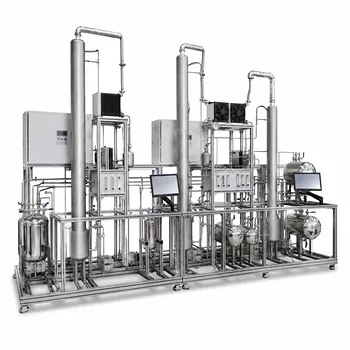
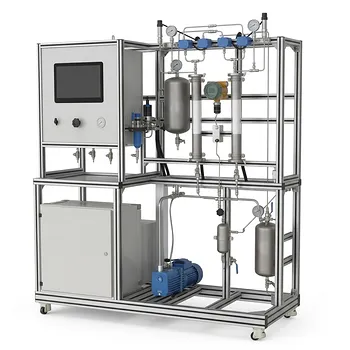
Ensure student safety and precise analytical training with LABPARK. We provide state-of-the-art Educational and Vocational Unit Operations Pilot Plants in chemical engineering, bioprocess & biotech, and environmental & water treatment designed specifically for universities, research institutes, and enterprises.
Ready to elevate your practical training and research capabilities? Contact us today to discover our robust distillation pilot plant solutions!
Related Products
- Multi-Functional Special Distillation Educational Pilot Plant
- Multi-Modal Distillation Unit Operations Training Pilot Plant
- Continuous Batch Extractive Distillation Educational Pilot Plant
- Continuous Sieve-Plate Distillation Pilot Plant for Unit Operations Laboratory Education
- Green Anhydrous Ethanol Refining Practical Training Pilot Plant
People Also Ask
- Why does simple distillation yield higher efficiency than flash distillation? Key thermodynamic differences.
- How does double temperature difference control improve distillation pilot plants? Stabilize purity.
- How to Integrate Spectroscopy in Distillation Pilot Plants for Advanced Process Control
- How to Verify Distillation Boundary Lines & Composition Regions with Pilot Plants
- Why is the acentric factor important in pilot plants? Fluid property prediction.