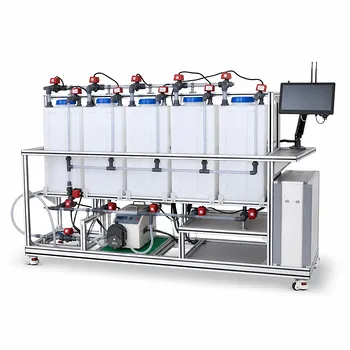
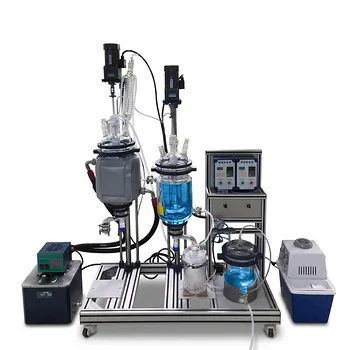
Operational viscosity spikes, scaling, and foaming are not just inconveniences—they are fundamental thermodynamic and fluid dynamic limits. These shifts directly degrade the heat transfer coefficient, physically block flow paths, and contaminate distillate streams. An educational pilot plant tackles these challenges not just by surviving them but by engineering transparent, measurable responses into the system so students can witness the physics in real time.
The core purpose of an educational pilot plant is to transform material property changes from a "black box" nuisance into an observable, controllable variable. The design must accommodate high viscosities via positive displacement pumping, combat scaling through forced-circulation velocity and easy disassembly, and demonstrate effective entrainment separation to preserve heat duty and product purity.
The Physics of Breakdown
As the solvent mass decreases, the remaining solute fundamentally changes the fluid’s behavior, attacking your system on three fronts.
The Fluid Dynamic Resistance of Viscosity
Concentration increases directly lead to exponential increases in viscosity. This isn't a linear problem; a fluid that moves like water at startup can become a non-Newtonian paste near the target endpoint.
This subjects the system to a severe reduction in the Reynolds number. Flow transitions from turbulent to laminar, destroying the heat transfer coefficient and turning your heat exchanger into a slow cooker that burns the product. An educational plant must demonstrate this shift.
Standard centrifugal pumps cavitate and lose flow under these conditions. The solution is integrating variable-speed positive displacement pumps. These allow students to control the flow rate independently of viscosity, maintaining a stable velocity to preserve heat transfer and prevent stagnation.
Scaling as a Thermal Insulator
Precipitation doesn’t just form a solid; it forms a ceramic-like insulating layer on the transfer surface. Scale buildup imposes a resistance that can drop the overall heat transfer coefficient by 50% or more in a single run.
Educational rigs must prioritize for "forced circulation" modes for saline or mineral-heavy feeds. The primary reference indicates that maintaining high tube velocities is critical for defense against deposition. The plant design should allow students to contrast a low-velocity natural circulation run against a turbulent forced-circulation run, measuring the subsequent drop in steam economy.
Entrainment and Purity Collapse
Foaming is a product thief. Bubbles carry liquid droplets into the vapor headspace, bypassing the separation process. This contaminates the downstream condensate and ruins the material balance for the pilot run.
Designing for Visibility, Not Just Productivity
Supplemental references stress that industrial users select hardware to match physical properties. An academic rig must contain multiple hardware types to fail safely. It should show why a rising-film evaporator is the wrong choice for a heat-sensitive, viscous fluid by allowing the student to observe dry-out and film breakup.
The Active Response Toolset
Pilot equipment must be a sensor-rich environment that enables active countermeasures:
- Hydrodynamic Defense: Integrated variable-speed recirculation pumps display real-time pressure drops. Students calculate the Reynolds number live to see when they cross the critical threshold into laminar flow failure.
- Thermal Stability Control: In exercises focusing on thermal degradation, the plant needs accurate vacuum control. Reducing pressure lowers the boiling point, protecting sensitive molecules from the prolonged heat mentioned in the supplementary references.
- Mechanical Agitation: For extreme pastes, a wiped-film rotor becomes essential. The pilot plant should feature a transparent shell section where possible, demonstrating how the blades spread a thin film to overcome conductive resistance.
- Physical Mitigation: A cleanable geometry is a primary operational feature. The plant should include centralized Cleaning-in-Place (CIP) connections or rapid-clamp sanitary fittings for manual teardown, reinforcing that accessibility dictates cleanability.
- Separation Integrity: A cyclonic or mesh-style entrainment separator, with differential pressure taps, provides the teachable moment for purity preservation.
Understanding the Trade-offs
The hardware used to solve one challenge invariably introduces another limitation.
Forced circulation rigs exemplify this tension. They prevent scaling and offer high heat transfer in viscous fluids, but they do so at a cost. A high recirculation flow rate requires a larger, energy-intensive pump with a significant electrical load. Furthermore, using a pressurization strategy to suppress boiling inside the tubes means the fluid exits in a superheated state that can "flash" violently downstream, potentially causing severe product degradation if not controlled.
Scraped-surface (wiped-film) evaporators trade simplicity for mechanical complexity. They are the only real solution for fluids quickly exceeding 1000 mPa·s, but they introduce mechanical heat and require precise rotor tolerance. The educational value lies in balancing the cost of vacuum-driven, gentle evaporation against the high purchase price and maintenance burden of a rotating mechanical device.
Making the Right Choice for Your Goal
The operational endpoint is not just running a pilot plant; it’s understanding the physical constraints of the fluid. Translate your upstream raw material obstacles into a design choice using the following guide.
- If your primary focus is mimicking a reaction mass with severe scaling potential: Specify a forced-circulation design with a recirculation pump achieving a 2.0–3.5 m/s tube velocity, and prioritize a layout with sanitary clamps for immediate post-run teardown.
- If your primary focus is concentrating temperature-sensitive biologics or high-viscosity polymers: Integrate a scraped-surface or wiped-film evaporator in series with a precise vacuum system to decouple heat input from film thickness.
- If your primary focus is training operators on fundamental fluid dynamics: Deploy a versatile falling-film unit with variable-speed feed and CIP. The transparent feedback of failing film coverage on a low-viscosity entry is the fastest way to cement the link between rheology and heat transfer.
The greatest engineering lesson a pilot plant teaches is that the fluid dictates the process—your job is simply to provide the correct physical architecture for the task.
Summary Table:
| Evaporation Challenge | Physical Effect on System | Educational Pilot Plant Solution |
|---|---|---|
| Viscosity Spikes | Laminar flow transition, destroyed heat transfer coefficient, pump cavitation | Variable-speed positive displacement pumps, wiped-film rotors |
| Scaling & Deposition | Thermal insulation, 50%+ drop in heat transfer coefficient | Forced-circulation mode (high velocity), easy-to-clean CIP/clamp geometry |
| Foaming & Entrainment | Liquid carryover, distillate contamination, product yield loss | Cyclonic/mesh entrainment separators, precise vacuum control |
Build a Smarter Engineering Lab with LABPARK
Equip your students to master real-world thermodynamic and fluid dynamic challenges. LABPARK provides state-of-the-art Educational and Vocational Unit Operations Pilot Plants in chemical engineering, bioprocess & biotech, and environmental & water treatment tailored for universities, research institutes, and enterprises.
Ready to enhance your curriculum with hands-on, transparent, and resilient evaporation systems? Contact LABPARK today to discover our custom pilot plant solutions!
Related Products
- Supercritical High-Gravity Flash Evaporation Educational Unit Operations Pilot Plant
- Rising and Falling Film Evaporation Educational Unit Operations Pilot Plant
- Natural Product Extraction Unit Operations Training Pilot Plant
- Continuous Sieve-Plate Distillation Pilot Plant for Unit Operations Laboratory Education
- Thermal Desorption Exhaust Gas and Tail Water Treatment Educational Pilot Plant
People Also Ask
- How is the heat transfer area calculated for an evaporation unit operations pilot plant during experimental design? Guide
- How to select educational evaporator pilot plants for thermal & scaling solutions? Complete Guide
- What is the practical significance of Kb in pilot plant evaporation? Master process design.
- How do flash calculations relate to flash evaporation pilot plants? Bridge Theory and Practice
- Vacuum vs. Atmospheric Evaporation: Key Pilot Plant Trade-Offs to Evaluate