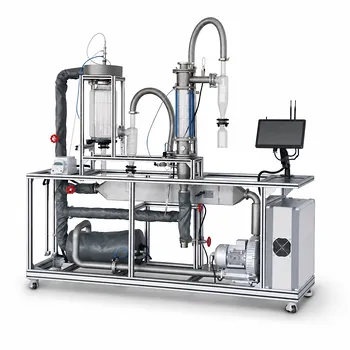
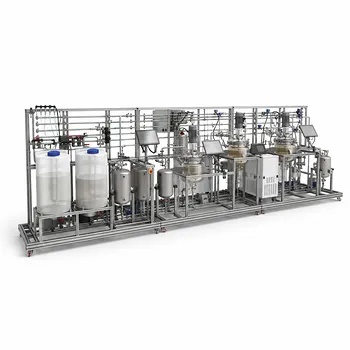
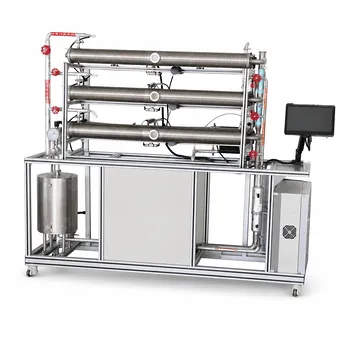
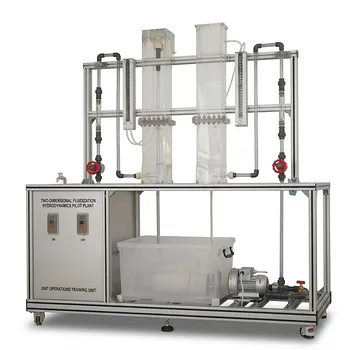
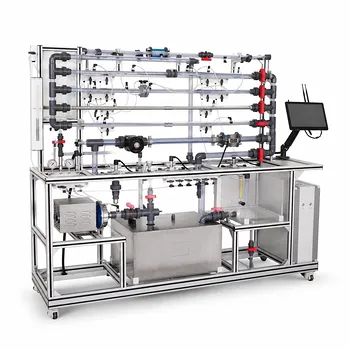
The holy grail of process scale-up is a predictable, mathematically grounded transition from lab to plant. To achieve this with a unit operations pilot plant, you must follow a structured methodology that combines first-principles modeling, the identification and control of scale-sensitive parameters, Design of Experiments (DOE) to map multivariate interactions, and Multivariate Statistical Process Control (MSPC) to validate that operational boundaries remain robust. The pilot plant’s role is not to simply reproduce a recipe, but to serve as the intermediate validation step where these four pillars are integrated into a proven, empirical design space.
A unit operations pilot plant transforms scale-up from an art of guesswork into a science of engineered certainty. The true methodology is not a single formula—it is a systematic workflow that uses the pilot plant to verify that a multivariate design space, built from first principles and DOE, holds firm against the physical realities of a larger scale.
The Four Pillars of a Successful Pilot Plant Scale-Up
The core methodology revolves around four sequential and interconnected activities. Rely on them together rather than in isolation.
1. Start with First Principles, Not Just Trial and Error
Before any pilot experiment begins, build a theoretical foundation. Use mass and energy balances, reaction kinetics, and transport phenomena to predict how the process should behave at scale.
This step ensures you have a hypothesis to test—not just a hope. Mathematical models can estimate required heating/cooling duties, vessel volumes, and potential bottlenecks, giving you a north star for the experimental campaign.
2. Identify and Neutralize Scale-Sensitive Parameters
Not all process variables scale linearly. Parameters like agitation shear rate, mass transfer coefficient, or residence time distribution are notorious for changing with size.
Your methodology must distinguish scale-dependent variables (e.g., impeller RPM, jacket heat-transfer area) from scale-independent ones (e.g., specific energy input, tip speed under certain regimes, residence time in a plug-flow unit). For example, simply maintaining constant tip speed during crystallization scale-up may fail to keep solids suspended, while scaling on constant energy dissipation rate (P/V) preserves homogeneity and reduces attrition. Your pilot-plant work wires these choices into a solid control strategy.
3. Map the Multivariate Landscape with Design of Experiments
Single-factor testing is blind to the interactions that dominate real processes. A rigorous DOE approach—manipulating multiple variables simultaneously—reveals how factors like feed rate, temperature, and screw speed co-influence quality.
In extrusion, for instance, DOE maps how lower feed rates increase backmixing and residence time, while aggressive screw profiles drive up melt temperature through viscous dissipation. The resulting empirical model defines the multidimensional boundaries within which product quality stays on target. The pilot plant provides the realistic environment to run these multi-variable batches without jeopardizing full-scale assets.
4. Validate and Monitor with Multivariate Statistical Process Control
Raw sensor data in a pilot plant is rich but noisy. MSPC and latent variable methods turn that noise into a diagnostic lens. They consolidate tens or hundreds of measurements into a few statistical scores that reveal when the process is drifting outside its design space.
This is the capstone of the methodology: it proves that the multivariate boundaries you defined in the lab and explored in the DOE actually hold true when the pumps, pipes, and powder flows are larger. It shifts your mindset from checking single-point specs to monitoring the process path—the entire fingerprint of mass, energy, and momentum balances.
The Pilot Plant as a Data Engine, Not Just a Big Reactor
Executing the four pillars requires a pilot plant that is instrumented and purposeful. It must generate the data that validates your models.
Bridging the Gap Between Models and Reality
Empirical data from the pilot plant validates your mass and energy simulations. It verifies that vessel sizing is adequate—preventing overfilling during agitation or boil-off—and confirms that material inputs, step durations, and yields match theoretical predictions.
This cross-check surfaces errors early, like missing reaction enthalpies or underestimated pressure drops, that would otherwise become costly surprises in the production plant.
Introducing Safe Process Upsets and Failure Modes
You can’t push a commercial reactor to its breaking point. You can and should do it in the pilot plant. Deliberately introduce upsets—block a flow, run at the edge of suspending solids, elevate a temperature ramp—to identify process limitations and characterize failure scenarios.
The data lets you design interlocks, backup unit operations, and safe operating envelopes that turn a process hazard analysis into a practical, tested safeguard. This is where risk assessment moves from theoretical to proven.
The Overlooked Complexity: Process Path vs. Endpoint Quality
A common mistake is scaling up by simply matching final product specifications. The pilot-plant methodology corrects this thinking.
Why Univariate Charts Mislead
Focusing on a single quality attribute—like a mean particle size—can hide the fact that the process path was wildly different. Two batches may end at the same point, but one might have experienced a longer high-shear window, making it brittle or morphologically unstable.
The pilot plant, equipped with proper instrumentation, allows you to track the entire process signature—the trajectory in a multivariate space defined by energy input, mass accumulation, and intermediate states. Scale-up success means replicating the path, not just the destination.
How PAT Transforms Scale-Up Decision Making
Process Analytical Technology (PAT), such as near-infrared (NIR) spectroscopy, captures the complete sample matrix in real time. This multivariate signal, when analyzed with latent variable models, reveals subtle shifts in reaction endpoints, phase transitions, or homogeneity that no single measurement would detect.
In the pilot plant, PAT becomes the control tower that tells you whether the design space is holding steady as geometry and hold-up volumes change. It converts the black box of scale-up into a transparent, data-driven narrative.
Understanding the Trade-offs
No methodology is cost-free. Applying this structured approach requires investment and discipline.
- Resource Intensity: A full DOE with PAT and MSPC demands time, sensor infrastructure, and skilled data analysts. However, the cost pales compared to the expense of a failed commercial batch.
- Imperfect Scale-Down: Even the best pilot plant is not a perfect miniature. Some multiphase effects (e.g., bubble coalescence in tall columns) may still surprise you. The methodology mitigates this by identifying where models break down, giving you a targeted list of unknowns to manage.
- Constant P/V Pitfalls: Scaling on constant energy dissipation rate is a powerful starting point, but it can lead to higher maximum shear rates near the impeller at larger scales if geometry is not matched perfectly. The pilot plant helps you see that sensitivity and adjust the target range.
- MSPC Requires Contextual Expertise: Statistical alarms are only as good as the engineering judgment behind them. Without process knowledge, you risk chasing noise or missing a true deviation. The methodology is a partnership between data science and physical understanding.
Making the Right Choice for Your Scale-Up Goal
The methodology is robust, but you can adapt its emphasis to your primary business or technical objective.
- If your primary focus is minimizing process risk: Heavy-weight the first principles and the deliberate process-upset testing. Use the pilot plant to find the edge of your design space and build a buffer zone of operational safety.
- If your primary focus is ensuring batch-to-batch quality similarity across scales: Concentrate on the DOE and MSPC arm. Invest in PAT to map the full process path and use multivariate models to define your release boundaries.
- If your primary focus is expediting time-to-market while maintaining robustness: Prioritize the identification of scale-sensitive parameters and use a focused factorial DOE to nail down the absolute critical variable interactions—leaving less sensitive parameters at robust center points for later optimization.
A unit operations pilot plant, operated under this four-pillar methodology, does more than prove a process works—it builds an empirical fortress around your design space, giving you the confidence to transfer, scale, and manufacture with predictable quality.
Summary Table:
| Scale-Up Pillar | Core Focus | Key Objective |
|---|---|---|
| 1. First Principles | Mass & energy balances, kinetics, transport | Establish theoretical baseline predictions |
| 2. Scale-Sensitive Parameters | Agitation, shear rate, mass transfer | Identify scale-dependent vs. independent variables |
| 3. Design of Experiments (DOE) | Multivariate interactions, process limits | Map the multidimensional design space boundaries |
| 4. MSPC & PAT | Real-time monitoring, process signatures | Validate that boundaries remain robust at scale |
Partner with LABPARK for Reliable Process Scale-Up and Training
To successfully define operational boundaries and bridge the gap between lab research and industrial scale, you need reliable, highly instrumented equipment.
LABPARK provides industry-leading Educational and Vocational Unit Operations Pilot Plants tailored for universities, research institutes, and enterprises. We deliver robust solutions across:
- Chemical Engineering: Distillation, extraction, and reactor systems.
- Bioprocess & Biotech: Fermentation and bioreactor pilot units.
- Environmental & Water Treatment: Advanced filtration and wastewater processing.
Equip your facility with the tools to minimize scale-up risks and train the next generation of engineers. Contact our experts at LABPARK today to discuss your project requirements!
Related Products
- Multi-Functional Drying Educational Unit Operations Pilot Plant
- General Purpose Cosmetics Production Unit Operations Training Pilot Plant
- Multi-Reactor Educational Pilot Plant for Reaction Engineering Unit Operations
- Dual-Mode Rectification Pilot Plant for Practical Training Unit Operations
- Multimodal Absorption and Desorption Pilot Plant for Unit Operations Training
People Also Ask
- How do deviations in estimating latent heat impact pilot plant thermal systems? Avoid hardware mis-sizing.
- How to study gasification in pilot plants? Compare exit gas composition & efficiency
- Why Use PTFE & Hastelloy in Chemical Pilot Plants? Prevent Corrosion & Ensure Safety
- Why is the chemical plant startup schedule crucial? De-risk scale-up with pilot plants.
- When to transition from PID to adaptive control in pilot plants? Key process indicators.