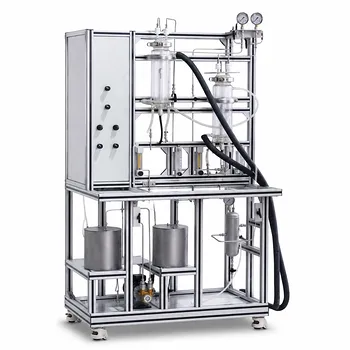
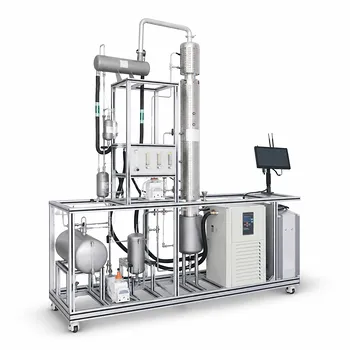
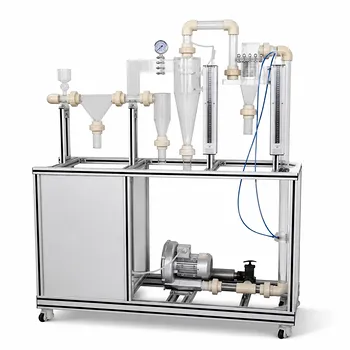
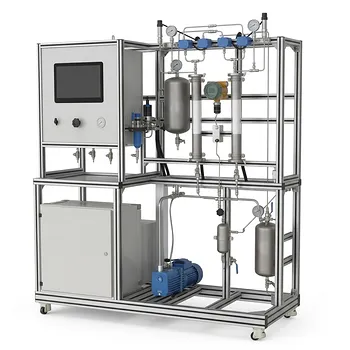
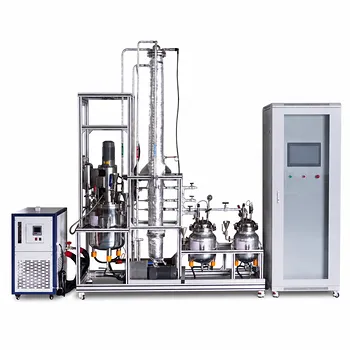
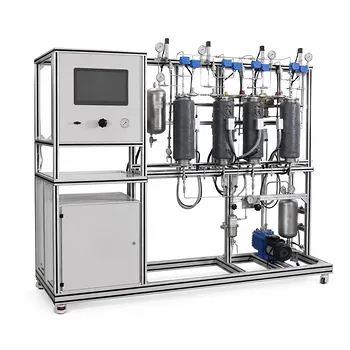
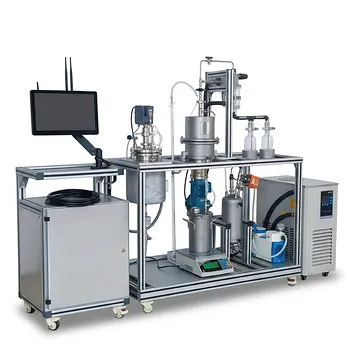
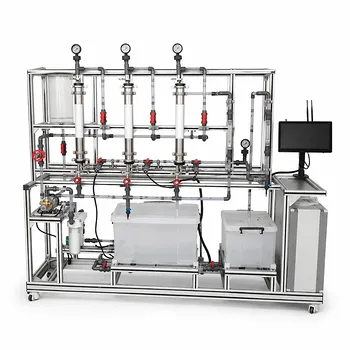
Here is the definitive guide to the critical focus areas. When training students on chromatographic separation using bioprocess pilot plants, the investigation must center on column temperature, mobile phase flow rate, buffer/mobile phase concentration, and gradient time parameters. These foundational chromatographic factors act as direct levers on peak resolution, retention time, and baseline quality, giving students a tangible understanding of how operational deviations impact separation efficiency at a meaningful scale.
Students often approach a pilot plant as just a bigger lab column. The real lesson is that a pilot plant is a system where thermodynamic, kinetic, and fluid dynamic variables intertwine. The core training goal is not just to run a separation, but to build a predictive mental model linking adjustable inputs to quality attributes, directly mirroring industrial robustness testing and method validation.
The Core Manipulable Process Variables
The primary reference rightly identifies the operational "dials" a student can turn during a run. However, their full importance is only unlocked when students connect a physical adjustment to a mechanistic outcome in the column bed. The learning must move from "turn the knob" to "control the separation."
Temperature: Governing Viscosity and Interaction Kinetics
Column temperature is far more than a simple environmental condition. It is a critical kinetic and thermodynamic variable. By having students intentionally vary the column jacket temperature, they can observe how it reduces mobile phase viscosity, directly lowering the column backpressure. More importantly, temperature changes the kinetics of the solute’s adsorption and desorption with the stationary phase. Students should measure how a 5-10°C shift can measurably reduce retention times and sharpen late-eluting peaks, a direct illustration of enhanced mass transfer.
Flow Rate: The Master Control of Resolution and Time
Mobile phase flow rate is the primary economic driver in chromatography, and students must directly investigate its profound trade-off. Encourage them to run the same separation at systematically increasing linear velocities. They will see a visual, data-driven demonstration of the van Deemter curve: resolution initially improves or holds steady, but beyond an optimum point, peak broadening becomes severe. The deep learning moment is calculating the Height Equivalent to a Theoretical Plate (HETP) at each flow rate. This transforms an abstract equation into a concrete performance map they created, directly applicable to optimizing throughput in good manufacturing practice (GMP) production.
Buffer and Mobile Phase Composition: Precision in Elution Strength
In a pilot plant, the "concentration" of a buffer or organic modifier is a digital, precision-controlled parameter, not an approximate bench mix. Students must investigate how a seemingly minor 1-2% error in an isocratic method or a mis-timed step in a salt gradient can catastrophically collapse resolution. The key exercise is to have them prepare and verify eluents with process-scale conductivity and pH meters. The lesson is one of absolute precision: at this scale, a poorly mixed or unverified buffer is a batch failure risk, linking operator discipline directly to critical quality attributes.
Gradient Time and Shape: Sculpting the Separation Space
Beyond a simple linear gradient from point A to B, a pilot plant allows students to investigate gradient slope and isocratic hold steps. They should design experiments changing the gradient steepness (e.g., from 2% to 5% organic modifier per column volume). This leads to the powerful insight that a shallower, longer gradient increases peak capacity and resolution for complex samples like protein digests but at the cost of process time and buffer consumption. Let them experience the real-world tension between high resolution and manufacturing efficiency.
Deconstructing the Chromatogram: From Peaks to Performance
Controlling input variables is pointless without a rigorous framework for evaluating the output. A pilot plant’s data acquisition system gives students a stream of rich data, and their training must center on translating peak shapes into a diagnosis of column health and method quality.
Why Packing Quality is the Primary Determinant of Success
The supplementary reference highlights a non-negotiable truth: a poorly packed column cannot be saved by fine-tuning the method. Students must experience this directly. Have them run an acetone pulse test on a poorly packed column (perhaps intentionally uneven) and on one packed with automated slurry systems for perfect uniformity. The difference in peak asymmetry and HETP will be stark. Investigating variables like slurry concentration ratio and settling velocity before the run connects bed mechanics directly to the resulting chromatogram's integrity and teaches them that scale-up is first a mechanical challenge.
Using Retention and Peak Width to Diagnose the System
Effective training links a number on a screen to a physical process inside the column. Students shouldn't just record retention time; they must calculate critical derived parameters.
- Dead Time: By injecting a non-binding tracer, they measure a system’s extra-column volume. A higher-than-expected dead time points to a plumbing or frit issue, not a chemistry problem.
- Adjusted Retention Time: This isolates the net time the solute spends interacting with the stationary phase. Changing the flow rate while monitoring this value reveals how fundamentally kinetic the separation is.
- Peak Width and Column Efficiency: Requiring students to measure peak width at half-height and calculate the theoretical plate number
Nimmediately shows the dispersion penalty of increased flow rate. The key insight is that plate count is not fixed; it’s a dynamic response to their operational choices.
Relating Theory to Industrial Scale-Up Economics
The primary training gap between a university lab and an industrial bioprocess plant is the economic imperative of scale-up. The supplementary references guide this directly. For a separation where the selectivity factor is low—less than 1.15—efficiency is the only tool. Students must investigate the pressure-flow relationship and grasp why this forces a design choice: a longer, narrower, high-pressure column. Conversely, for an easy separation with high selectivity, they can practice scaling out by using a shorter, wider column, where the learning pivots to diagnosing wall effects and the performance of distributor plates to prevent channeling.
Understanding the Trade-offs and Common Pitfalls
To build genuine competence, you must move beyond theory and let students manage real failure modes in a low-stakes environment. The pilot plant is the perfect place to safely cause problems and then solve them.
The Resolution-Throughput Conflict
This is the central, irreconcilable trade-off in process chromatography. A student’s impulse is often to run at a low flow rate to maximize resolution. Have them calculate the resulting process time and buffer costs for a hypothetical 1000-liter batch. Then, let them run at a faster, commercially-viable flow rate and see if the resolution loss is acceptable. The lesson is that "good enough" resolution achieved quickly is almost always more valuable than "perfect" resolution that takes three times as long.
When Column Overload Masquerades as Bad Chemistry
Students often misinterpret the symptom of broad, fronting peaks as a mobile phase or chemistry issue. A pivotal training exercise is a variable loading study. Have them inject the same sample at increasing mass or volume loads onto the column. They will directly observe the rapid degradation of efficiency once the adsorbent’s binding capacity is breached. This shows that pilot plant problems are often about mass balance and capacity limits, not just the separation factors, and links directly to bioprocess yield calculations.
The Danger of Inconsistent Bed Height and Voiding
Pilot-scale dynamic axial compression columns are complex. A critical operational variable is maintaining a constant bed height and preventing a void space from forming at the column inlet. Students should be trained to monitor the hydraulic pressure of the piston head and the pressure drop across the bed. If the bed settles and a headspace forms, the mobile phase will take the path of least resistance, leading to catastrophic peak splitting and doublet peaks throughout the run. The lesson is that mechanical vigilance is a core chromatographic skill.
Making the Right Choice for Your Training Objective
The specific variables to emphasize depend entirely on the course’s ultimate goal. A bioprocess engineering curriculum requires a different lens than an analytical chemistry course.
- If your primary focus is biopharmaceutical process development: Center every investigation on resolution and impurity clearance under variable loading conditions. The deep lesson is that a process is defined by its failure limits, not just its ideal condition.
- If your primary focus is analytical method transfer and validation: The investigation must be a systematic robustness study. Guide students to use a Plackett-Burman factorial design to vary all four primary parameters simultaneously, quantifying which factor most critically controls the critical pair resolution.
- If your primary focus is chemical engineering unit operations: Integrate the chromatography step with upstream and downstream processes. Have students measure the impact of a fluctuating eluent feed concentration from a prior reaction step on column performance, and then optimize in-line blending to correct it.
- If your primary focus is fluid mechanics and scale-up: De-prioritize the separation chemistry. Instead, investigate the pressure drop profile as a function of bed height and flow rate, use tracer tests to quantify axial dispersion, and benchmark the performance of different flow distributor designs.
The ultimate goal of pilot-plant training is not to produce perfect chromatograms, but to produce engineers and scientists who can predictably control the output of a complex, dynamic system under real-world constraints.
Summary Table:
| Key Variable | Mechanistic Impact | Primary Learning Outcome |
|---|---|---|
| Temperature | Alters mobile phase viscosity and adsorption kinetics | Understand mass transfer and column backpressure |
| Flow Rate | Balances resolution and run time (van Deemter curve) | Map column efficiency and calculate HETP |
| Buffer Concentration | Controls elution strength and peak resolution | Practice precision preparation to prevent batch failure |
| Gradient Time | Sculpts peak capacity and resolution for complex samples | Balance high-resolution purity against process cycle time |
Elevate Your Bioprocess & Chemical Engineering Training
At LABPARK, we design and supply premium Educational and Vocational Unit Operations Pilot Plants across chemical engineering, bioprocess & biotech, and environmental & water treatment. Specially engineered for universities, research institutes, and enterprises, our pilot plants bridge the gap between classroom theory and industrial reality.
Help your students and researchers master critical variables like column temperature, flow rate, and gradient optimization on industry-grade systems. Contact LABPARK today to find the perfect pilot plant solution for your lab.
Related Products
- Bio-fermentation Ethanol Production Practical Training Unit Operations Pilot Plant
- Multi-Functional Membrane Separation Educational Pilot Plant for Unit Operations Lab
- Hot Filtration Educational Unit Operations Pilot Plant Laboratory System
- Photocatalytic Membrane Separation and Degradation Unit Operations Pilot Plant
- Continuous Sieve-Plate Distillation Pilot Plant for Unit Operations Laboratory Education
People Also Ask
- Why Use PTFE & Hastelloy in Chemical Pilot Plants? Prevent Corrosion & Ensure Safety
- Why Compare Predicted and Experimental Excess Enthalpy? Key to Accurate Pilot Plant Scale-up
- Why is the chemical plant startup schedule crucial? De-risk scale-up with pilot plants.
- When to transition from PID to adaptive control in pilot plants? Key process indicators.
- Why must batch and fed-batch fermentation pilot plants be designed to accommodate changing rheological conditions?