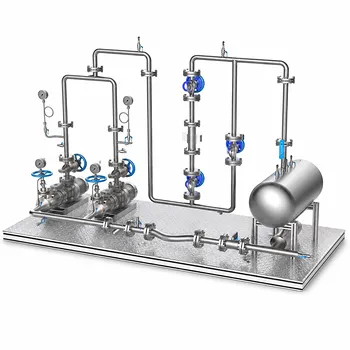
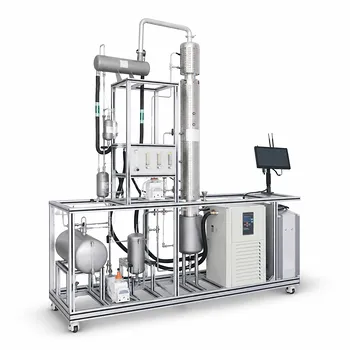
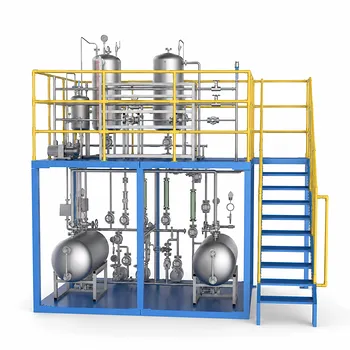
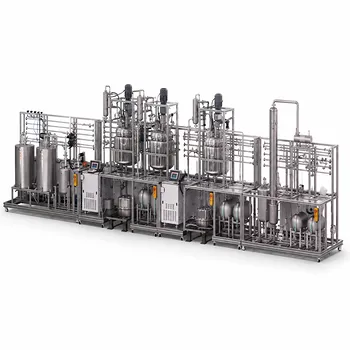
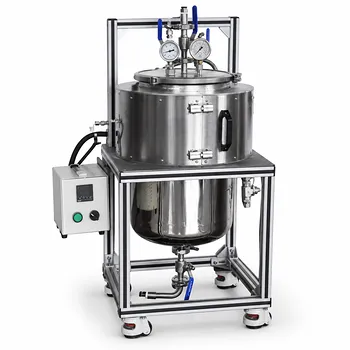
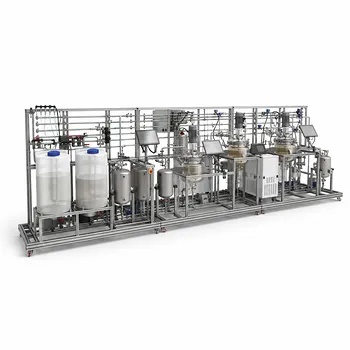
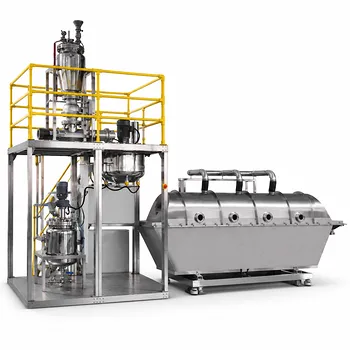
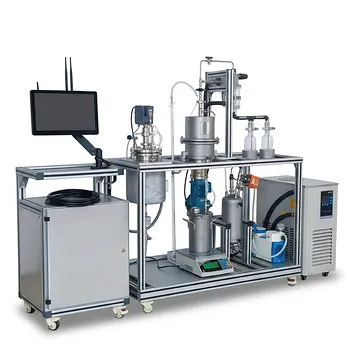
A pilot-scale process safety evaluation is not a single study but a rigorous, multi-layered investigation. It must critically assess the reaction chemistry, the thermal stability of all materials, and the physical integrity of the equipment under the new, larger scale. This assessment moves beyond theoretical hazards to define the practical safe operating limits that prevent fires, explosions, and toxic releases.
The core challenge of scale-up is that the physics of heat and mass transfer change dramatically from the lab bench. A formal process safety evaluation is your systematic method to identify these new risks. It must confirm that the reactor can control the heat it generates, that the materials can withstand the process conditions over a longer duration, and that the facility is prepared for a worst-case scenario.
The Three Pillars of a Scale-Up Safety Assessment
Before a single gram of material is processed in a pilot plant, your evaluation must provide definitive answers across three critical domains.
Defining the Reaction Hazards at Scale
The reaction that ran safely in a 100 mL flask can behave unpredictably in a 20 L reactor. This is due to fundamental changes in heat and mass transfer.
The heat of reaction and mixing effects become paramount. A larger vessel can lose its ability to remove heat as efficiently as a small flask, leading to a dangerous accumulation of unreacted material and a sudden, uncontrolled exotherm. Your evaluation must quantify the heat generation rate and confirm the pilot plant’s cooling capacity.
Raw material charge sequence and self-heating must be critically re-examined. An addition sequence that was safe at a small scale might create a high local concentration of a reactant at scale, initiating a runaway reaction. The assessment must also account for self-heating parameters, where a large mass of material in a vessel, dryer, or storage hopper can retain heat internally and decompose.
The potential for gas evolution and corrosivity must be measured, not assumed. A process that generated minimal gas in lab glassware could produce a catastrophic pressure rise in a sealed pilot vessel. Simultaneously, you must confirm that the corrosion rate on the specific pilot plant materials (like 316 stainless steel or gaskets) is acceptable under process conditions, including upset scenarios.
Validating Thermal and Chemical Stability
This pillar extends the hazard analysis to materials that are not actively reacting but are being held, heated, or isolated over time. The scale-up process inherently means longer cycle times.
Testing process stream stability under reflux is non-negotiable. A distillation that takes 30 minutes in a lab may take hours in a pilot plant due to a lower heat transfer area-to-volume ratio. This prolonged heat exposure at the highest anticipated pressure can cause thermal degradation of the product. The evaluation must physically test the process stream’s stability under these exact conditions.
The impact of jacket temperature and residue decomposition is another profound scale-dependent hazard. To achieve a reasonable distillation rate, a pilot plant reactor must use a jacket temperature far higher than the internal process temperature. This can cause solids deposited on the vessel wall to decompose rapidly. The safety assessment must determine the safe maximum jacket temperature based on the thermal stability of these residues.
Material incompatibility across the entire design envelope must be considered. Your evaluation must confirm that the chosen materials of construction can handle not just the "normal" operating temperature and pressure, but also the extremes. This includes verifying that carbon steel vessels won’t become brittle at low-temperature excursions and that pump seals and gaskets are compatible with the solvent streams.
Controlling the Physical Environment
At the pilot scale, the physical equipment and the environment you create within it introduce hazards that are largely absent from the laboratory. The evaluation must focus on the integrity of the containment and the control of energy.
Electrostatic discharge and dust explosion risks are primary physical threats. Flowing powders or non-conductive liquids through large piping can build a charge that finds a catastrophic discharge. Similarly, handling dry solids in hoppers creates a dust cloud explosion risk that must be evaluated, often for the first time at scale.
Sealing system integrity and leakage hazards are a continuous operational risk. Every joint, pump seal, sight glass, and gasket becomes a potential leak point. The risk multiplies significantly in systems with complex piping or frequent thermal expansion cycles. The evaluation must scrutinize the selected high-integrity sealing materials for the specific process chemistry and pressure profile.
Thermal and pressure extremes in utility systems are often overlooked. The most common hazard is a heat transfer system using thermal oil or another flammable fluid operating above its flash point. Your safety assessment must verify that the heating system is a robust, closed-loop design with its own independent safety relief and temperature cutoffs to prevent a major fire.
Structuring a Methodical Hazard Review
Individual data points are useless without a framework to connect them to the equipment and the operating procedure.
The Role of a Formal Hazard Analysis
A formal Process Hazard Analysis (PHA) or Hazard and Operability Study (HAZOP) is the engine of the safety evaluation. This is where the thermal and chemical stability data you've gathered is systematically applied to the plant’s design.
The methodology links equipment to deviation. A team uses the pilot plant’s Piping and Instrumentation Diagrams (P&IDs) and batch instructions to methodically question what happens when process parameters deviate from the norm. For a reactor, this means evaluating the consequences of a cooling water failure, an overcharge of a key raw material, or the complete loss of agitation.
The review validates layers of protection. The HAZOP’s output is not just a list of problems. It is a verified audit trail that confirms adequate safeguards—such as emergency relief systems, automated safety interlocks, and pressure relief valves—are in place to handle the identified overpressure or runaway scenarios.
Understanding the Trade-offs Between Safety and Operational Goals
An overly conservative safety evaluation can make a process economically non-viable, while an optimistic one can cause a disaster. Recognizing these inherent tensions is part of a mature technical assessment.
The Conflict of Speed, Purity, and Procedural Safety
Process intensification often increases risk. For example, using a pressurized flow and vacuum system in a large-scale chromatography column dramatically increases throughput, which is an operational goal. However, your safety evaluation must address the trade-off: this higher flow velocity generates friction and heat of adsorption, which can cause localized boiling. The final safe operating limit for flow may be lower than the theoretical maximum to prevent this physical hazard.
Automated Safeguards vs. Flexibility
Integrating industrial-grade safety into a pilot plant can reduce operational visibility. Automated safety interlocks and a closed-loop solvent recovery system are excellent for containment and preventing operator exposure. Yet, an evaluation must also consider how to monitor the process when direct visual checks—like seeing mixture behavior through a glass flask—are replaced by radar level sensors that can be rendered inaccurate by foaming. The procedure must be built to compensate for this inaccuracy, ensuring a safety margin for end-point detection.
Making the Right Choice for Your Safety Evaluation Plan
Your focus should be guided by the specific goal of the pilot campaign. The safety evaluation is a living process that must be re-validated for each new chemistry.
- If your primary focus is preventing a runaway reaction: Concentrate your testing budget on reaction calorimetry to define a clear maximum safe jacket temperature and confirm that a loss of cooling will not trigger a thermal explosion.
- If your primary focus is protecting the pilot plant facility: Direct the HAZOP to scrutinize the integrity of all pressure containment systems, paying close attention to the hazard of hot oil heat transfer systems operating above their flashpoint and the condition of every pump seal and gasket.
- If your primary focus is scaling up a distillation end-point safely: You must experimentally determine the thermal stability limit of your product at the highest anticipated boiling point and cross-reference this with the pilot radar level sensor’s margin of error to set a safe, minimum stop volume.
The ultimate value of a process safety evaluation is not the completion of a report, but the engineering judgment it provides to confidently walk the line between innovation and catastrophe.
Summary Table:
| Safety Evaluation Pillar | Key Focus Areas | Critical Risks Addressed |
|---|---|---|
| Reaction Hazards | Heat of reaction, raw material charge sequence, gas evolution | Runaway reactions, local exotherms, overpressurization |
| Thermal & Chemical Stability | Reflux stability, jacket temperature, material compatibility | Thermal degradation, residue decomposition, equipment corrosion |
| Physical Environment | Electrostatic charge, sealing systems, utility extremes | Dust explosions, hazardous chemical leaks, thermal oil fires |
Secure Your Scale-Up Operations with LABPARK
Ensure safety, compliance, and efficiency at every stage of your process scale-up. LABPARK provides premium Educational and Vocational Unit Operations Pilot Plants in chemical engineering, bioprocess & biotech, and environmental & water treatment tailored for universities, research institutes, and enterprises.
Ready to build a safe, reliable, and high-performing pilot system? Contact LABPARK today to discuss your project requirements with our technical experts!
Related Products
- Chemical Pipeline Assembly and Fluid Transport Practical Training Unit Operations Pilot Plant
- Fixed-Bed Chemical Reaction and Gas Dust Tar Removal Unit Operations Pilot Plant
- Ethyl Acetate Synthesis Unit Operations Pilot Plant for Practical Training
- Carbon Dioxide Hydrogen Methanol Synthesis Educational Unit Operations Pilot Plant
- Continuous Sieve-Plate Distillation Pilot Plant for Unit Operations Laboratory Education
People Also Ask
- Why distinguish Newtonian & non-Newtonian fluids in pilot plants? Prevent design errors.
- Gear vs Centrifugal Pumps in Pilot Plants: How do operating characteristics and power requirements differ?
- How is shaft work (We) used to determine pump specifications? Optimize pilot plant fluid transport design.
- How to determine the operating point of a centrifugal pump in a pilot plant? A practical guide.
- How does fluid density affect pump head and pressure? Avoid Pilot Plant Motor Overload