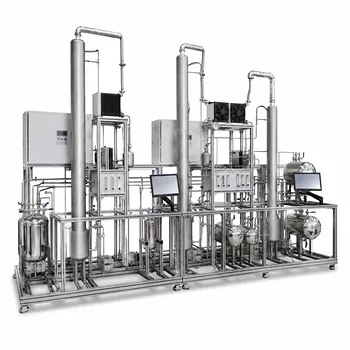
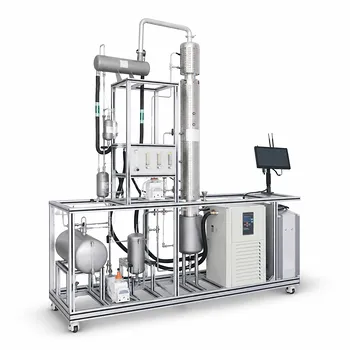
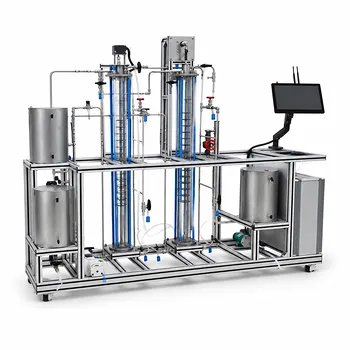
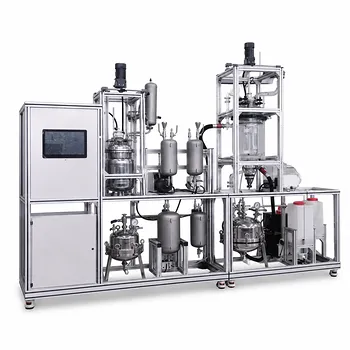
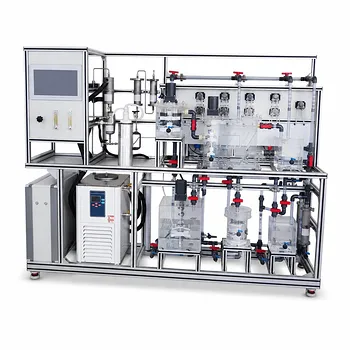
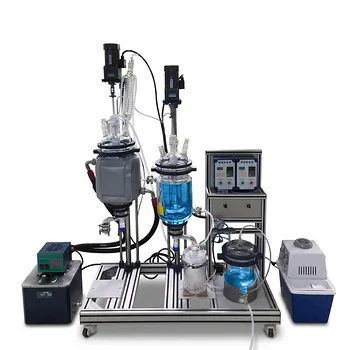
The definitive starting point for any extractive distillation pilot plant is a continuous, two-column system.
A standard teaching and research unit features an extractive distillation column and a solvent recovery column working in tandem. In the first column, a high-boiling solvent is fed near the top, above the raw mixture. This solvent selectively alters relative volatilities, pushing one purified component out the top. The solvent and the other component exit the bottom and flow to the second column, where the component is distilled overhead and the recovered solvent is recycled back to the first column.
Separating close-boiling or azeotropic mixtures requires a two-column pilot plant that demonstrates how a non-volatile entrainer manipulates vapor-liquid equilibrium. The extractive distillation column performs the core separation by altering volatility, while the solvent recovery column closes the loop, making a continuous, cost-efficient process possible for education and research.
The Two-Column Architecture
A pilot-scale extractive distillation system is not a single tower. It is a continuous, closed-loop process that mirrors industrial reality.
The Primary Separation Engine
The heart of the system is the extractive distillation column.
Here, a binary mixture with nearly identical boiling points or an azeotrope is separated.
The key is a high-boiling solvent (entrainer) introduced from a feed port located above the raw feed tray.
This placement maintains a high solvent concentration throughout the active separation section, from the solvent feed down to the bottom.
The Entrainer’s Selective Action
As the solvent descends, it preferentially interacts with one of the two components.
This interaction alters the relative volatility of that component, effectively pulling it downward.
The component whose volatility has been reduced is carried to the column bottom with the solvent.
The other component, now more volatile relative to the mixture, rises and exits as a high-purity distillate from the column top.
The Solvent Regeneration Loop
The bottom product is a binary mixture of the solvent and the second component.
This stream is immediately directed to the solvent recovery column.
Here, a simpler distillation takes place.
The second component, now freed from the solvent’s influence, is boiled off and collected as the overhead product.
Closing the Loop
The now-purified, high-boiling solvent collects at the bottom of the recovery column.
It is then cooled and recycled back to the extractive distillation column’s solvent feed port.
This closed-loop design is critical for demonstrating cost-effective, continuous operation in a teaching lab.
It eliminates the need for constant fresh solvent and teaches the principles of heat integration and material balance.
Critical Control Parameters for Effective Teaching
Pilot plants must be instrumented to make the underlying thermodynamic principles visible.
Certain variables must be precisely controlled to achieve separation and provide clear learning outcomes.
Solvent-to-Feed Ratio
This is arguably the most crucial parameter for a successful demonstration.
In classic teaching examples—like separating acrylonitrile (77.3°C) from acetonitrile (81.6°C) using water as the solvent—the water-to-feed ratio is typically set high, in the range of 8:1 to 10:1.
A higher ratio ensures a strong selectivity shift but also increases the reboiler duty in both columns.
Students can map how this ratio directly affects product purity and energy consumption.
Solvent Feed Location and Temperature
The solvent must enter the column at a precise point below the condenser but above the raw feed.
This creates a scrubbing zone where the downward-flowing solvent contacts the rising vapors from the feed stage.
Additionally, the solvent is often introduced at a controlled, slightly sub-cooled temperature.
This prevents excessive flashing and helps maintain a stable concentration profile across the column’s stages.
Reflux and Pressure Profiles
Precise reflux control at the top of the extractive column ensures the high-purity distillate is maintained.
Pressure drops across the column, measured by differential pressure transmitters, provide real-time insight into tray loading and the onset of flooding—key lessons for any chemical engineering student.
Understanding the Trade-offs and Limitations
No process is perfect. A pilot plant must reveal these compromises to deliver genuine educational value.
Energy Penalty
The solvent loop adds a significant energy burden.
You must now boil and condense not just the feed mixture, but also a large mass of recycled solvent. The reboiler duties of the extractive column and the recovery column together are substantially higher than a single conventional distillation.
Solvent Selection is Everything
The process only works if the solvent is miscible, non-azeotrope-forming, and selectively interacts with one component.
Water is safe and cheap, but it limits operating temperatures and may not work for all organic systems. The wrong solvent will fail to alter volatility or will create a new azeotropic nightmare.
Maintenance of Solvent Purity
The recovery column is vulnerable to thermal degradation of the solvent over time.
In a lab setting, routine sampling and gas chromatography analysis are essential to detect trace byproducts. A slight loss of solvent purity can sabotage the entire separation because the altered volatility effects depend on a clean entrainer.
Common Pitfalls to Avoid
- Flooding in the Extractive Column: The high liquid traffic from the large solvent flow can easily push the column into flooding. Pilot-scale operations must start with conservative vapor velocities.
- Incorrect Solvent Feed Temperature: Feeding the solvent too hot strips light ends prematurely; feeding it too cold quenches the vapor traffic and kills the separation profile.
- Neglecting the Recycle Loop Dynamics: Start-up transients in the closed loop can cause product purity to swing for hours. Teaching proper step-change analysis and control tuning is a major research benefit.
Making the Right Choice for Your Goal
The configuration you emphasize should match the educational or research objective.
- If your primary focus is teaching classical unit operations: Prioritize a transparent, well-instrumented two-column glass pilot plant, where students can visually trace the solvent and vapor flows and sample from every tray.
- If your primary focus is process control research: Invest in a system with dynamic sensors on the solvent recycle loop, enabling studies on multi-variable control, feed-forward adjustments, and disturbance rejection during solvent-to-feed ratio changes.
- If your primary focus is solvent screening and thermodynamics: Choose a pilot plant with a flexible solvent feed system and easy column reconfiguration, allowing you to test different entrainers and precisely map residue curves for saddle-point separations.
By marrying the classic two-column architecture with deep inquiry into control and thermodynamics, an extractive distillation pilot plant becomes an unparalleled platform for illuminating the invisible dance of molecules.
Summary Table:
| Component | Primary Function | Key Operational Parameter |
|---|---|---|
| Extractive Column | Separates close-boiling/azeotropic mixtures using an entrainer | Solvent-to-feed ratio & feed location |
| Recovery Column | Separates the target product from the solvent via distillation | Reboiler duty & solvent purity |
| Recycle Loop | Cools and returns recovered solvent to the primary column | Flow rate & loop thermal dynamics |
Elevate Your Chemical Engineering Lab with LABPARK
Are you looking to enhance your university, research institute, or enterprise's practical curriculum? LABPARK provides state-of-the-art Educational and Vocational Unit Operations Pilot Plants in chemical engineering, bioprocess & biotech, and environmental & water treatment.
Our custom-engineered pilot plants offer students and researchers hands-on experience with complex thermodynamic separations, solvent recovery loops, and advanced process control.
Ready to upgrade your training or research capabilities? Contact us today to discuss your specific requirements!
Related Products
- Green Anhydrous Ethanol Purification Extractive Distillation Unit Operations Training Pilot Plant
- Continuous Batch Extractive Distillation Educational Pilot Plant
- Multi-Functional Special Distillation Educational Pilot Plant
- Green Anhydrous Ethanol Refining Practical Training Pilot Plant
- Continuous Sieve-Plate Distillation Pilot Plant for Unit Operations Laboratory Education
People Also Ask
- How can energy balance equations for condensers & reboilers be validated experimentally? Guide
- Fugacity vs Activity Coefficient: How to Choose VLE Models for Distillation Pilot Plants
- How can real-time carbon number prediction improve distillation pilot plants? Optimize control.
- How Reflux Ratio Affects Distillation Pilot Plant Separation Efficiency & Limits
- Why is vacuum operation capability an essential feature for a distillation unit operations pilot plant? Unlock Efficiency