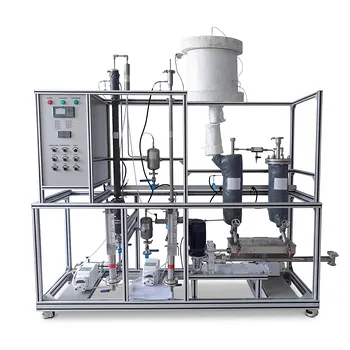
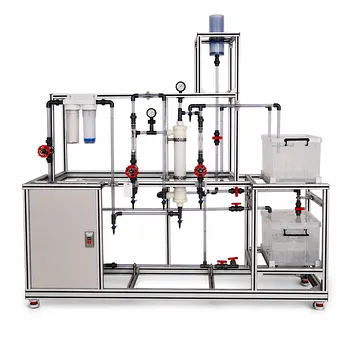
Supercritical fluid (SCF) integration transforms a standard pilot plant into a platform for advanced, sustainable chemical engineering. It allows universities and research institutes to move beyond textbook theory and physically demonstrate how a solvent like supercritical CO2 can replace hazardous organics, achieve high mass transfer rates, and enable a near-instant, residue-free separation of products from the solvent by a simple shift in pressure. This single unit operation simultaneously teaches core thermodynamic principles, process intensification, and green chemistry metrics in a hands-on environment.
The core value of SCFs in a pilot plant is twofold: they serve as a direct, practical demonstration of green solvent principles in action, and they offer a set of inherently efficient process advantages—tunable solvency, gas-like diffusivity, and effortless product recovery—that no traditional liquid solvent can easily replicate.
The Significance of SCF Technology in Pilot Plant Education and Research
Pilot plants are the bridge between a chemist’s beaker and a commercial reactor. Integrating SCF technology into this setting elevates that bridge from a simple scale-up exercise to a deep exploration of sustainable process design.
A Living Laboratory for Green Engineering Principles
The primary significance is pedagogical. SCFs, particularly supercritical CO2 (scCO2), materialize the principles of green chemistry in a way that lecturing alone cannot.
Students and researchers directly observe how a non-toxic, non-flammable solvent like CO2 can completely replace carcinogenic chlorinated solvents such as dichloromethane. The process eliminates toxic waste at the source, rather than managing it after the fact. This isn't just an extraction; it's a working model of pollution prevention.
Hands-On Mastery of Critical Process Variables
An SCF pilot plant is a powerful tool for teaching the relationship between phase behavior and process performance.
Near the critical point, minuscule changes in temperature or pressure cause dramatic shifts in fluid density and solvent power. Operators gain an intuitive feel for manipulating these variables—temperature, pressure, and co-solvent addition—to control extraction selectivity and yield. This experience in tuning a fluid’s properties in real time is irreplaceable training for modern chemical engineers.
A Modern Complement to Traditional Techniques
An SCF unit does not stand alone; it creates a comprehensive curriculum when compared with a classic technique like Soxhlet extraction.
The Soxhlet unit teaches fundamental solid-liquid mass transfer, equilibrium stages, and basic solvent recycling. Placed beside it, the SCF unit becomes a direct comparator, highlighting advanced concepts: how gas-like diffusivity shortens extraction times, how depressurization eliminates a distillation step, and how a cool process preserves heat-sensitive bioactives. This dual platform teaches critical evaluation of efficiency, operating cost, and environmental impact.
The Core Process Advantages of Supercritical Fluids
Beyond educational value, SCFs bring a unique set of physical properties that translate directly into powerful process advantages.
Superior Mass Transfer and Tunable Solvent Power
An SCF possesses a unique hybrid character: liquid-like density and gas-like viscosity and diffusivity.
The high density gives it strong solvent power to dissolve target compounds. Simultaneously, its gas-like transport properties mean it can penetrate a solid matrix and diffuse through it far faster than any liquid solvent. This directly results in high mass transfer rates and shorter extraction times. Furthermore, because solvency is a continuous function of density, a single pilot plant run can fractionate complex mixtures simply by ramping pressure, making it a tunable, intelligent solvent.
Effortless Separation and Zero Solvent Residue
The separation advantage is definitive. In a traditional process, separating a product from a solvent like ethanol or dichloromethane requires energy-intensive distillation, often leaving trace toxic residues.
With an SCF like CO2, this step collapses into a simple pressure reduction. When the system exits supercritical conditions, the CO2 flashes harmlessly into a gas, leaving the extracted product with zero solvent residue. This eliminates a major unit operation, slashes energy consumption, and delivers an ultra-pure product. In food or pharmaceutical applications, this complete removal of the solvent is a critical safety and compliance advantage.
Protecting Heat-Sensitive and High-Value Compounds
Supercritical CO2 extraction occurs under relatively mild temperatures, thanks to CO2's low critical point (31°C).
This creates a non-oxidative, low-temperature environment that conserves thermally labile bioactive compounds like antioxidants, flavors, and fragrances. Where steam distillation or hot solvent extraction would degrade the product, SCF technology preserves its structural integrity and potency. This is significant for high-value natural products, medicines, and botanical oils where quality is directly linked to value.
Environmental and Safety Performance Gains
By design, the technology eliminates the bulk of hazardous volatile organic compounds (VOCs) from the process flow.
The shift to scCO2 can reduce VOC emissions by 60% to 80% and remove the need for complex solvent recovery and disposal infrastructure. Since CO2 is non-flammable and non-toxic, the intrinsic safety of the operation improves dramatically, reducing explosion risks and health hazards for pilot plant operators.
Understanding the Trade-offs and Operational Realities
No technology is without trade-offs. A realistic assessment of SCF integration must weigh these powerful benefits against its practical demands.
High-Pressure Complexity and Capital Investment
The fundamental enabling challenge is the high-pressure environment.
Operating at and above 7.38 MPa demands specialized, thick-walled vessels, high-pressure pumps, and robust safety systems. The capital cost of a pilot-scale SCF unit is significantly higher than a comparable low-pressure extraction system. Safe operation requires rigorous training to manipulate pressure and temperature parameters without risk, adding a layer of operational discipline that does not exist in ambient-pressure processes.
Energy Considerations and Process Optimization
While depressurization recovers the product without distillation, the energy cost shifts to compression and thermal management.
Compressing CO2 to a supercritical state and recycling it in a closed loop requires power. The overall life-cycle energy and carbon footprint are not zero; they demand thoughtful process optimization and heat integration. The true "green" credential is won when the elimination of toxic solvents and distillation steps outweighs this compression cost, a balance a pilot plant teaches engineers to calculate and manage.
Making the Right Choice for Your Pilot Plant Program
The decision to integrate SCF technology should be driven by your core educational and research objectives. The pilot plant’s output is not just a product—it is the competency of the engineers who run it.
- If your primary focus is green engineering and sustainability education: Integrating an SCF unit is essential. It provides the definitive, hands-on demonstration of solvent replacement, waste prevention, and safe operations that lectures cannot deliver, making abstract metrics tangible.
- If your primary focus is the extraction of high-value, heat-sensitive bio-products: The SCF platform is the superior technical choice. Its low-temperature, oxygen-free environment and zero-residue guarantee directly preserve product quality and purity, which are critical for pharmaceutical or nutraceutical research.
- If your primary focus is teaching comparative process analysis and critical thinking: The ideal configuration is a pilot plant that pairs SCF with Soxhlet extraction. This combination forces a direct, data-driven comparison of classical and modern methods, teaching the core skill of evaluating a process for cost, efficiency, and environmental impact.
- If your primary focus is low-cost, basic material throughput: An SCF system is likely not the right fit. The high-pressure infrastructure and training requirements represent an investment that is justified by its advanced capabilities and educational value, not by simple, high-volume extraction.
Integrating SCF technology is a strategic choice to prioritize process intensification, product purity, and deep pedagogical value over simplicity.
Summary Table:
| Parameter | Supercritical Fluid (SCF) Technology | Traditional Solvent Methods |
|---|---|---|
| Solvent Residue | Zero residue (gas flashes off) | Often leaves toxic solvent trace |
| Mass Transfer | Fast (gas-like diffusivity, liquid-like density) | Slower (liquid diffusion rates) |
| Thermal Sensitivity | Low temp (e.g., 31°C for CO2), preserves bioactives | High temp distillation degrades compounds |
| Safety & Environment | Non-toxic, non-flammable (scCO2) | Hazardous, volatile organic solvents |
Bring Advanced Green Chemistry to Your Lab with LABPARK
Are you looking to bridge the gap between classroom theory and industrial application? LABPARK provides state-of-the-art Educational and Vocational Unit Operations Pilot Plants in chemical engineering, bioprocess & biotech, and environmental & water treatment.
We empower universities, research institutes, and enterprises to build hands-on expertise in advanced technologies like supercritical fluid (SCF) extraction, green engineering, and process intensification.
Ready to elevate your research and training capabilities? Contact our experts today to customize the perfect pilot plant solution for your facility!
Related Products
- Supercritical High-Gravity Flash Evaporation Educational Unit Operations Pilot Plant
- Fluidized Bed Gas Solid Catalytic Reaction Educational Pilot Plant
- Comprehensive Fluid Mechanics Educational Unit Operations Pilot Plant
- Multi-Reactor Educational Pilot Plant for Reaction Engineering Unit Operations
- Two Phase Flow Pattern Velocity Resistance Measurement Educational Pilot Plant
People Also Ask
- How is the heat transfer area calculated for an evaporation unit operations pilot plant during experimental design? Guide
- How to select educational evaporator pilot plants for thermal & scaling solutions? Complete Guide
- What is the practical significance of Kb in pilot plant evaporation? Master process design.
- How do flash calculations relate to flash evaporation pilot plants? Bridge Theory and Practice
- Vacuum vs. Atmospheric Evaporation: Key Pilot Plant Trade-Offs to Evaluate