You cannot trust a single-phase model. Answers from pilot plants designed with a simple plug-flow or CSTR assumption will be dangerously misleading. The significance of distinguishing the bubble and emulsion phases is that it is the only way to decouple the true chemical reaction rate from the physical mixing and mass transfer resistances that dominate a fluidized bed. By isolating the emulsion phase—where the solid reactant sits and the actual gas-solid reaction occurs—from the bypassing bubble phase, you can extract intrinsic kinetic parameters like reaction order and effective diffusivity, and build a model that scales reliably.
The fundamental challenge in gas-solid noncatalytic kinetics is that the fluidizing gas does not flow uniformly. It splits into a dense, reacting emulsion phase and a fast-moving, catalyst-dilute bubble phase. Without a two-phase analysis, any kinetic data you gather from a pilot plant is a convolution of true chemistry, gas bypass, and interphase mass transfer—making accurate scale-up impossible.
The Physical Reality of a Fluidized Bed
The moment gas exceeds the minimum fluidization velocity, the bed segregates into two distinct regions. Recognizing this physical reality is the starting point for any meaningful kinetic analysis.
How the Gas Splits
According to the two-phase theory, all gas in excess of that required to just suspend the particles travels as bubbles. The total flow (Q) divides linearly: the emulsion phase gas moves at approximately the minimum fluidization velocity (Umf), while the excess gas (U – Umf) forms the bubble phase. This split is the origin of every performance deviation from a fixed-bed reactor.
The Emulsion Phase: Where Reaction Rules
The emulsion phase is a dense suspension of solid reactant particles. The interstitial gas in this phase travels slowly through the void spaces, maintaining intimate contact with the solids. All the noncatalytic reaction—gasification, combustion, or solid conversion—takes place here, and material balances on the solid reactant must account for convection, dispersion, and the intrinsic chemical conversion rate.
The Bubble Phase: A Bypass Mechanism
Bubbles rise rapidly, contain little to no solid reactant, and act as conduits that shuttle unconverted gaseous reactant straight through the bed. Gas in a bubble has a drastically shorter residence time and a completely different contacting pattern. If this phase is ignored, the measured conversion will falsely suggest a much slower reaction than actually occurs in the emulsion.
Why a Two-Phase Model is Non-Negotiable for Kinetics
Treating the bed as a single well-mixed tank or a simple plug-flow reactor erases the heterogeneity that defines a fluidized bed. The two-phase model, by contrast, gives you the mathematical framework to isolate what you came to measure.
Decoupling Mass Transfer from Kinetics
The bubble and emulsion phases exchange gas continuously. The rate of this interphase mass transfer (quantified by bubble-to-emulsion exchange coefficients) often limits the overall conversion, not the intrinsic chemistry. By explicitly modeling the bubble phase cloud and the exchange rate, using Davidson’s bubble model, you can back-calculate the true solid conversion rate from the overall outlet concentration. This makes it possible to determine whether the apparent reaction order is zero or first, a distinction that defines reactor sizing.
Enabling Parameter Extraction for Solid Reactants
For noncatalytic reactions, the solid reactant itself changes over time. The emulsion phase material balance incorporates effective diffusivity through the product layer and the kinetic rate constant at the unreacted core. Coupling this with the bubble-phase balance—where gas flows and exchanges—lets you extract effective diffusivities and solid exit concentrations directly from pilot plant data. Without the two-phase split, these parameters are hopelessly entangled with hydrodynamic artifacts.
Accounting for Bubble Coalescence
Real fluidized beds are not populated with identical, solitary bubbles. As bubbles rise, they coalesce, and this merging process can increase the mass transfer coefficient of the leading bubble by two to three times. The two-phase framework accommodates this through empirical enhancement factors—like the 1.32 modifier in some modified Murray equations—ensuring your kinetic model doesn’t underestimate reactant delivery to the emulsion.
Understanding the Trade-offs and Limitations
No model is perfect, and blindly accepting the two-phase split without critical evaluation will still lead to errors. Being explicit about its shortcomings makes your conclusions more defensible.
- Solids in the Bubble Phase: Real bubbles often entrain some fines, especially with wide particle size distributions. Ignoring this can slightly overestimate bypass.
- Emulsion Backmixing: The emulsion phase is rarely perfect plug flow. Significant backmixing can smear the solid residence time distribution, complicating the extraction of a single reaction order.
- Attrition and Entrainment: Fluidized beds lose catalyst to attrition. For noncatalytic solids, the reaction itself changes particle size and density, altering fluidization behavior over time. The pilot plant must treat the solid as a dynamic inventory, not a static charge.
- Scale-Dependent Hydrodynamics: Bubble size distribution and coalescence patterns change with bed diameter. A pilot-scale two-phase model is a better starting point than a single-phase guess, but it still requires empirical bubble-size correlations that carry scale-up uncertainty.
Making the Right Choice for Your Research Goal
Applying this distinction requires you to decide how your pilot plant data will ultimately be used. Your analysis path should align with that goal.
- If your primary goal is extracting intrinsic, scalable kinetics: Invest heavily in the two-phase model with Davidson’s bubble dynamics. Use the emulsion-phase balance to isolate the solid reaction rate and diffusivity, and treat interphase mass transfer as a known resistance to be subtracted, not a mystery to be ignored.
- If your primary goal is pilot-scale performance prediction for a specific feedstock: You can use the two-phase model empirically. Measure the overall conversion at various U/Umf ratios, then tune the effective mass transfer coefficients and voidage parameters in your model to match the data, creating a validated digital twin of your specific unit.
- If your primary goal is teaching fundamental reaction engineering: Design experiments that deliberately vary the gas velocity to shift the bubble-to-emulsion flow ratio. Have students observe the resulting drop in conversion and calculate the bypass fraction, directly proving that the two-phase split is not an abstract concept but a measurable, dominating phenomenon.
When you recognize the bubble and emulsion phases as separate, interacting reactors, a chaotic fluidized bed becomes a decipherable kinetic tool rather than a source of irreproducible data.
Summary Table:
| Feature | Bubble Phase | Emulsion Phase |
|---|---|---|
| Gas Velocity | Fast-moving, carries excess gas ($U - U_{mf}$) | Slow-moving, stays near minimum fluidization ($U_{mf}$) |
| Solid Content | Minimal to none (dilute) | Dense suspension of reacting solid particles |
| Primary Role | Acts as a bypass conduit (short residence time) | The actual zone where the gas-solid reaction occurs |
| Kinetic Impact | Distorts raw conversion data if not decoupled | Contains the intrinsic kinetic & diffusivity parameters |
Optimize Your Fluidization Research with LABPARK
Accurate kinetic modeling requires precise, reliable pilot-scale data. LABPARK provides state-of-the-art Educational and Vocational Unit Operations Pilot Plants in chemical engineering, bioprocess & biotech, and environmental & water treatment. We help universities, research institutes, and enterprises bridge the gap between theory and industrial scale-up with highly controllable, robust systems.
Ready to elevate your laboratory's research and training capabilities? Contact our engineering experts today to find the perfect pilot plant configuration for your needs.
Related Products
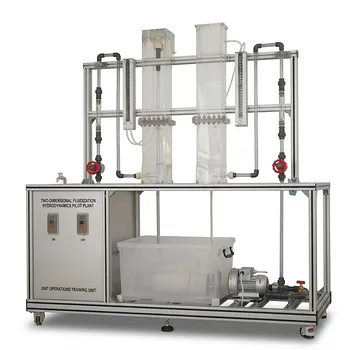
- Two-Dimensional Fluidization Hydrodynamics Educational Pilot Plant for Unit Operations Training
- Educational Unit Operations Pilot Plant for Intraparticle Diffusion Effective Factor Measurement
- Multi-Reactor Educational Pilot Plant for Reaction Engineering Unit Operations
- Packed Bed Absorption Educational Unit Operations Pilot Plant
- Fixed-Bed Chemical Reaction and Gas Dust Tar Removal Unit Operations Pilot Plant
People Also Ask
- What pressure drop characteristics should students & researchers monitor in a fluidization pilot plant?
- How does active time pulsing mixing enhance fluid homogenization? Configuration Guide for Educational Pilot Plants
- How can acoustic chemometrics prevent reactor clogging in educational fluidized bed pilot plants?
- What is the operational significance of solids feed rate on emulsion phase dynamics in fluidized bed pilot plants?
- Why is UB/Ui critical in fluidized bed pilot plant modeling? Master Gas-Solid Contact