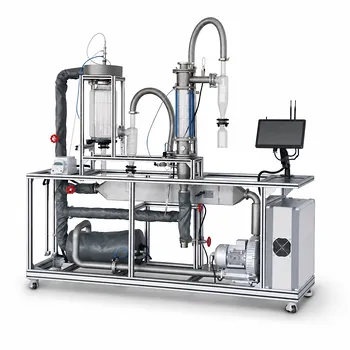
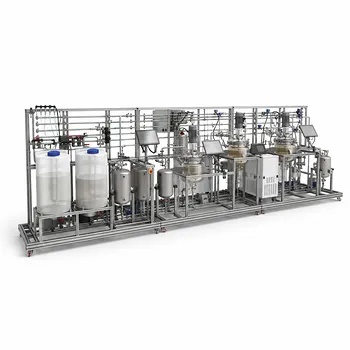
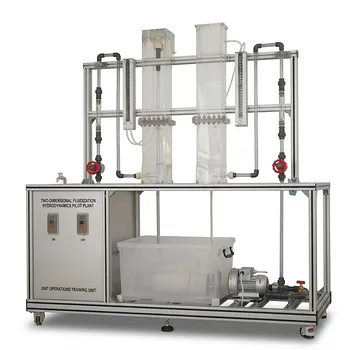
Pilot plants are not miniature factories; they are dynamic learning laboratories. The real role of process control strategies like feedforward and feedback is to transform a pilot plant from a simple demonstration rig into a powerful platform for de-risking scale-up. In unit operations pilot plants, these strategies demonstrate how to maintain consistent product quality despite disturbances, teach users to dynamically adjust processing parameters, and provide a practical, hands-on method for establishing raw material specifications that will hold up in full-scale production.
At its core, applying feedforward and feedback control in a pilot plant is about mastering variability. By learning to reject inlet disturbances proactively and correct residual errors reactively, you gain the empirical evidence needed to build robust, Quality-by-Design manufacturing processes long before commercial investment is committed.
The Core Mission: De-risking Process Development and Scale-Up
Pilot plants serve one overriding purpose: to gather the data and confidence needed for a successful scale-up. Process control strategies are the tools that make this possible. They move the plant beyond merely operating at a fixed setpoint and into a state where you can observe, quantify, and model how the process responds to real-world changes. This transforms a pilot run into a rich source of empirical process knowledge, directly addressing the “how do we keep quality on target when things change?” question that dominates every scale-up discussion.
Using Control Loops as an Empirical Modeling Engine
When you configure a control loop on a reactor, dryer, or mixer, you are not just stabilizing a temperature or flow rate. You are building a functional relationship between a measured disturbance and the required compensatory action. This empirical model can then be used in reverse: if a final quality attribute must stay within a tight window, the control strategy tells you exactly what allowable variation in incoming raw materials the process can tolerate. This closes the loop between process development, raw material sourcing, and final product quality.
How Feedforward and Feedback Control Operate in Pilot Plants
Understanding the distinct roles of feedforward and feedback action is essential because they solve different halves of the control problem. A pilot plant’s educational and research value multiplies when you separate these mechanisms and then combine them.
Feedforward: Proactive Disturbance Rejection
Feedforward control is an open-loop strategy that acts before a disturbance has time to upset the process. In a heat exchanger pilot plant, for example, the primary measurable disturbance is often the inlet flow rate of the process fluid. A feedforward controller immediately calculates the exact change needed in steam flow to compensate, without waiting for the outlet temperature to drift. This provides extremely rapid compensation. It is ideal for teaching how a multivariate model—linking an upstream change to a downstream actuator—can prevent quality deviations in real time.
Feedback: Ensuring Zero Steady-State Error
Feedback control is the closed-loop, corrective backbone. It continuously measures the controlled variable—such as the outlet temperature—and adjusts the manipulating variable to drive the error signal to zero. Because it only reacts after a deviation exists, it operates with an inherent time lag. However, it is the only mechanism that can correct for unmeasured disturbances (like steam pressure fluctuations or ambient heat loss) and eliminate steady-state offset. In a pilot plant, negative feedback also serves a critical safety function, keeping parameters within safe operating limits for both personnel and accurate data collection.
The Synergistic Combination
A feedforward-feedback combination is where industrial-grade control is demonstrated. The feedforward loop handles the large, measurable, and frequent disturbance—rejecting its impact almost entirely. The feedback loop then does the fine-tuning, mopping up the residual error and any unmeasured perturbations. For students and researchers, this dual configuration turns a heat exchanger or reactor into a living textbook that shows how to achieve high-precision control under dynamic, non-ideal conditions.
From Single Loops to Multi-Stage Quality-by-Design
The power of these strategies extends far beyond a single piece of equipment. In multi-stage unit operations, feedforward control becomes a vessel for modern Quality by Design (QbD) principles.
Implementing Cross-Unit Feedforward Control
In a multi-step process, the intermediate product quality leaving Unit N-1 becomes a measured disturbance for Unit N. A pilot plant can demonstrate how a multivariate model, built from batch data, relates that incoming material state to the operating conditions needed downstream. By adjusting the process trajectory of Unit N in anticipation of the upstream variation, the system maintains the final quality target without reworking the intermediate material. This is exactly the kind of active process control that reduces the reliance on rigid, fixed recipes and end-product testing.
Demonstrating the QbD Feedback Loop
To demonstrate QbD, a pilot plant must clearly show how raw material variability propagates. With flexible control software, users can solve model equations in real time and watch the control system adapt. Process Analytical Technology (PAT) tools, such as inline sensors and automated data acquisition, provide the continuous process verification that defines modern manufacturing. This teaches that a robust process is not one that never sees variation, but one that controls variation back on target using the appropriate strategy.
Understanding the Trade-offs
An objective view requires acknowledging that these control strategies come with distinct limitations. Ignoring these trade-offs can lead to misleading pilot plant results and a false sense of security.
The Limitations of Feedforward Control
Feedforward control is fundamentally limited by the accuracy of its model and the scope of its sensors. It cannot correct for an unmeasured disturbance—if a variable like catalyst activity or ambient heat loss is not part of the model, the feedforward action will be systematically wrong. Any mismatch between the calculated compensation and the actual required correction will result in an uncorrected offset unless a feedback trim is present.
The Inherent Lag of Feedback Control
Feedback isolation is slow by design. It must observe an error before it acts, which means it cannot prevent an initial quality spike following a sudden disturbance. In processes with long time delays or large thermal masses, the corrective action can arrive too late, causing significant transient deviations. Overly aggressive tuning in an attempt to speed up response can destabilize the entire pilot plant.
Managing Complexity in Pilot Plant Configurations
Custom strategies like cascade, ratio, or split-range control require a higher skill level to implement. While modern pilot plant software provides pre-built PID algorithms for standard loops, advanced custom configurations demand that you write, compile, and test your own control logic. This is a powerful educational feature, but it introduces a risk of programming errors that can damage equipment or produce invalid data. The pedagogical value must be balanced against the need for safe, reproducible operation.
Making the Right Choice for Your Research or Training Goal
Your selection of a control strategy should be driven entirely by what you need to learn or prove. A one-size-fits-all approach does not exist, but this framework will guide your decision.
- If your primary focus is disturbance rejection and product consistency: Start with a combined feedforward-feedback scheme on your most critical unit operation. This will give you rapid compensation for measurable inlet changes and the steady-state precision of feedback, mirroring industrial best practice.
- If your primary focus is QbD methodology and raw material specification: Implement a cross-unit feedforward strategy. Use historical batch data to build a multivariate model that links upstream material state to downstream setpoints, and test how process trajectories can absorb incoming variability.
- If your primary focus is student education and hands-on training: Use a stepped approach. Begin with simple negative feedback loops to teach stability and offset, then layer on feedforward so students can directly observe the difference in response speed and the need for model accuracy.
- If your primary focus is safety and stable data collection: Never rely on feedforward alone. Always back an open-loop action with a closed-loop feedback trim. This ensures that even if your disturbance model is imperfect, the plant will remain stable and your experimental datasets will be valid.
A pilot plant equipped with well-chosen control strategies stops being a static piece of hardware and becomes an active instrument for risk reduction, giving you the process understanding that makes scale-up a predictable step rather than a leap of faith.
Summary Table:
| Control Strategy | Action Type | Primary Benefit | Main Limitation | Pilot Plant Application |
|---|---|---|---|---|
| Feedforward | Proactive (Open-loop) | Rapidly rejects measured disturbances before they upset the process | Cannot correct unmeasured disturbances; highly model-dependent | Heat exchangers (flow disturbance), cross-unit QbD modeling |
| Feedback | Reactive (Closed-loop) | Eliminates steady-state error; corrects unmeasured disturbances | Inherent time lag; risk of instability if over-tuned | Reactor temperature control, safety loops, data stabilization |
Bring Industrial-Grade Process Control to Your Lab
Teaching dynamic process control and de-risking chemical scale-up requires reliable, flexible hardware. LABPARK provides advanced Educational and Vocational Unit Operations Pilot Plants in chemical engineering, bioprocess & biotech, and environmental & water treatment for universities, research institutes, and enterprises.
Our systems allow you to:
- Demonstrate real-world feedforward and feedback loops.
- Train students on industrial-grade PID tuning and QbD principles.
- Secure high-fidelity empirical data for scale-up validation.
Contact LABPARK today to discuss your curriculum or research requirements and request a customized quote!
Related Products
- Multi-Functional Drying Educational Unit Operations Pilot Plant
- General Purpose Cosmetics Production Unit Operations Training Pilot Plant
- Dual-Mode Rectification Pilot Plant for Practical Training Unit Operations
- Multi-Reactor Educational Pilot Plant for Reaction Engineering Unit Operations
- Multimodal Absorption and Desorption Pilot Plant for Unit Operations Training
People Also Ask
- How to study gasification in pilot plants? Compare exit gas composition & efficiency
- How do deviations in estimating latent heat impact pilot plant thermal systems? Avoid hardware mis-sizing.
- Why Use PTFE & Hastelloy in Chemical Pilot Plants? Prevent Corrosion & Ensure Safety
- Why is the chemical plant startup schedule crucial? De-risk scale-up with pilot plants.
- When to transition from PID to adaptive control in pilot plants? Key process indicators.