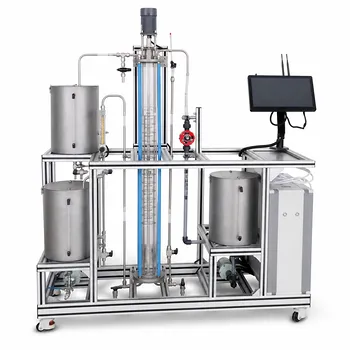
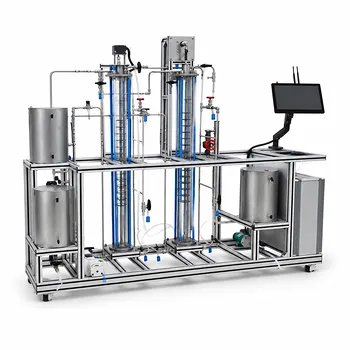
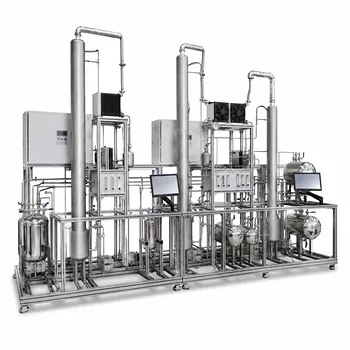
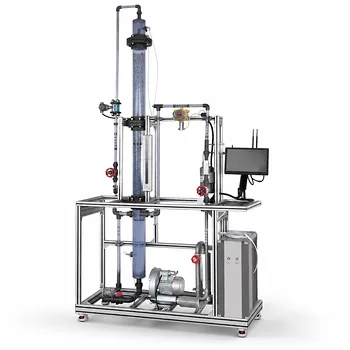
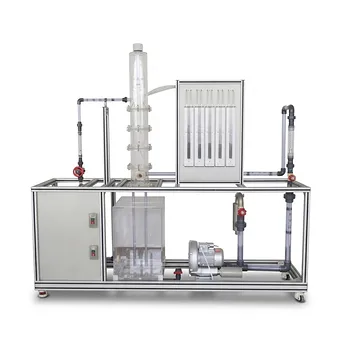
The only way to ensure smooth, stable operation when one distillation column feeds directly into the next is to deliberately abandon tight level control. A uniform control system is implemented to resolve the inherent conflict between maintaining a constant liquid level in the upstream column’s sump and delivering a steady, uninterrupted feed flow to the downstream column. Instead of forcing the level to a single setpoint, uniform control allows both the liquid level and the outflow rate to fluctuate gradually within safe, predefined limits, creating a hydraulic buffer that absorbs transient disturbances and prevents sudden surges or starvations that would otherwise disrupt the entire pilot plant.
Connecting unit operations in series creates a tug-of-war between level stability and flow stability. Uniform control rejects perfect level control in favor of a balanced, damped response, using the vessel’s capacity as a buffer to harmonize the conflicting demands and maintain steady-state operation across all stages.
Why Cascading Unit Ops Create a Control Nightmare
Pilot plants that link multiple unit operations—like two distillation columns in series—share a fundamental physical law: the liquid leaving the first unit becomes the feed for the second. This tight coupling turns two simple control loops into an interactive system that can easily destabilize the entire plant.
The Downstream Dependency
The performance of the second distillation column depends entirely on a stable feed rate and composition. If the feed flow suddenly drops, the downstream column experiences a starving reboiler and collapsing level on its feed tray. If it surges, the column floods, trays dump, and separation efficiency plummets. So the over-arching need is a very steady feed.
The Upstream Reality
The upstream column’s bottom liquid level naturally varies because of changing boil-up rates, reflux ratio adjustments, and feed composition shifts. A conventional level controller would react to every small change by aggressively moving the bottom outlet valve to restore the level setpoint immediately. That immediate correction translates directly into a rapid, unwanted change in the feed to the downstream column.
The Core Conflict: Level vs. Flow
This is where the design tension appears in its sharpest form. Two different control objectives collide in the same physical system.
Why Perfect Level Control Destroys Steady Flow
If you enforce a strictly constant liquid level in the upstream sump, every external disturbance or operational change is pushed straight into the outlet flow. The level controller acts as a perfect transmitter of every ripple. The result is a violently fluctuating feed to the second column, which is the opposite of what the plant needs for steady-state research or demonstration.
Why Steady Flow Alone Risks an Overflow or Dry Sump
Conversely, a fixed outflow rate would guarantee a steady feed, but it would completely decouple the level from any material balance. A small imbalance—more liquid entering the sump than leaving—would eventually flood the vessel. An under-flow condition would pump the sump dry, causing catastrophic pump cavitation and immediate process shutdown.
How Uniform Control Breaks the Deadlock
The solution is a control philosophy that refuses to pick one variable to hold perfectly at the expense of the other. Uniform control intentionally allows a controlled, slow drift in both the level and the outflow.
Using the Vessel as a Hydraulic Buffer
Instead of a tight setpoint, uniform control treats the liquid level as a variable that can float between a high and a low limit. The tank’s volume absorbs short-term flow mismatches. This turns the upstream sump from a passive hazard into an active shock absorber.
The "Slow Drift" Principle
The controller is tuned to be sluggish—far slower than a typical level loop. When a disturbance occurs, the level drifts gradually away from its nominal value, and the manipulated outlet flow changes just enough to begin correcting the imbalance over a long time window. The downstream column sees only a gentle, smoothed-out flow change instead of a sharp spike.
Preventing Surges and Interruptions
By permitting the level to rise temporarily, uniform control prevents the outlet valve from snapping open and flooding the downstream column. By allowing it to fall temporarily, it prevents the valve from slamming shut and starving the process. The plant's operations stay inside a safe, operable envelope without triggering alarms or shutdowns.
The Practical Payoff in a Pilot Plant Environment
In a research or teaching pilot plant where experiments change frequently and operators are often learners, this buffering role becomes critical for data quality and operational safety.
Maintaining Steady-State Data Validity
Research runs rely on the assumption of steady-state conditions for accurate mass and energy balance calculations. Uniform control ensures that the downstream column sees a feed flow that is essentially constant over the timescales of the measurement, eliminating a major source of data scatter and non-reproducibility.
Protecting Equipment and Reducing Operator Workload
Automatic buffering prevents the kind of cascade alarm that frustrates students and destroys experimental continuity. Without it, an operator would have to manually juggle the first column’s level and the second column’s feed flow, a task that is extremely difficult to do well and distracts from the actual scientific goals.
Understanding the Trade-offs of Uniform Control
Uniform control is not a golden hammer. Choosing it means accepting deliberate performance trade-offs that must be carefully engineered.
The Loss of Tight Level Supervision
The most obvious downside is that the upstream liquid level is no longer held tightly at a single value. In columns with a small sump, this buffer capacity is limited, and the level can drift close to the alarm or trip limits faster than expected if the disturbance is severe. The vessel must be sized appropriately, and the acceptable level band must be wide enough to absorb normal swings.
Increased Interaction During Transients
While uniform control dampens the flow swings, it still couples the two units during large transitions (like start-up or a major setpoint change). The slow drift can cause the downstream column to see a feed rate that lags and then slowly ramps, which may temporarily shift its own internal profiles. Researchers must allow for a longer stabilization period before taking data.
Tuning is Not Trivial
Setting the controller gain and integral time for the right "sluggishness" requires a good understanding of the vessel volume, flow rates, and expected disturbances. Too aggressive, and it reverts to upsetting the feed; too slow, and the level may violate its limits. This tuning often needs to be re-evaluated when the experiment’s throughput changes significantly.
Making the Right Choice for Your Pilot Plant
Deciding whether to implement uniform control—and how to set it up—depends entirely on your primary experimental objective and plant configuration.
- If your primary focus is studying the downstream unit’s steady-state behavior: Uniform control is almost mandatory. The damped, stable feed it provides is a precondition for obtaining valid separation efficiency and hydraulic data from the second column.
- If your primary focus is investigating pure level control dynamics or you have a massive surge vessel: A standard level control strategy may be sufficient, especially if the large vessel volume already provides natural buffering. However, uniform control can still add a layer of consistency to the outlet flow profile.
- If your pilot plant is a teaching platform for advanced process control: Frame uniform control as a fundamental building block that demonstrates the need to prioritize overall plant stability over single-loop perfection. It opens the door to discussing the hierarchy of control, where uniform control handles base-layer buffering and higher-level algorithms like MPC can later optimize the entire cascade.
A uniform control system is the engineering acknowledgement that a series of connected processes is a single, integrated organism—and that sometimes the wisest control action is to relax a perfect number in one place to preserve harmony across the whole.
Summary Table:
| Feature | Conventional Level Control | Uniform Control System |
|---|---|---|
| Primary Objective | Maintain strict level setpoint | Balance level and flow variations |
| Downstream Impact | Volatile, fluctuating feed flow | Smooth, gradual feed transition |
| Vessel Utilization | Passive container | Active hydraulic shock absorber |
| Best Used For | Standalone unit operations | Multi-stage, coupled unit operations |
Optimize Your Multi-Stage Process Control with LABPARK
Building stable, interconnected systems for research and teaching requires expert engineering. LABPARK provides state-of-the-art Educational and Vocational Unit Operations Pilot Plants in chemical engineering, bioprocess & biotech, and environmental & water treatment. Designed specifically for universities, research institutes, and enterprises, our pilot plants feature advanced process control configurations to ensure stable data collection and safe operation.
Ready to elevate your laboratory capabilities? Contact LABPARK today to discuss your custom pilot plant requirements with our specialists!
Related Products
- Continuous Sieve-Plate Distillation Pilot Plant for Unit Operations Laboratory Education
- Multi-Functional Special Distillation Educational Pilot Plant
- Continuous Batch Extractive Distillation Educational Pilot Plant
- Multi-Modal Distillation Unit Operations Training Pilot Plant
- Dual-Mode Rectification Pilot Plant for Practical Training Unit Operations
People Also Ask
- Why is vacuum operation capability an essential feature for a distillation unit operations pilot plant? Unlock Efficiency
- What are the primary reflux ratio control strategies? Master Distillation Unit Operations
- How to select the right activity coefficient model (Wilson, NRTL, UNIQUAC) for distillation pilot plants?
- How can real-time carbon number prediction improve distillation pilot plants? Optimize control.
- How does catalyst water concentration affect distillation pilot plant design? Key separation train choices.