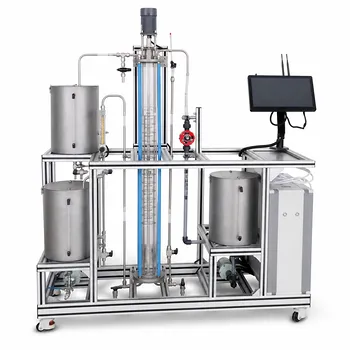
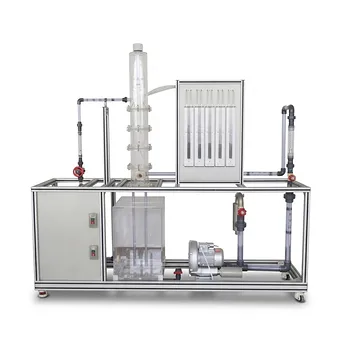
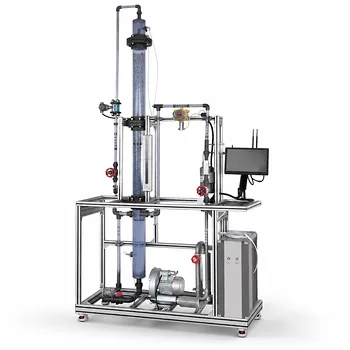
The main difference is clear: Direct steam heating demands a significantly higher number of theoretical plates to achieve the same distillate composition and recovery rate as indirect steam heating. This happens because the injected steam dilutes the volatile components in the column's bottom liquid, lowering the effective concentration driving force and forcing the column to work harder. For a pilot plant, where accurate scale-up data and efficiency measurements are critical, overlooking this requirement can lead to misleading performance parameters.
The core takeaway: Direct steam injection in a fractional distillation column always increases the theoretical plate count needed for a given separation, compared to a reboiler-driven (indirect) system. This is a fundamental mass-transfer consequence, not a minor operational tweak.
Why Steam Injection Demands Extra Stages
Direct steam eliminates the reboiler and bubbles live steam straight into the column sump. That simple change reshapes the internal composition profiles and stage-by-stage requirements.
The Dilution Effect on Bottom Composition
In an indirect system, the reboiler vaporizes the liquid without adding foreign material. Composition in the bottom stage is determined solely by the liquid overflow from the tray above and the boil-up ratio.
Direct steam introduces pure water (or process steam) into the liquid phase. This dilution immediately reduces the mole fraction of volatile components in the bottom liquid. To reach the same distillate purity, the column must provide more trays to re-concentrate the volatiles that would otherwise be lost in the diluted bottoms.
Altered Liquid and Vapor Traffic
Steam injection also changes the internal flows. The added steam condenses partially, increasing the liquid traffic in the stripping section. A higher liquid load typically lowers tray efficiency and may require even more plates to maintain separation sharpness. In pilot-plant columns with limited height, this effect can become the bottleneck.
The Impact on Pilot Plant Data
Pilot columns are often used to measure height equivalent to a theoretical plate (HETP) or to generate scale-up data. If you switch from an indirect to a direct heating method without adjusting the tray count, you’ll observe a drop in apparent efficiency. Researchers may misinterpret this as degraded packing performance, when in reality the system simply lacks the necessary stages to overcome the dilution penalty.
Understanding the Trade-offs
Direct steam is not without merits, but its plate penalty must be weighed against practical benefits.
Simplicity vs. Separation Capability
Direct heating removes the reboiler, lowering capital cost and eliminating a potential fouling point. This is attractive for feedstocks that polymerize or degrade at reboiler temperatures. However, you pay for that simplicity with increased column height (or more trays) to achieve the same separation. In a pilot plant where flexibility matters, this may limit the range of mixtures you can efficiently handle with a fixed column.
Thermal Sensitivity and Bottom Temperature
Direct steam can operate at a lower bottom temperature because the steam’s partial pressure reduces the boiling point of the mixture. That can protect heat-sensitive compounds. But it also means the bottom composition is pinned by the steam–liquid equilibrium; you lose a degree of freedom for controlling bottoms purity. This can force even more plates to hit the same distillate spec.
Common Pitfalls in Scale-Up
The most dangerous mistake is ignoring the plate difference when scaling from a direct-steam pilot to an indirect-steam production unit. Data collected on a direct-heated column will suggest a higher HETP or more required stages. If that number is blindly applied to a reboiler-driven column, you might overbuild the commercial unit, wasting capital. Conversely, assuming parity in the other direction can yield an under-designed plant.
Making the Right Choice for Your Pilot Plant Goal
Your decision between heating methods should be guided by what you truly need to learn or achieve. Use the following priorities to inform your design:
- If your primary focus is generating accurate scale-up data for a reboiler-based production unit: Stay with indirect heating in the pilot plant. This avoids the plate-count offset and gives you directly transferable stage counts.
- If your primary focus is exploring separations of heat-sensitive or fouling materials where a reboiler is impractical: Embrace direct steam, but plan for a taller column or more packing trays. Explicitly note the dilution effect in your reports so that future users don’t misinterpret the required stages.
- If your primary focus is teaching distillation fundamentals or demonstrating column efficiency: Use the heating method that matches your curriculum, but make the plate-count trade-off a central part of the experiment. It teaches students how mass balances and equilibrium staging interact in a tangible way.
In every case, remember that direct steam heating increases the minimum theoretical plate count—treat it as a design constant, not a variable you can ignore.
Summary Table:
| Feature / Parameter | Direct Steam Heating | Indirect Steam Heating |
|---|---|---|
| Theoretical Plates Needed | Higher (due to dilution) | Lower |
| Bottoms Dilution | High (water/steam added) | None (reboiler-driven) |
| Capital Cost & Fouling | Lower (no reboiler) | Higher (reboiler required) |
| Operating Temperature | Lower (due to steam partial pressure) | Higher (boiling point of mixture) |
| Scale-up Transferability | Complex (requires HETP adjustments) | Straightforward |
Are you designing a chemical engineering lab or scaling up your distillation process? LABPARK provides premium Educational and Vocational Unit Operations Pilot Plants in chemical engineering, bioprocess & biotech, and environmental & water treatment. We help universities, research institutes, and enterprises achieve accurate experimental data, robust scale-up parameters, and hands-on learning experiences.
Whether you need a custom fractional distillation column with direct steam injection or a reboiler-driven system, our expert team is ready to assist. Contact LABPARK today to discover the perfect pilot plant solution for your facility!
Related Products
- Multi-Modal Distillation Unit Operations Training Pilot Plant
- Continuous Sieve-Plate Distillation Pilot Plant for Unit Operations Laboratory Education
- Multi-Functional Special Distillation Educational Pilot Plant
- Educational Rotary Disc Liquid-Liquid Extraction Pilot Plant
- Dual-Mode Rectification Pilot Plant for Practical Training Unit Operations
People Also Ask
- How can energy balance equations for condensers & reboilers be validated experimentally? Guide
- How can real-time carbon number prediction improve distillation pilot plants? Optimize control.
- What are the primary reflux ratio control strategies? Master Distillation Unit Operations
- How does catalyst water concentration affect distillation pilot plant design? Key separation train choices.
- Why is vacuum operation capability an essential feature for a distillation unit operations pilot plant? Unlock Efficiency