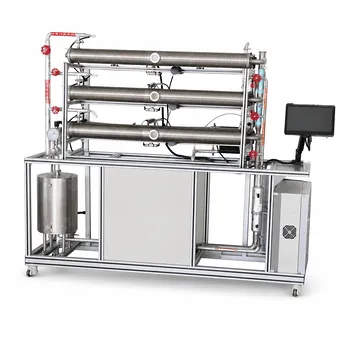
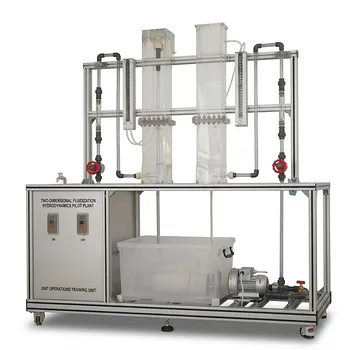
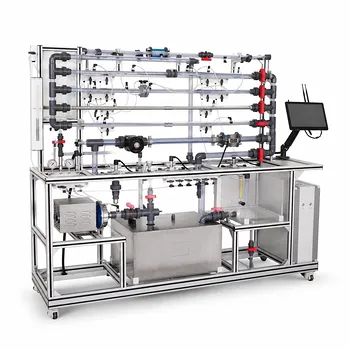
Offset is the single most powerful teaching tool for bridging the gap between abstract PID theory and the tangible reality of process control. When students tune a loop on a unit operations pilot plant and see the steady-state deviation—the controlled variable stubbornly sitting away from the setpoint—they internalize the fundamental limitation of proportional-only control. This visible, quantifiable error forces them to confront a critical engineering question: can my process live with this mistake, or does it demand zero steady-state error?
The educational power of offset lies not in its nuisance, but in its clarity. It gives students an immediate, physical demonstration of why integral action exists, how different processes tolerate residual error, and when selecting the right control algorithm becomes a matter of safety or profitability rather than abstract preference.
The Core Lesson: Why Offset is a Teaching Tool
Offset transforms a mathematical concept into a hands-on, unforgettable experience. Students who only simulate a controller on a screen often miss the visceral reality of a liquid level that refuses to match its setpoint. The pilot plant makes that gap real.
The Unforgettable Demonstration of Control Actions
P-only control always leaves a persistent offset after a load change. As the primary reference states, this deviation is the steady-state penalty paid for proportionality alone.
When a student then activates integral action, they witness the controlled variable creep back to the setpoint. This direct A/B test burns the distinction between P and I into memory far more effectively than any lecture.
Translating Theory into Tactile Understanding
The offset is not a failure—it is the curriculum. Students measure it with a ruler or a trend chart, turning "residual error" from a textbook term into a number they can see, react to, and fix.
This tactile loop helps them grasp why derivative action cannot fix it, and why only the accumulation of past error (integral action) can drive the offset to zero. The pilot plant becomes the proof.
Beyond the Textbook: Linking Offset to Real-world Tolerances
The second layer of educational significance is the lesson in process-criticality. A single offset demonstration teaches students that not all errors are equal, forcing them to evaluate the consequence of a steady-state deviation.
The Tolerant Process: Storage Tanks and Surge Vessels
A level loop in a buffer tank can tolerate a persistent offset. The primary purpose is often to prevent overflow or pump cavitation, not to hold an exact height.
When students see a liquid level settle slightly above the setpoint, they learn that a simple P-only controller can be good enough. This saves cost and complexity in an industrial setting where perfect control is unnecessary.
The Intolerant Process: Reactors and Exothermic Systems
The same offset becomes a critical safety issue in a reactor temperature loop. A small, persistent temperature error can alter reaction kinetics, ruin product quality, or trigger a runaway.
Here, the pilot plant demonstration connects the abstract need for integral action to a tangible safety case. Students learn to ask the right question first: Will this offset break my process or my business?
Common Pitfalls and Trade-offs in Teaching Offset
While offset is a masterclass in control, it also introduces subtle traps if not framed correctly. A good educator uses these pitfalls to deepen understanding.
When Offset Masks Other Problems
Students might attribute any steady-state error to P-only control when it could be a sticky control valve or sensor calibration drift.
The pilot plant must therefore be well-maintained, so the offset is a pure control phenomenon. The lesson then expands: always rule out equipment problems before tuning.
The Risk of Over-Tuning
After seeing offset, the instinct is to add huge integral action to kill it fast. This easily leads to instability, overshoot, or endless cycling—another essential lesson, but one that must be supervised.
The trade-off is clear: eliminating offset through integral action can sacrifice relative stability. The pilot plant lets students see both sides of this compromise, learning that "zero offset" is not always the same as "good control."
Making the Right Choice for Your Learning Goal
The way you structure the offset experiment determines the lesson learned. Tailor the activity to the specific takeaway.
- If your primary focus is teaching the P–I difference: Start with a P-only controller, introduce a load disturbance, and let the offset stabilize. Then add a small integral term and let the student watch the correction in real time.
- If your primary focus is process-criticality assessment: Provide two loops—one level, one temperature—and ask students to justify in writing where offset is acceptable and why. This forces the engineering judgment the industry demands.
- If your primary focus is controller tuning discipline: Use the offset as a benchmark: after tuning, measure the remaining steady-state error and the settling time, then discuss the interplay between offset, integral windup, and overshoot.
Offset on a pilot plant is not a problem to hide; it is the one lesson that stays with a student long after the control room lights are off.
Summary Table:
| Concept | Educational Significance | Real-World Application |
|---|---|---|
| P-only Offset | Visualizes persistent steady-state error physically | Tolerable in buffer tanks; saves cost and complexity |
| Integral Action | Demonstrates error correction over time (A/B test) | Essential for safety-critical systems (reactors) |
| Equipment Diagnostics | Distinguishes control offset from mechanical faults | Crucial troubleshooting skill before loop tuning |
Bring Hands-On Process Control to Your Lab
Ready to bridge the gap between abstract control theory and real-world engineering? LABPARK provides state-of-the-art Educational and Vocational Unit Operations Pilot Plants in chemical engineering, bioprocess & biotech, and environmental & water treatment.
Designed for universities, research institutes, and enterprises, our systems offer the hands-on experience students need to master PID tuning, handle offset, and manage complex process dynamics.
Contact LABPARK today to elevate your lab's training capabilities!
Related Products
- Multi-Functional Drying Educational Unit Operations Pilot Plant
- General Purpose Cosmetics Production Unit Operations Training Pilot Plant
- Dual-Mode Rectification Pilot Plant for Practical Training Unit Operations
- Multi-Reactor Educational Pilot Plant for Reaction Engineering Unit Operations
- Multimodal Absorption and Desorption Pilot Plant for Unit Operations Training
People Also Ask
- Why Use PTFE & Hastelloy in Chemical Pilot Plants? Prevent Corrosion & Ensure Safety
- How to study gasification in pilot plants? Compare exit gas composition & efficiency
- Why is the chemical plant startup schedule crucial? De-risk scale-up with pilot plants.
- How do deviations in estimating latent heat impact pilot plant thermal systems? Avoid hardware mis-sizing.
- When to transition from PID to adaptive control in pilot plants? Key process indicators.