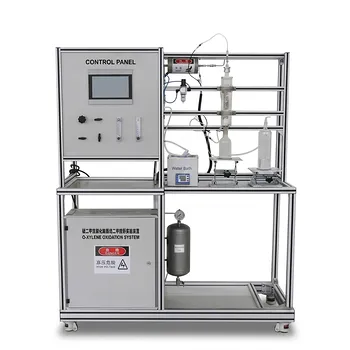
For chemical engineering students and researchers, the true power of a pilot plant lies not just in running reactions but in extracting actionable insights from complex data streams. Chemometric PLS models unlock this power by translating massive spectral datasets into real-time predictions of feed composition—like n-paraffins, iso-paraffins, naphthenes, and aromatics (PINA). This integration teaches feed-forward control and yield optimization, while enabling researchers to accelerate process understanding without being shackled to purely mechanistic models.
The educational value comes from seamlessly linking theoretical reactor design with hands-on, data-driven operation—preparing students for modern industrial practice. The research value emerges from the ability to rapidly model complex, unknown systems, provided you rigorously respect the ironclad limitations of empirical tools and validate them correctly.
Turning Spectral Data into Real-Time Process Knowledge
In a pilot plant, feed variability is the enemy of consistent yield. PLS models calibrated against online spectral data transform a hidden property—hydrocarbon group composition—into an immediate, actionable digital signal.
This means you can continuously see the concentration of aromatics or naphthenes as the feed changes, without waiting hours for a lab result. That live view is the foundation for everything that follows.
Predicting the Unseen: From Spectrum to PINA
Traditional lab analysis gives a snapshot that is already history by the time you receive it. PLS changes this by building a multivariate correlation between the spectral fingerprint and reference PINA values.
Once calibrated, the model can predict the breakdown of paraffins, naphthenes, and aromatics in seconds. This provides a real-time chemical signature of the feedstock entering your reactor.
Enabling Feed-Forward Operation
Knowing the feed composition in real time allows you to adjust reactor conditions before a disturbance hits your product yield. This is the essence of feed-forward optimization.
Students learn to vary temperature, space velocity, or catalyst circulation proactively based on the predicted n-paraffin or aromatic load. That skill is precisely what separates a modern processing plant from one stuck in reactive mode.
Bridging Theory and Practice in Chemical Engineering Education
The most profound educational value lies in closing the gap between sterile textbook equations and the messy reality of a running pilot plant. Students see theoretical kinetic models bump up against actual, noisy process data.
PLS models serve as the bridge, forcing students to reconcile what they calculated should happen with what the reactor actually produces. This reconciliation is where deep, intuitive understanding is forged.
Learning to Maximize Specific Product Yields
A pilot plant tasked with optimizing jet fuel or kerosene cannot treat the feed as a simple "hydrocarbon" flow. The PINA distribution dictates cracking severity and product quality.
Using PLS predictions, students can experiment with changing reactor severity to favor jet fuel when aromatics are high, or to maximize light olefins when n-paraffins spike. They learn that yield optimization is fundamentally a feed composition management challenge, not a fixed recipe.
Connecting Data to Fundamental Principles
Empirical models can feel like "black boxes," but a well-designed curriculum forces students to interrogate them. They must compare the PLS-predicted yields against first-principles thermodynamic or kinetic models.
This process cultivates a critical mindset: students learn where data-driven models fill gaps left by incomplete physics, and where physics must constrain the data model. It teaches humility with models and sharpens engineering judgment.
Accelerating Research Through Empirical Modeling
For researchers, the value of PLS in pilot plants is speed and scope. You can test hypotheses about feed effects without building a fully parameterized kinetic model for every new crude or blend.
The key mathematical advantage is that empirical models can capture the behavior of complex, unknown systems without being limited by theoretical constraints. If the data contains the pattern, the model can learn it.
Rapid Exploration of Feedstock Spaces
Screening ten different feedstocks with full PINA lab analysis is slow and expensive. With a robust PLS model, you can run campaigns on multiple feeds and instantly quantify their compositional fingerprints.
This accelerates the entire Design of Experiments cycle. You spend less time characterizing, and more time generating actionable yield and selectivity data for novel feedstocks.
An Unbiased Lens on Hidden Interactions
Mechanistic models can be stubbornly wrong due to unaccounted trace contaminants or nonlinear mixing effects. A PLS model, provided it is fed high-quality, representative data, can reveal non-obvious correlations that theory misses.
Researchers can then use those unexpected correlations as starting points to investigate new reaction pathways. The empirical model becomes a discovery tool, not just a predictor.
Understanding the Critical Trade-offs and Pitfalls
The educational and research value of PLS models evaporates instantly if you ignore their serious limitations. These are not minor footnotes; they are safety-critical boundaries that must be part of any curriculum or research protocol.
Treating an empirical model as a universal truth generator is a recipe for dangerous process decisions. The following constraints must be internalized by every student and researcher who touches these tools.
The Data Demands Are Relentless
Large amounts of high-quality data are non-negotiable. The model is only as good as the reference lab work and the stability of the spectrometer. Garbage in, garbage out.
Students must experience the painstaking effort of curating a calibration set that spans the real process variation—different operators, raw material batches, and ambient conditions. This teaches that the "math" is the easy part; data engineering is the true craft.
The Extrapolation Danger Is Absolute
A PLS model can only be safely applied to conditions represented within the calibration dataset. Asking it to predict a feed with a temperature or concentration far outside the training range is not just unreliable—it is unpredictable and hazardous.
This is a critical lesson in model domain definition. You must install hard guardrails in any real-time optimization system that block control moves derived from extrapolated model predictions.
Overfitting Creates Beautiful Lies
During development, an overfit model will show artificially stunning fit statistics on the calibration data, only to fail miserably on new runs. This happens when the model memorizes noise instead of learning the underlying relationship.
The antidote is rigorous validation. Researchers must evaluate models only on completely independent validation samples that reflect normal process variation. Standard Error of Prediction (SEP) from those external batches tells the true story of accuracy.
The Right Way to Validate Linearity
A high coefficient of determination (R²) is a seductive but insufficient indicator of linear model quality for multivariate systems. The correct test is a deep look at the residuals—the difference between PLS predictions and reference values.
Plot those residuals on a normal probability plot. If they form a straight line, the residuals are normally distributed, and the linear model assumption is robust. A curved pattern reveals a non-linear relationship that a PLS model cannot handle, demanding a different approach.
Making the Right Choice for Your Pilot Plant Goals
The decision to integrate PLS modeling into a pilot plant should be guided by your primary objective. The technology is not a universal solution, but a powerful instrument with a specific fit.
- If your primary focus is undergraduate education: Use PLS to give students a visceral, real-time link between spectral data and reactor performance. Focus on the "aha moment" when they connect a feed spike in aromatics to a drop in product quality, and drill the validation lessons as the ultimate takeaway.
- If your primary focus is graduate-level research: Leverage PLS to rapidly explore complex feedstock spaces and uncover non-obvious relationships. Pair it with mechanistic modeling to validate and explain the empirical findings, and publish the rigorous validation metrics (SEP and residual analysis) to build trust.
- If your primary focus is developing industrial-ready operators: Emphasize the operational logic: how to use the predicted PINA for feed-forward control. But spend equal time on the red lines—the absolute prohibition against trusting the model outside its calibrated domain and the habit of visual residual inspection before any critical decision.
The ultimate educational gift of the PLS model in a pilot plant is not just the numbers it produces, but the profound respect for empirical truth that it instills—a truth that is powerful when respected and catastrophically deceptive when ignored.
Summary Table:
| Aspect | Key Value & Features | Practical Application |
|---|---|---|
| Educational Value | Bridges theory & hands-on operation | Real-time yield optimization & feed-forward control |
| Research Value | Accelerates feedstock screening | Rapid empirical modeling of complex, unknown systems |
| Key Challenge | High-quality data demands | Requires robust calibration datasets & validation |
| Critical Pitfall | Risk of model extrapolation | Restrict predictions strictly to calibrated ranges |
Empower your students and researchers with cutting-edge, data-driven process control. LABPARK provides premium Educational and Vocational Unit Operations Pilot Plants in chemical engineering, bioprocess & biotech, and environmental & water treatment for universities, research institutes, and enterprises.
By choosing LABPARK, you benefit from:
- Industry-Ready Training: Equip students to master advanced feed-forward control and real-time PLS modeling.
- Accelerated Research: Run complex feedstock simulations and design of experiments efficiently on reliable setups.
- Customizable & Robust Systems: High-durability pilot plants built to meet rigorous academic and industrial standards.
Ready to elevate your chemical engineering labs? Contact LABPARK today to discuss your custom pilot plant requirements!
Related Products
- Fixed-Bed Chemical Reaction and Gas Dust Tar Removal Unit Operations Pilot Plant
- Fixed Bed Gas Solid Catalytic Reaction Educational Pilot Plant
- Residence Time Distribution and Reactor Flow Characteristics Determination Educational Pilot Plant
- Multi-Reactor Educational Pilot Plant for Reaction Engineering Unit Operations
- Tubular Reactor Flow Characteristics Determination Educational Unit Operations Pilot Plant
People Also Ask
- When to transition from PID to adaptive control in pilot plants? Key process indicators.
- How do deviations in estimating latent heat impact pilot plant thermal systems? Avoid hardware mis-sizing.
- Why Compare Predicted and Experimental Excess Enthalpy? Key to Accurate Pilot Plant Scale-up
- How to study gasification in pilot plants? Compare exit gas composition & efficiency
- Why Use PTFE & Hastelloy in Chemical Pilot Plants? Prevent Corrosion & Ensure Safety