Knowledge Chemical Engineering Education What is the CMO assumption & how is it verified on a pilot plant? Master distillation design.
Author avatar

Tech Team · LABPARK

Updated 1 month ago

What is the CMO assumption & how is it verified on a pilot plant? Master distillation design.


The constant molar overflow (CMO) assumption is a fundamental simplification in distillation design that states the molar flow rates of liquid and vapor remain constant within the rectifying section and within the stripping section of a column. This assumption allows engineers to draw straight operating lines on an x-y diagram and use the McCabe-Thiele method for stage‑by‑stage calculations. In a pilot plant, students can verify CMO validity by analyzing the column’s thermal profile, performing energy balances around the reboiler and condenser, assessing shell heat losses, and checking whether experimental operating lines remain straight.

The CMO assumption holds when components have nearly identical molar heats of vaporization, heat of mixing is negligible, and heat loss from the column is minimal. In a chemical engineering pilot plant, students verify this not by assuming it blindly but by measuring temperature gradients, checking energy balances, and observing the linearity of operating lines—turning a textbook simplification into a hands‑on validation of real‑world deviation.

The Foundation of CMO: Why It Simplifies Distillation

The Assumption Defined

The CMO assumption divides the column into two zones. In the rectifying section (above the feed), the molar liquid flow (L) and vapor flow (V) stay unchanged from tray to tray. In the stripping section (below the feed), the flows (L') and (V') are also constant, though different from the rectifying values.

This is a molar, not mass, balance simplification. It relies on the idea that every mole of vapor condensed releases exactly enough energy to vaporize one mole of liquid, so the internal traffic remains steady.

Why It Matters for McCabe-Thiele

With constant molar flows, the operating line equations become linear. The rectifying operating line is (y_{n+1} = \frac{R}{R+1}x_n + \frac{x_D}{R+1}) and the stripping line is similarly simple.

Straight lines make graphical stage‑counting possible. Without CMO, these lines would curve, and the elegant McCabe‑Thiele construction would fail. That is why verifying CMO is not just an academic exercise—it dictates whether classical shortcut methods are trustworthy.

Verifying CMO in a Chemical Engineering Pilot Plant

Using Thermal Profiles and Energy Balances

A pilot plant provides direct access to the column’s thermal behavior. Students can install temperature sensors along the column height to record a detailed thermal profile.

By performing an energy balance around the reboiler, students calculate the vapor flow generated at the bottom. A balance around the condenser gives the vapor arriving at the top. If the difference between these two vapor flows aligns with expected linear variations (and is not driven by excessive heat loss), CMO is likely valid. This exercise also quantifies heat loss through the column shell, which is the most common cause of CMO failure.

Checking the Straightness of Operating Lines

When experimental liquid and vapor composition data (obtained from sample ports or inferred from tray temperatures using VLE data) are plotted on an x‑y diagram, the operating points should fall on straight lines if CMO holds.

Curved trendlines directly signal a breakdown of the assumption. Students can then quantify the degree of curvature and relate it to unequal latent heats or significant heat losses—turning a visual check into a quantitative diagnostic.

Sampling and Tray-to-Tray Composition Analysis

A pilot plant allows physical sampling from each tray under steady‑state conditions. Using a refractometer or gas chromatograph, students measure the composition at every stage.

They then compare this experimental stage‑by‑stage profile to the theoretical step profile calculated from the McCabe‑Thiele method (which assumes CMO). A close match between the experimental and predicted number of stages indicates that CMO is a reasonable approximation for that mixture and setup. Mismatches, on the other hand, reveal the real limits of the assumption.

Understanding the Trade-offs: When CMO Breaks Down

Consequences for Operating Lines

If CMO fails, the operating lines become curved on the x‑y diagram. Drawing simple triangles between the equilibrium curve and operating line becomes impossible, and the McCabe‑Thiele technique loses its accuracy.

Students learn that the assumption is convenient but not universal. Polar mixtures, large boiling point differences, or poorly insulated columns can all cause significant deviations that must be accounted for in rigorous simulations.

The Role of Column Insulation and Heat Loss

Heat loss through the column wall is a primary culprit in pilot‑scale experiments. A poorly insulated column will see excessive condensation or vaporization along the shell, changing internal traffic and invalidating CMO.

By comparing runs with and without insulation, or by calculating the heat loss from the thermal profile, students see firsthand why industrial columns are heavily insulated and how even small energy leaks can distort theoretical stage predictions.

Alternative Calculation Methods

When CMO does not hold, simpler methods give way to more demanding ones. The Ponchon‑Savarit method, which uses enthalpy‑concentration diagrams, can handle varying molar flows. Modern process simulators (like Aspen Plus) perform rigorous stage‑by‑stage energy balances automatically.

Students who verify CMO failure on a pilot plant are therefore perfectly positioned to appreciate when and why these advanced tools become necessary.

Making the Right Choice for Your Pilot Plant Study

Once you have the data from your pilot plant, apply the verification steps to decide how to model your column.

  • If your primary focus is learning the McCabe‑Thiele method: Choose a binary test mixture with similar latent heats (e.g., methanol‑water at moderate concentrations) and insulate the column well—then check the straightness of the operating lines to confirm CMO.
  • If your primary focus is examining real‑world non‑idealities: Intentionally run the column with a poorly insulated section or a mixture with highly unequal latent heats, and quantify how the curvature of the operating line grows.
  • If your primary focus is rigorous process modeling: Perform the energy balance around reboiler and condenser, calculate the point‑by‑point internal flows, and use the results in a simulation that does not require CMO—then compare the predicted and experimental profiles.

By methodically testing the constant molar overflow assumption on a pilot plant, you transform a theoretical shortcut into a practical diagnostic tool, gaining deep insight into the energy and mass balances that truly govern distillation.

Summary Table:

Verification Method Key Parameter Measured How it Verifies CMO
Thermal Profile & Energy Balances Temperature gradients, reboiler & condenser duties Quantifies column heat loss and calculates changes in internal vapor flow.
Operating Line Straightness Tray compositions (liquid & vapor $x$-$y$ data) Plotted data points should form straight lines; curvature indicates a breakdown of CMO.
Tray-to-Tray Analysis Physical sample compositions (via GC or refractometer) Compares the actual stage profile against McCabe-Thiele stage-by-stage predictions.

Bring Distillation Theory to Life in Your Lab

Looking to bridge the gap between textbook thermodynamics and real-world engineering? LABPARK provides premium Educational and Vocational Unit Operations Pilot Plants in chemical engineering, bioprocess & biotech, and environmental & water treatment.

Specially designed for universities, research institutes, and enterprises, our pilot plants empower students and researchers to hands-on verify critical concepts like Constant Molar Overflow (CMO) under precise, monitored conditions.

Contact LABPARK today to discover how our pilot plants can elevate your training curriculum and research capabilities!

Related Products

People Also Ask

Related Products

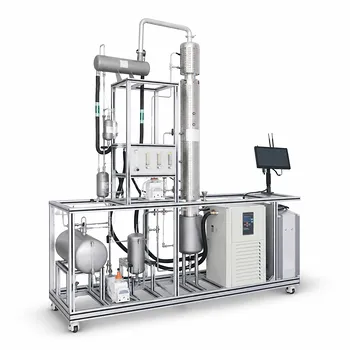
Continuous Sieve-Plate Distillation Pilot Plant for Unit Operations Laboratory Education

Continuous Sieve-Plate Distillation Pilot Plant for Unit Operations Laboratory Education

Integrated pilot-scale teaching system for continuous sieve-plate distillation studies. Visual demonstration of tray hydraulics, flexible feed positions, and automatic reflux control for hands-on unit operations education in engineering labs. Designed for higher education engineering laboratories.

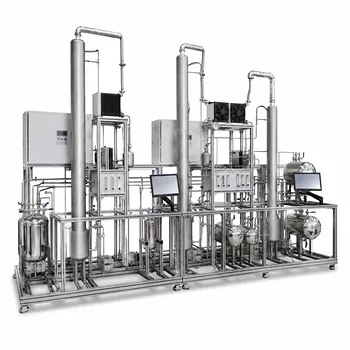
Multi-Functional Special Distillation Educational Pilot Plant

Multi-Functional Special Distillation Educational Pilot Plant

Versatile multi-functional special distillation pilot plant for chemical engineering education. Supports continuous, vacuum, azeotropic, reactive, extractive distillation. Transparent glass columns enable real-time visual observation of hydrodynamics and separation processes.

Continuous Batch Extractive Distillation Educational Pilot Plant

Continuous Batch Extractive Distillation Educational Pilot Plant

Versatile pilot plant for continuous, batch, and extractive distillation training. High-borosilicate glass column for visualizing hydraulics, 15.6-inch touchscreen with data logging, precise reflux ratio control 1-99, and durable corrosion-resistant frame. Ideal for chemical engineering education and process research.

Multi-Modal Distillation Unit Operations Training Pilot Plant

Multi-Modal Distillation Unit Operations Training Pilot Plant

Multi-modal distillation pilot plant for practical unit operations training in chemical engineering education. Features real, analog, and semi-physical simulation modes, industrial construction, customizable for university labs. Hands-on fractionation columns, SCADA control, safety systems. Includes sight glasses, sampling ports, closed-loop recycling.

Electrolyte Distillation Purification and Formulation Educational Pilot Plant

Electrolyte Distillation Purification and Formulation Educational Pilot Plant

Integrated bench-to-pilot scale educational pilot plant for electrolyte distillation, purification, and formulation with borosilicate glass construction, PLC automation, touchscreen HMI, and advanced industrial safety features for hands-on chemical process training, ideal for chemical engineering and materials science curricula.

Green Anhydrous Ethanol Purification Extractive Distillation Unit Operations Training Pilot Plant

Green Anhydrous Ethanol Purification Extractive Distillation Unit Operations Training Pilot Plant

Modular pilot plant produces high-purity anhydrous ethanol from crude ethanol via extractive distillation in a zero-emission closed-loop process providing hands-on training in unit operations with PLC-based control SCADA software and digitalized process management focusing on green engineering principles

Dual-Mode Rectification Pilot Plant for Practical Training Unit Operations

Dual-Mode Rectification Pilot Plant for Practical Training Unit Operations

Industrial-scale dual-mode rectification pilot plant for chemical engineering practical training. Features real-material and simulated-material operation modes, sieve-plate column with sight glasses for visual observation of hydrodynamics, and customizable SCADA control for safe, hands-on learning of unit operations and mass transfer.

Green Anhydrous Ethanol Refining Practical Training Pilot Plant

Green Anhydrous Ethanol Refining Practical Training Pilot Plant

Advanced integrated pilot plant for university labs demonstrating extractive distillation to produce high-purity absolute ethanol from crude feedstock, featuring multi-column continuous operation, closed-loop solvent recycling, and customizable controls for hands-on engineering education, ideal for chemical engineering training and research.

Ethyl Acetate Synthesis Unit Operations Pilot Plant for Practical Training

Ethyl Acetate Synthesis Unit Operations Pilot Plant for Practical Training

Modular and customizable pilot plant for ethyl acetate synthesis practical training. Integrates esterification reaction, liquid-liquid extraction, neutralization, and sieve-plate distillation unit operations. Bridging theory and real-world industrial processes. Designed for university chemical engineering labs

Multi Functional Membrane Crystallization Educational Unit Operations Pilot Plant

Multi Functional Membrane Crystallization Educational Unit Operations Pilot Plant

Integrated bench-scale membrane crystallization pilot plant for engineering education. Provides hands-on training in advanced separation technologies, combining membrane distillation crystallization and process intensification. Features variable scaling vessels, industrial-grade flow control, and interactive digital data acquisition. Customizable for university labs.

Bio-fermentation Ethanol Production Practical Training Unit Operations Pilot Plant

Bio-fermentation Ethanol Production Practical Training Unit Operations Pilot Plant

Bio-fermentation ethanol production pilot plant for hands-on training in unit operations: fermentation, solid-liquid filtration, membrane separation, and distillation. Bridges theory with industrial practice using industrial-grade components, customizable for university labs. Hybrid automated and manual control for comprehensive learning.

Natural Product Extraction Unit Operations Training Pilot Plant

Natural Product Extraction Unit Operations Training Pilot Plant

Integrated natural product extraction pilot plant for chemical engineering training bridges theory and industrial practice with modular extraction and evaporation/concentration units, hybrid touchscreen and manual control, realistic process simulation, and self-contained softened water and vacuum utilities.

Electrolytic Hydrogen Production Educational Unit Operations Pilot Plant

Electrolytic Hydrogen Production Educational Unit Operations Pilot Plant

Bench-scale electrolytic hydrogen production pilot plant designed for university engineering labs. Provides hands-on training in water electrolysis, gas-liquid separation, and process safety. Fully customizable system with digital PID control, corrosion-resistant components, and hydrogen gas detector. Ideal for chemical engineering curricula.

Constant Pressure Filtration Educational Unit Operations Pilot Plant

Constant Pressure Filtration Educational Unit Operations Pilot Plant

Hands-on educational pilot plant for constant pressure filtration. Classic plate and frame filter press allows students to study kinetics, determine specific cake resistance, perform cake washing and evaluate washing rates. Ideal for chemical engineering curriculum. Mobile, customizable, safety-compliant design.

Methanol Synthesis and Catalyst Performance Evaluation Educational Unit Operations Pilot Plant

Methanol Synthesis and Catalyst Performance Evaluation Educational Unit Operations Pilot Plant

Bench-scale methanol synthesis and catalyst evaluation educational pilot plant for chemical engineering labs to study catalytic kinetics, high-pressure operations, process control, and unit operations under realistic conditions with industrial safety features, precision gas delivery, data acquisition, and intelligent monitoring.

Solid Waste Pyrolysis and Refining Educational Pilot Plant for Unit Operations

Solid Waste Pyrolysis and Refining Educational Pilot Plant for Unit Operations

This pilot plant for solid waste pyrolysis and refining integrates pyrolysis, separation, distillation, and catalytic hydrogenation into one educational unit. It provides visual process observation, smart data logging, and industrial safety for hands-on learning of engineering unit operations.

Carbon Dioxide Hydrogen Methanol Synthesis Educational Unit Operations Pilot Plant

Carbon Dioxide Hydrogen Methanol Synthesis Educational Unit Operations Pilot Plant

Hands-on educational pilot plant for methanol synthesis from carbon dioxide and hydrogen. Enables practical study of high-pressure catalysis, unit operations, and process control. Features real-time data acquisition, safety systems, and customizable experiment modules for undergraduate and graduate chemical engineering laboratories.

100L Continuous Loop Hydrogenation Educational Unit Operations Pilot Plant

100L Continuous Loop Hydrogenation Educational Unit Operations Pilot Plant

This 100L continuous loop hydrogenation pilot plant is designed for chemical engineering education, featuring 316 stainless steel construction, advanced gas-liquid mass transfer components, explosion-proof safety systems, and a 15.6-inch touchscreen with 5G connectivity, cloud data logging, bridging theory and industry.

Water Electrolysis Hydrogen Production and Storage Educational Pilot Plant

Water Electrolysis Hydrogen Production and Storage Educational Pilot Plant

Integrated pilot-scale training system for higher education engineering labs. Features AWE/PEM electrolysis, adjustable DC power, PLC controls, gas-liquid separation, and pressurized hydrogen storage. Hands-on learning in green hydrogen, process control, and safety, ideal for chemical and energy departments.

Fixed-Bed Chemical Reaction and Gas Dust Tar Removal Unit Operations Pilot Plant

Fixed-Bed Chemical Reaction and Gas Dust Tar Removal Unit Operations Pilot Plant

Integrated educational pilot plant for studying catalytic gas-solid reactions and downstream gas purification. Features dual fixed-bed reactor, three-stage heating, and touchscreen control for hands-on engineering training. Ideal for chemical and environmental engineering curricula.


Leave Your Message