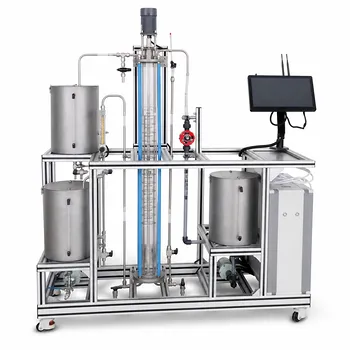
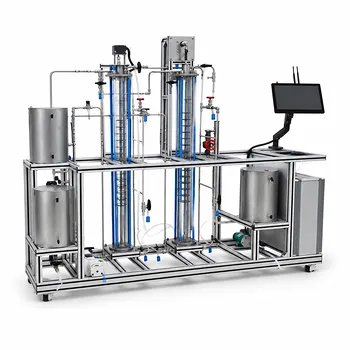
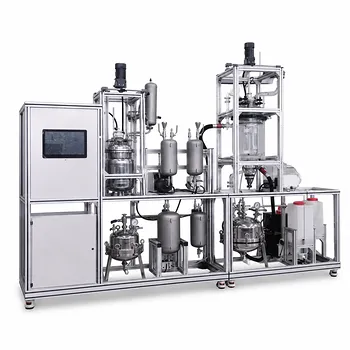
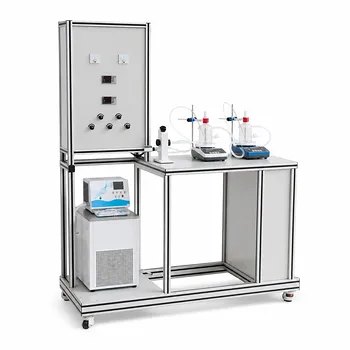
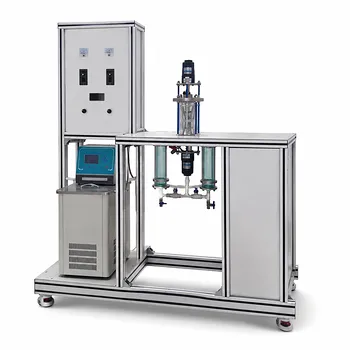
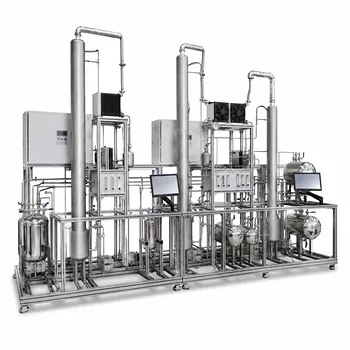
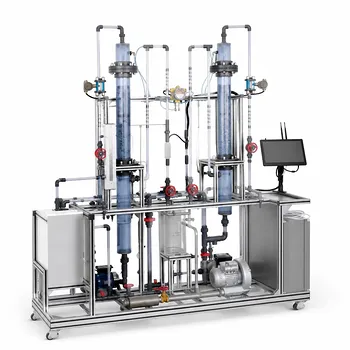
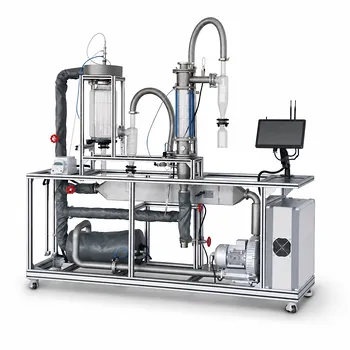
A pilot plant's ultimate purpose is not just to separate a mixture, but to make abstract mass transfer theory visible, measurable, and controllable. For a university engineering laboratory, a liquid-liquid extraction pilot plant must fundamentally demonstrate how a solute distributes between two immiscible phases based on solubility differences, while providing a hands-on platform to classify that separation process by its chemical mechanism, feed complexity, and phase chemistry. The system must allow students to move beyond textbook diagrams to actively evaluate the distribution coefficient, manipulate solvent-to-feed ratios, and diagnose phase separation dynamics in real-time.
A well-designed educational pilot plant serves as a bridge between theoretical equations and industrial reality. While it demonstrates the core "like dissolves like" solubility principle, its true pedagogical value lies in revealing the engineering trade-offs between equilibrium stages, mass transfer kinetics, and hydraulic constraints.
Classifying the Separation: The Three Fundamental Axes
Before a student can operate the equipment, they must know what kind of extraction they are running. The pilot plant setup must physically demonstrate these three core classification methods to turn chemical theory into an observable process.
Physical vs. Chemical Extraction: More Than Just Dissolving
This classification teaches students that not all extractions are created equal. Physical extraction relies purely on solubility differences, where the solute simply dissolves into the solvent without changing its molecular form. A classic demonstration is extracting non-polar iodine from water into a non-polar organic solvent. The color transfer from the aqueous to the organic phase makes the principle immediately visible and intuitive.
Chemical extraction involves a reaction between the solute and the solvent. The educational pilot plant should have the capability for pH monitoring and control, as this is often critical for reactive systems. For instance, using an organic acid extractant to pull metal ions from an aqueous solution demonstrates how a chemical complex is formed, fundamentally changing the separation mechanism and efficiency.
Single-Component vs. Multi-Component Extraction: The Complexity Jump
This classification distinguishes a simple purification from a complex separation. A single-component extraction involves removing one target solute from an inert diluent. This is the starting point for teaching basic mass balance and the distribution coefficient.
Multi-component extraction is where the real industrial relevance appears. The pilot plant should be configurable to handle feeds with multiple solutes. A powerful educational demonstration is fractional extraction for lanthanide separation. This involves a multistage setup that exploits subtle differences in the coordination ability of nearly identical metal ions. Students see firsthand why one theoretical stage is never enough for such a challenging separation.
Organic vs. Inorganic Extraction: Contrasting Chemistries
This classification connects the extraction principle to different industries. Organic extraction focuses on separating non-aqueous compounds, common in pharmaceutical and petrochemical processes. Inorganic extraction deals with metals, acids, or salts in aqueous solutions, central to hydrometallurgy and environmental engineering.
The same pilot plant can often demonstrate both, but the solvent selection and safety protocols will differ drastically. Showing students how an organic solvent extracts an organic acid versus how a chelating agent extracts copper from a leach solution solidifies their understanding of the "like dissolves like" rule at a molecular level.
Core Operational Principles the Plant Must Expose
Beyond classification, the pilot plant's physical instrumentation must illuminate the fundamental engineering variables that govern every extraction process.
The Distribution Coefficient (Kd) in Practice
The foundational thermodynamic parameter is the distribution coefficient. An educational pilot plant must allow for precise sampling of both the extract and raffinate phases at steady state. By comparing the solute concentration in each phase, students learn that a constant Kd is an idealized concept that shifts with temperature, pH, and concentration. The plant should include sample ports at multiple stages so this value can be tracked stage-by-stage.
Controlling the Solvent-to-Feed (S/F) Ratio
This is the primary operational "knob" a student can turn. The pilot plant must have accurate, independently adjustable flow control for both the aqueous feed and the organic solvent. By varying the S/F ratio, students directly observe the trade-off: a higher solvent flow increases recovery but yields a more dilute extract, increasing downstream solvent recovery costs. Visualizing this on a flow meter and then proving it with a concentration analysis cements a core process engineering lesson.
Diagnosing Phase Separation Dynamics
The settling zone is where theory often fails in practice. The pilot plant's settler must be observable, ideally through a transparent section. Students need to see the coalescence of droplets, the formation of a clear interface, and the onset of problems like "rag layers" (stable emulsions). This teaches them that density difference is just one factor; interfacial tension, viscosity, and the presence of contaminants are equally critical for a clean separation.
Mapping the Equipment to the Separation Goal
The choice of pilot plant hardware is itself a core curriculum point, directly tied to the classification of the separation problem. The equipment is not arbitrary; it must be matched to the required number of theoretical stages and the physical properties of the fluids.
Selecting for the Number of Theoretical Stages
This is the most direct link between the separation's difficulty and the equipment's design. An educational pilot plant should include a clear methodology for determining this.
- Simple Separations (<=3 stages): A gravity-driven spray or packed column is sufficient. It demonstrates the baseline principle with minimal complexity, making it ideal for introductory experiments on a simple physical extraction.
- Intermediate Separations (4-10 stages): This demands a more efficient design like a sieve tray column or a pulsed column. Here, students learn how external energy input can create more interfacial area and improve mass transfer without requiring an excessively tall column.
- Difficult Separations (10-20+ stages): A multistage mixer-settler battery or a rotating disc contactor (RDC) is essential. For a challenging lab like lanthanide fractional extraction, a series of mixer-settlers allows students to sample each stage, plot the concentration profile, and calculate the actual number of stages required to achieve a target purity.
Selecting for Problematic Physical Properties
Sometimes, the fluid properties, not the stage count, dictate the equipment. The pilot plant or its modular options should demonstrate this critical engineering constraint.
Systems with low interfacial tension or small density differences are prone to emulsification. A standard gravity settler will fail, producing a cloudy raffinate. To demonstrate a solution, the plant could feature a centrifugal contactor or a pulsed column with coalescing internals. This shows students that for viscous or easily emulsified feeds, adding mechanical energy for separation is non-negotiable.
Understanding the Trade-offs: Avoiding Common Pitfalls
No single pilot plant configuration is perfect. A crucial part of the educational experience is learning to identify and manage the inherent limitations of extraction equipment.
The Visibility-Performance Compromise
Glass-walled sieve or packed columns offer excellent visibility of hydrodynamics like droplet formation, flow regimes, and flooding. However, they can be fragile and have low throughput. A high-efficiency RDC or centrifugal extractor maximizes mass transfer and handles tough emulsions but provides zero visual insight into the process. An ideal teaching plant is often a compromise, perhaps a modular system that allows a see-through basic column to be swapped with a more advanced, industrial-style unit.
The Axial Dispersion Trap
A classic lesson in scale-up is the danger of axial dispersion, or backmixing. In a tall column, a portion of the raffinate or extract can mix backwards against the main flow. This degrades the effective concentration gradient, which reduces the driving force for mass transfer and requires a taller column to compensate. An educational setup can quantify this by measuring concentration profiles that deviate from the plug-flow ideal, teaching students why a mathematical model with perfect stages is always an optimistic estimate.
Making the Right Choice for Your Educational Goal
The final configuration of a university pilot plant must be driven by the curriculum's specific learning objectives. The best system is modular and adaptable, allowing you to build complexity incrementally.
- If your primary focus is teaching core unit operations fundamentals: Prioritize a system with a fully observable glass column. This visibility is paramount for students to see the physics of flooding, droplet size distribution, and phase inversion, and to manually determine HTU/HETS values.
- If your primary focus is demonstrating industrially-relevant separations: Select a working module like a robust, floor-standing mixer-settler cascade or an RDC. Use this to run a project-based experiment, like the fractional extraction of a multi-component mixture, focusing on yield, purity, and the economics of solvent recovery.
- If your primary focus is tackling complex fluids with poor settling behavior: Invest in a single-stage centrifugal extractor or a pulsed column. This allows research into bioseparations or waste treatment where the feed forms stable emulsions, and the defining engineering challenge is phase disengagement, not just mass transfer.
- If your laboratory space is highly constrained: Opt for a horizontally-oriented set of small mixer-settlers or a benchtop centrifugal contactor. This demonstrates multistage counter-current extraction without needing the vertical clearance of a tower, while also being easier to clean if the feed has particulates.
The ultimate goal is to move students from passively accepting an extraction flowsheet to actively thinking like an engineer who can diagnose problems, select the right tool for the mixture, and defend those choices with experimental data.
Summary Table:
| Equipment Type | Theoretical Stages | Best Application / Use Case |
|---|---|---|
| Spray / Packed Column | Simple (≤3 stages) | Introductory physical extraction & baseline hydrodynamic studies |
| Sieve Tray / Pulsed Column | Intermediate (4-10 stages) | Mass transfer optimization experiments with external energy input |
| Mixer-Settler Battery / RDC | Difficult (10-20+ stages) | Challenging multi-component separations (e.g., lanthanides) |
| Centrifugal Contactor | Single / Multistage | Highly viscous fluids or systems prone to stable emulsification |
Bring Hands-On Chemical Engineering to Your Lab
Are you looking to bridge the gap between abstract mass transfer theory and real-world industrial operations? LABPARK provides state-of-the-art Educational and Vocational Unit Operations Pilot Plants in chemical engineering, bioprocess & biotech, and environmental & water treatment designed specifically for universities, research institutes, and enterprises.
Our custom-built liquid-liquid extraction pilot plants enable students and researchers to visualize phase separation, manipulate S/F ratios, and master complex unit operations with safety and precision.
Contact LABPARK today to discuss your laboratory requirements and request a customized equipment solution!
Related Products
- Educational Rotary Disc Liquid-Liquid Extraction Pilot Plant
- Comprehensive Liquid-Liquid Extraction Pilot Plant for Engineering Education
- Gallium and Indium Selective Extraction Educational Pilot Plant
- Ternary Liquid-Liquid Equilibrium Educational Pilot Plant
- Liquid-Liquid Mass Transfer Coefficient Determination Educational Pilot Plant
People Also Ask
- How do density and IFT affect liquid-liquid extraction pilot plants? Optimize Column Performance
- In a liquid-liquid extraction pilot plant, how is a ternary-phase diagram utilized to determine solvent feed requirements?
- How are ternary phase diagrams and LLE data applied in extraction experiments? Optimize Pilot Plant Scale-up
- How Do Selectivity & Distribution Coefficients Influence LLE Pilot Plant Solvent Choice?
- How to Validate BIPs for LLE Pilot Plants? Steps to Align Simulations with Reality