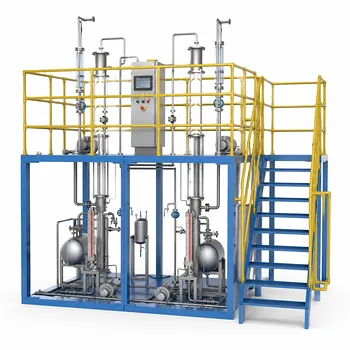
The engineering controls you can demonstrate in a pilot plant to prevent protein denaturation revolve around three critical process parameters: temperature, pH gradients, and fluid shear. Using jacketed process vessels with precise thermal regulation (typically capping heat‑exchange fluid at 45–50 °C), designing agitation to achieve rapid mixing during pH adjustments, and laying out piping and pumps to suppress turbulent flow and air entrainment all give students hands‑on insight into protecting fragile biomolecules during scale‑up.
The real lesson is that denaturation is a system‑level challenge. Every unit operation—from the pump to the vessel jacket—demands a deliberate engineering choice that balances mixing, heat transfer, and mechanical stress against the stability limits of the protein. A pilot plant makes these choices tangible.
The Core Causes of Denaturation in Processing
Protein molecules lose their functional three‑dimensional structure when environmental stressors exceed their resilience. In a chemical or biotech pilot plant, three stressors dominate.
Extreme Temperatures
Even brief excursions above a protein’s melting temperature (often between 40 °C and 60 °C) can unfold the polypeptide chain irreversibly. Heat denaturation is time‑ and temperature‑dependent, so both the peak value and the duration of exposure matter. In a process vessel, heating jackets or internal coils can create hot spots if mixing is insufficient, accelerating damage.
Localized pH Extremes
When an acid or base is titrated into a protein solution, the addition point momentarily experiences a very low or very high pH. If mixing cannot dissipate that gradient fast enough, the protein’s surface charge pattern is disrupted, triggering aggregation or unfolding. This is especially critical during buffer preparation, fermentation pH control, or viral inactivation steps.
Hydrodynamic Shear and Gas‑Liquid Interfaces
Pumps that cavitate or piping that creates intense turbulence inject energy that can stretch protein molecules beyond their elastic limit. More insidious is the air entrainment that accompanies poor pipe design or vortex formation in a tank: the gas‑liquid interface exposes hydrophobic patches on the protein, causing it to unfold and adsorb to the bubble surface. When the bubble bursts, the denatured protein aggregates.
Engineering Controls Demonstrated in Pilot Plants
By exposing students and engineers to real hardware—reactors, pumps, heat exchangers, and instrumentation—pilot plant exercises transform theoretical risks into measurable design variables.
Precise Thermal Management with Jacketed Vessels
Control strategy: Limit the temperature of the heat‑exchange fluid circulating through the vessel jacket, not just the bulk liquid setpoint. The primary reference highlights capping the jacket fluid at 45–50 °C to prevent local wall temperatures from creating a denaturing hot‑zone.
- A pilot plant shows how a jacketed stirred tank with multiple temperature sensors can map the radial and axial temperature profile during heating.
- Students can compare direct steam injection with jacket‑only heating and quantify the difference in monomer recovery.
- They also learn that gentle ramp rates often matter as much as the final temperature, because the protein’s unfolding kinetics compete with the rate of heat input.
pH Gradient Mitigation Through Rapid Mixing Design
Control strategy: Configure the agitation system—impeller type, speed, and baffle geometry—so that acid or base addition is diluted to a safe pH within seconds. The demonstration uses a pH probe near the addition port versus a probe far away to visualize the gradient.
- A pitched‑blade turbine or hydrofoil impeller paired with subsurface addition via a dip tube shows how to collapse the mixing time.
- Conversely, adding reagent on the surface with a slow‑spinning paddle illustrates catastrophic local denaturation; precipitation often appears as a visible haze.
- The pilot plant exercise reinforces that mixing time must be shorter than the protein’s half‑life at the extreme pH. This insight directly feeds into scale‑up calculations.
Minimizing Shear and Air Entrainment in Fluid Transfer
Control strategy: Design piping runs to avoid unnecessary fittings, sharp bends, and lengthy small‑diameter lines. Select pump types that produce low pulsation and operate at speeds that avoid cavitation. The primary reference emphasizes configuring systems to minimize turbulent flow and air entrainment.
- Students can compare a peristaltic or diaphragm pump with a high‑speed centrifugal pump, measuring the protein’s residual activity after each pass.
- Installing a sight glass or a dissolved‑oxygen probe reveals that a poorly submerged return line or a vortex in the feed tank introduces bubbles—and with them, denaturing interfaces.
- Pipe diameter and flow velocity are adjusted to keep the Reynolds number in the transitional or laminar regime where possible, without sacrificing throughput. In a pilot plant, that tension becomes a real‑world optimization problem.
Understanding the Trade‑offs
Every protective engineering control carries a penalty. Ignoring these compromises leads to processes that are safe for the protein but economically or technically unworkable at scale.
Thermal Safety vs. Heat Transfer Rate
Capping the jacket temperature at 45 °C protects the protein but dramatically prolongs heating and cooling steps. In production, that may bottleneck downstream equipment. A pilot plant exercise can calculate the productivity loss and guide the search for a higher‑throughput yet still gentle heat exchanger design, such as a scraped‑surface exchanger.
Rapid Mixing vs. Shear Damage
Faster agitation eliminates pH gradients, but intense turbulence simultaneously increases shear stress and air ingestion. The impeller that gives the shortest mixing time may also be the one that shreds the protein. Demonstrating this contradictory demand teaches the value of measuring both mixing time and protein integrity, then plotting them against power input to find the optimum.
Laminar Flow vs. Capacity
Keeping the Reynolds number low protects the protein but forces larger pipe diameters or slower throughput. For high‑value biologics, the trade‑off often tips toward gentleness; for commodity enzymes, it may not. A pilot plant lets teams quantify the cost of gentle handling in capital and cycle time, enabling a data‑backed decision.
Making the Right Choice for Your Goal
The unit operations you select to demonstrate all boil down to which protein damage mechanism is the biggest threat in your process. Focus your pilot‑plant experiments accordingly.
- If your primary focus is thermal sensitivity: Start with jacketed vessel dynamics. Show that capping the jacket fluid temperature and monitoring surface‑to‑bulk gradients can prevent hot‑spot denaturation, even if it means a longer batch time.
- If your primary focus is pH‑induced aggregation: Design a mixing study around acid/base titration. Demonstrate that subsurface addition with a high‑efficiency impeller can obliterate the pH gradient before the protein unfolds.
- If your primary focus is shear‑ or interface‑driven loss: Re‑plumb the transfer line to compare pump types and pipe diameters. Measure air entrainment and protein activity to prove that deliberate, low‑energy fluid handling preserves structure.
The ultimate value of a pilot plant is the ability to turn those abstract risks into pressure gauges, thermocouples, and activity assays—giving you the confidence that a process designed on the bench will survive the journey to the factory floor.
Summary Table:
| Stressor | Engineering Control Strategy | Pilot Plant Demonstration |
|---|---|---|
| Extreme Temperature | Cap jacket fluid temperature at 45–50 °C | Jacketed vessel with multi-point temperature sensors |
| Localized pH Gradients | Rapid mixing with subsurface reagent addition | Pitched-blade turbine/hydrofoil impeller & pH probes |
| Shear & Air Entrainment | Low-pulsation pumps, transitional flow velocity | Peristaltic/diaphragm pumps & optimized piping |
Bring Hands-On Bioprocess Engineering to Life with LABPARK
Teaching students and researchers how to mitigate protein denaturation requires reliable, real-world equipment. LABPARK provides premium Educational and Vocational Unit Operations Pilot Plants in chemical engineering, bioprocess & biotech, and environmental & water treatment for universities, research institutes, and enterprises.
Equip your lab with jacketed reactors, precise control systems, and low-shear fluid transfer setups to demonstrate critical scale-up challenges.
Contact LABPARK today to request a catalog or discuss your lab's training requirements!
Related Products
- Bio-fermentation Ethanol Production Practical Training Unit Operations Pilot Plant
- Natural Product Extraction Unit Operations Training Pilot Plant
- Dual Mode Heat Transfer Pilot Plant for Unit Operations Training
- Multi-Reactor Educational Pilot Plant for Reaction Engineering Unit Operations
- Dual-Mode Rectification Pilot Plant for Practical Training Unit Operations
People Also Ask
- Why Use PTFE & Hastelloy in Chemical Pilot Plants? Prevent Corrosion & Ensure Safety
- Why Compare Predicted and Experimental Excess Enthalpy? Key to Accurate Pilot Plant Scale-up
- Why is the chemical plant startup schedule crucial? De-risk scale-up with pilot plants.
- When to transition from PID to adaptive control in pilot plants? Key process indicators.
- Why must batch and fed-batch fermentation pilot plants be designed to accommodate changing rheological conditions?